Prefer Jewish News on Google
A Devon on earth!
Lucy Daltroff goes underground to explore the spectacular Kents Cavern and discovers how one coastal home inspired Agatha Christie’s greatest mysteries…
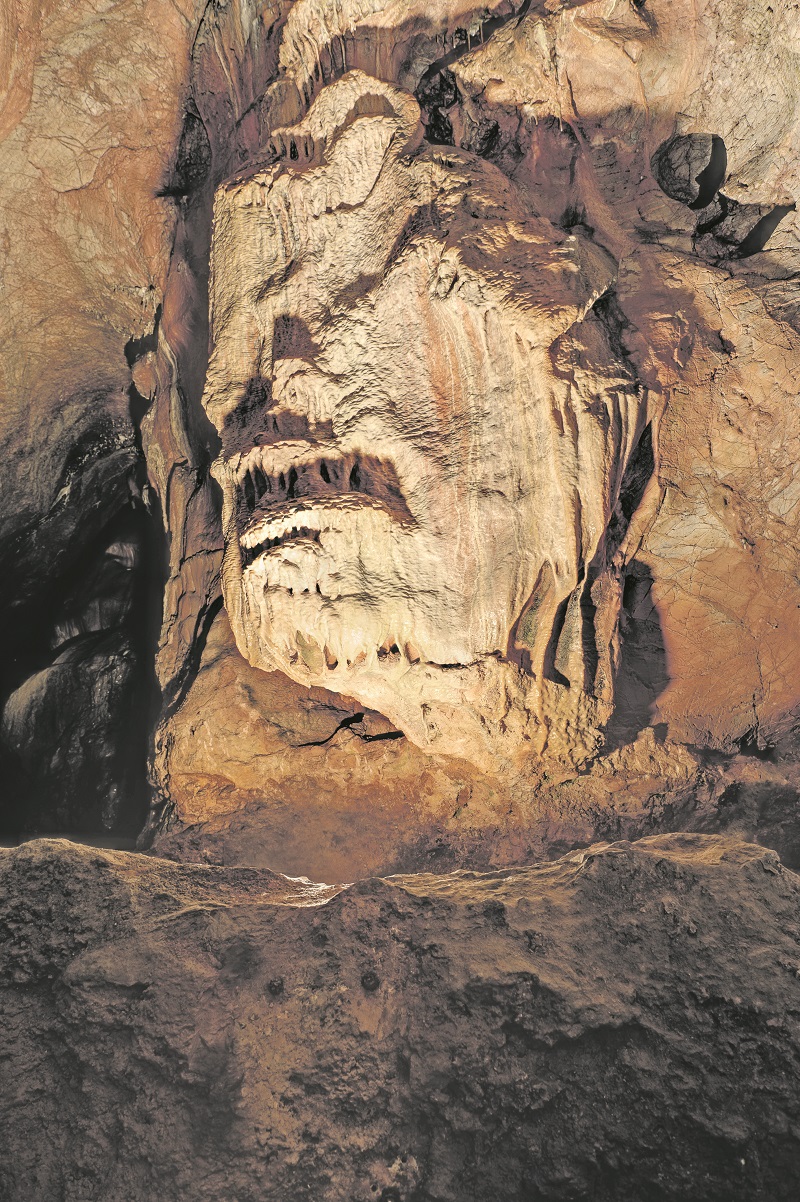
Some say there is a resemblance to Mick Jagger, others the legendary figure of Merlin, but whichever way you look at it, these ancient rock formations have certainly created one eerie-looking face.
I’m at Kents Cavern, the visitor attraction of one of the most important Stone Age sites in Europe, and as our excellent tour guide Kate shines her torch over the “nose” and “lips” protruding from the stone, she explains that past excavators have even found Roman coins left behind as an o ffering to whatever deity they believed it represented.
These spectacular caves have been used as living quarters by our ancestors, whether they were sheltering from extreme weather, making fires, or shaping tools to hunt Ice Age animals.
Bones and other archaeological finds have revealed that three di fferent species of human have been here. Homo Heidelbergensis, Neanderthal and Homo sapiens and, incredibly, it is the only site in the world to yield evidence of all three.
A brief exhibition introduces the visitor to the historic significance of this and guided tours take place at regular intervals.



Once inside, it is fascinating to walk through the caverns and see the spectacular stalagmites and stalactites, at times illuminated by ancient shell torches, rivalling the installed modern lighting – and it’s all just a mile from Torquay, in Devon.
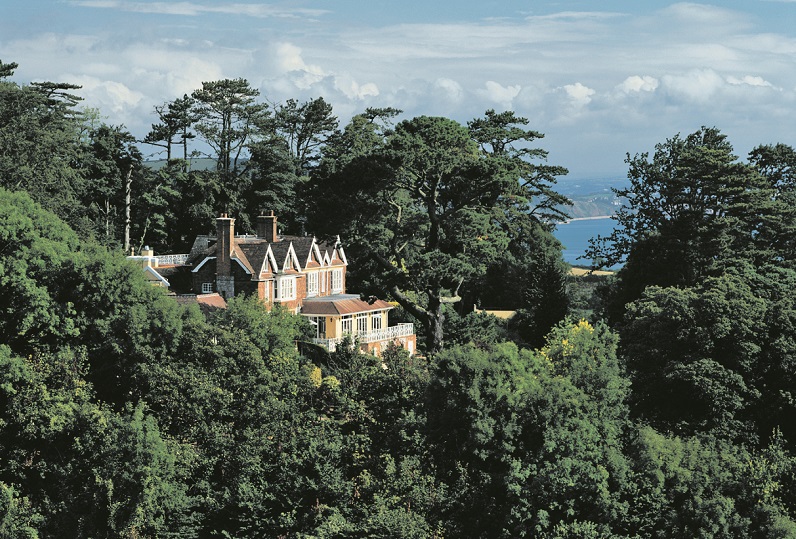
My base on this trip is 10 minutes’ drive away, at the family-owned country hotel Orestone Manor.
It was once the home of the artist Sir John Calcott Horsley, brother-in-law to Isambard Kingdom Brunel and the painter of his o fficial portrait in the National Portrait Gallery – although, he is possibly more famous for designing the world’s first Christmas card.
The Georgian house is now something of a foodie heaven, run by husband-and wife chefs Neil and Catherine D’Allen, along with their son, Craig, and his wife, Laura.
They have won a number of double AA Rosettes for their cuisine and after eating here I can totally understand their boast that they use the finest local meats and freshly-caught Brixham fish, while the vegetable produce is partly grown in the hotel’s gardens.
The menus are a set price and reasonable for the appetising and original food on offer.
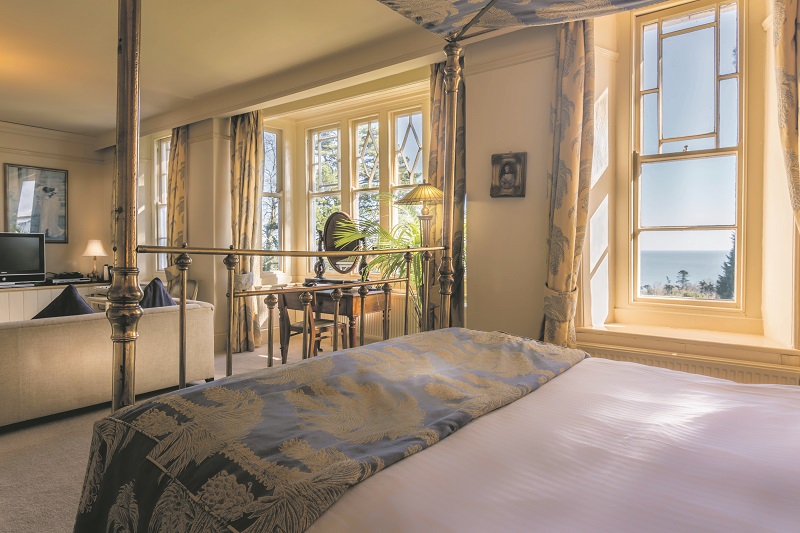
Orestone Manor also has a 4* AA gold star rating for its 14 bedrooms, some with their own hot tubs, surrounded by privacy glass, that overlook the splendid views.
The boutique hotel’s location in Maidencombe, near Newton Abbott, south Devon, adds to its charms with a panorama over Lyme Bay and a close proximity to the coastal path. Our only di fficulty in driving down there was that the satnav took us down a tiny little track which was di fficult to navigate and was an entirely unnecessary diversion, as the hotel is just o the A379.
Also nearby is Agatha Christie’s holiday home, “Greenway”, which the crime novelist referred to as “the loveliest place in the world” and which she visited most summers and Christmases. It is now a National Trust property.
The surroundings occasionally inspired some of her fictional murders. It is beautifully situated on the River Dart, near Brixham, and can be reached by ferry from Dartmouth. Visitors who arrive by car should book a space in the car park the day before.
Each room in the house is filled with items dear to the family; and recordings by Agatha’s grandson, Mathew Prichard, recount memories of his grandmother and his childhood spent here.
We learnt too that the novelist was a talented pianist, but very shy, never playing to anyone except her husband.
Although the rooms are attractive, in my opinion the grounds are the star feature,
with beautiful walks signposted among the mature trees and shrubs. A fairly ordinary boathouse sits on the edge of the River Dart, but it features in Agatha’s novel Dead Man’s Folly. It was also used on location for David Suchet’s final Poirot film of the same name.
In this area of south Devon, often referred to as the English Riviera, are two of the oldest synagogues in England: Plymouth, founded in 1762 and Exeter, in 1763. These two beautiful shuls are still in use today, showing how Jews have lived and worshipped in this part of south-west England for more than 250 years.
Lucy’s travel tips
Lucy stayed at Orestone Manor, Maidencombe, where a superior double room starts from £86, www.orestonemanor.com. She also visited Kents Cavern, www.kents-cavern.co.uk and Greenway, www.nationaltrust.org.uk/greenway. For more information about the area’s Jewish communities, visit www.exetersynagogue.org.uk and www.plymouthsynagogue.com

Keep community journalism free.
Jewish News is free for everyone. No paywall. No barriers. Just trusted journalism for anyone who wants to stay connected to Jewish life in Britain.
If you value that, please support us.
From as little as £5 a month, you can help keep our journalism free and accessible to all.
Every day, we report on the issues that matter to our community. We celebrate achievements, support charities, challenge antisemitism and ensure Jewish voices are heard more widely.
From as little as £5 a month, you can help us continue to:
- Report on the stories shaping Jewish life in the UK and beyond
- Bring our community together through shared stories, events and campaigns
- Celebrate the people, culture and moments that define our community
- Support organisations doing vital work across Jewish Britain
You can make a one-off donation or become a regular supporter. Every contribution helps keep our journalism free, independent and accessible to all.
If everyone who values Jewish News gave a small amount, it would make a real difference to our future.