Prefer Jewish News on Google
ANALYSIS: The Kotel photo that fed fake news
Nathan Jeffay looks at an image that circulated on social media, purporting to show Israelis celebrating a fire at Al Aqsa Mosque. But it didn't tell the real story.
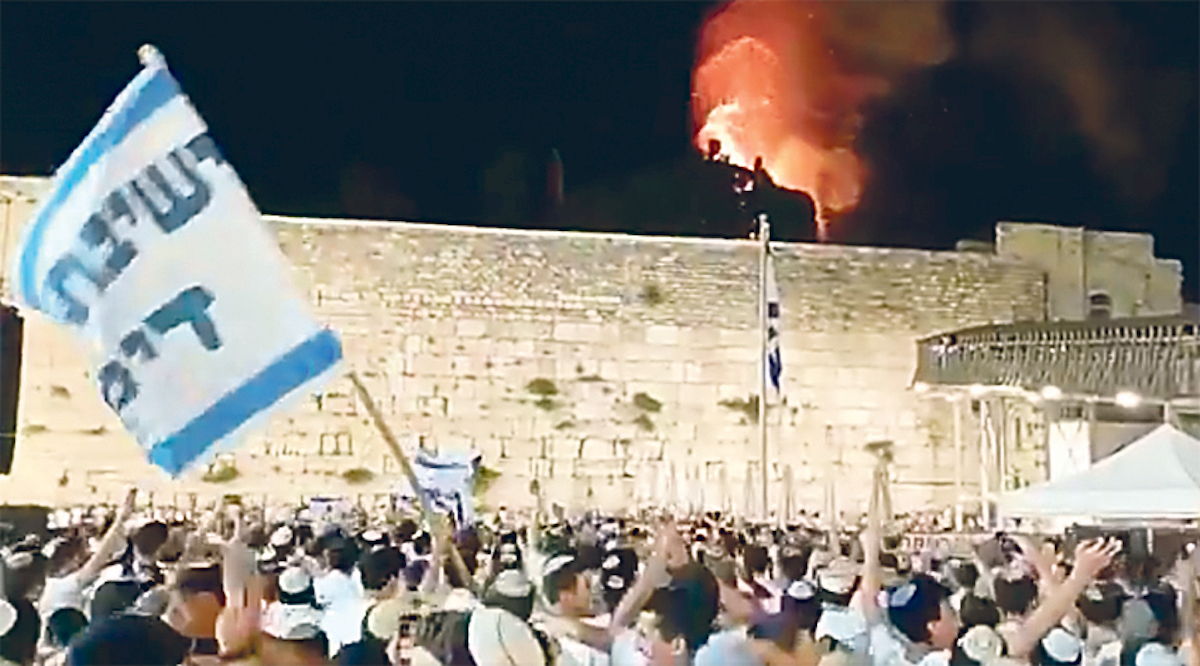
Fire raged by the al-Aqsa Mosque as Israelis danced at the Western Wall. Captured in the same frame, the image is etched on to the minds of huge numbers of Palestinians.
Many think it confirms the claim that citizens of the Jewish state have ill will towards their holy site. It’s dynamite for the cause of Palestinian radicals, almost literally, as such an image can easily inspire violence.
In reality, it was a tree that had caught fire, not any part of the mosque, and the dancing was due to Jerusalem Day, not because of the flames.
“Yes, it’s out of context, but it goes on social media with a banner saying the mosque was harmed, and this impacts people,” says Yoram Meital, head of the Chaim Herzog Center for Middle East Studies and Diplomacy at Ben-Gurion University.
Jerusalem Palestinians were on edge long before they saw this image, and long before the current violence. There is anger towards both Israel and their own leadership over the fact that Palestinian elections have been cancelled. There are political grievances, and there are deep social and economic problems.
“Life is increasingly difficult, especially since the coronavirus crisis,” says Palestinian political scientist Ghassen Khatib, a former government spokesman and currently professor at Birzeit University near Ramallah. “Unemployment is high, dropout rates from schools are at 40 percent, and there are serious issues with housing.”
But most Israelis strongly reject his reading of how this volatile population engaged in violence. He insists it is purely reactive. Israel’s actions to stop large gatherings by the Damascus Gate for part of Ramadan, the controversy surrounding Sheikh Jarrah, and the Jerusalem Day Flag March caused a Palestinian reaction that has consisted purely of raw anger, he claimed.
“This is spontaneous,” he insisted. “Political factions don’t actually have strong influence among Jerusalem Palestinians, so people are not acting in response to politicians. Most of the young people in Jerusalem aren’t politically affiliated, so this is really spontaneous.”
Meital wonders how, based on spontaneous anger alone, events became so big in just a few days. “The fact it happened in a very short span of time suggests that while the violence started as spontaneous, the politicians got to the heart of it very quickly, and it became more organised.”

Keep community journalism free.
Jewish News is free for everyone. No paywall. No barriers. Just trusted journalism for anyone who wants to stay connected to Jewish life in Britain.
If you value that, please support us.
From as little as £5 a month, you can help keep our journalism free and accessible to all.
Every day, we report on the issues that matter to our community. We celebrate achievements, support charities, challenge antisemitism and ensure Jewish voices are heard more widely.
From as little as £5 a month, you can help us continue to:
- Report on the stories shaping Jewish life in the UK and beyond
- Bring our community together through shared stories, events and campaigns
- Celebrate the people, culture and moments that define our community
- Support organisations doing vital work across Jewish Britain
You can make a one-off donation or become a regular supporter. Every contribution helps keep our journalism free, independent and accessible to all.
If everyone who values Jewish News gave a small amount, it would make a real difference to our future.