Prefer Jewish News on Google
‘Hamas sympathiser threatened to behead me’
British-Iranian hunger striker has campaigned for months to demand that the government proscribe the Islamic Revolutionary Guards Corps as a threat to British society
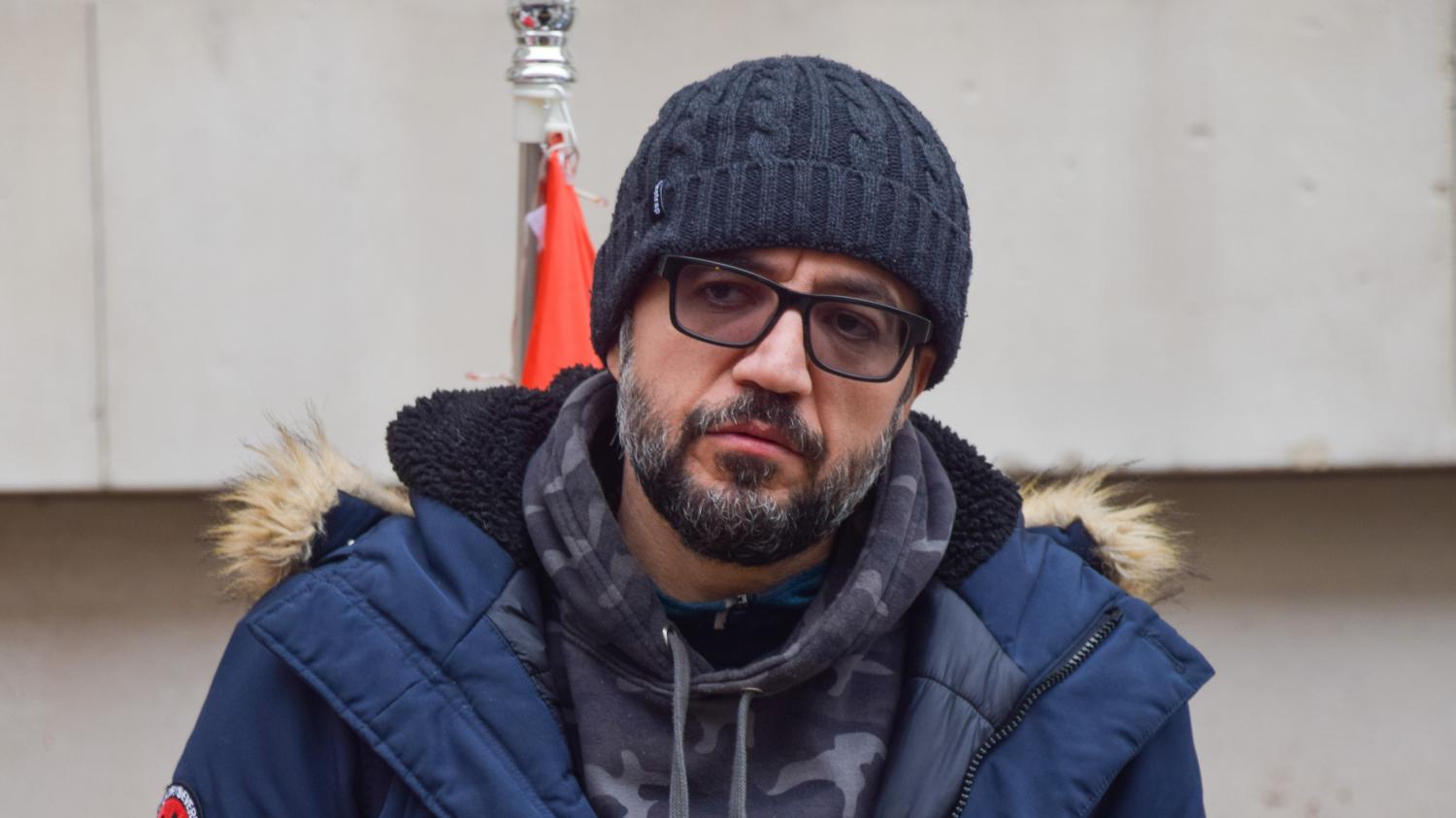
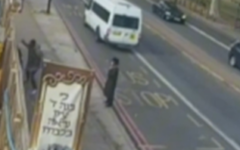
On day 234 of our sit-in protest opposite the UK’s Foreign Office, with the request to proscribe the Islamic Revolutionary Guard Corps (IRGC), our Peace Camp was attacked three times by a number of supporters of Hamas, Hezbollah and the IRGC.
These individuals were not pro-Palestinian protesters. They were pro-terrorism activists who held placards with photographs of Khomeini, Khamenei, Ghasem Soleimani and leaders of other terrorist organisations. They chanted slogans in support of the brutal regime in Iran, and vandalised our Peace Camp by ripping off and stealing the Israeli flag which we had placed alongside the Persian, British and Ukrainian flags. Of course, I retrieved the flags that they took down and placed them back up on the Peace Camp before they had the chance to burn it.
One of these terrorist sympathisers at the attack threatened to behead me. Later on, police arrested this individual and found him to be in possession of a large knife.
It is clear that their violent presence at our Peace Camp was purely with the intention to assassinate me – a plot that was successfully foiled by the police present at the scene.
Over the years, and specifically in the last 236 days, I have been warning about the dangers of terrorists affiliated with the IRGC, who are freely living here in the UK. Appeasement policy has never worked, and it will never work. This is a war against terrorism. This is a war against Hamas, Hezbollah, Islamic Jihad and the IRGC, a war in which – in my opinion – the Palestinian people, who are being used as human shields, must stand with us side by side.

Saturday’s unsettling encounter and attack emphasises the urgent need for the British government to designate the Islamic Revolutionary Guard Corps as a terrorist organisation.
I’d like to emphasise a critical distinction: the actions of the IRGC and the Hamas terrorist group are separate from the broader Israeli-Palestinian conflict. The signing of peace treaties between Israel and neighbouring countries, including Egypt and Jordan, as well as with the Fatah organisation, recognised as the legitimate representative of the Palestinian people, demonstrates that a political solution has been achieved to address the discord between Israel and Arab nations.
The fact that three Israeli officials, alongside leaders from Arab countries, have received the Nobel Peace Prize for their relentless efforts to achieve peace underscores Israel’s genuine commitment to establishing peace and upholding borders recognized by the United Nations.
Thus, the issue lies not in finding a solution, but in the implementation of the agreed solution.
The truth is that Hamas has nothing to do with the Palestinian people. Hamas is an illegitimate child who was born from the dying body of Egyptian Muslim Brotherhood by a midwife named IRGC with the ultimate mission of destroying any peace process.
In reality, the leaders of the Islamic State in Iran aim to assert their dominance over the global Muslim community. They encounter significant challenges in this endeavor. Firstly, due to historical differences between Arabs and Iranians, persuading Arabs to follow Iranian leadership is complex. Secondly, Iran’s leaders predominantly belong to the Shiite minority, which constitutes roughly only ten percent of the global Muslim population. As a strategy to circumvent these challenges, they portray the Palestinian-Israeli peace process as unsuccessful. By doing so, they seek to erode trust in Arab and Muslim leaders and gain their allegiance
It’s essential to recognise that Israel stands as the sole democratic political regime in the Middle East. This position poses a threat to autocratic and dictatorial systems, such as those in Syria and the Islamic Republic of Iran. As a result, these regimes are motivated to use various means to challenge Israel.
In essence, the defence of Israel is not just about its own sovereignty but also the preservation of democratic values globally. Israel’s stance echoes the defence of other democratic nations, including the UK. It is therefore unjust for Israel to shoulder this immense responsibility in isolation. It becomes imperative for all democratic nations to rally in defence of these shared values through a unified international coalition.
Given Britain’s longstanding commitment to democracy, it is expected to take the lead on this front. A pivotal starting point would be designating the IRGC as a terrorist organisation. In light of recent events, any delay by the British government on this issue may pave the way for similar incidents in other countries, akin to the episode in southern Israel last week.

Keep community journalism free.
Jewish News is free for everyone. No paywall. No barriers. Just trusted journalism for anyone who wants to stay connected to Jewish life in Britain.
If you value that, please support us.
From as little as £5 a month, you can help keep our journalism free and accessible to all.
Every day, we report on the issues that matter to our community. We celebrate achievements, support charities, challenge antisemitism and ensure Jewish voices are heard more widely.
From as little as £5 a month, you can help us continue to:
- Report on the stories shaping Jewish life in the UK and beyond
- Bring our community together through shared stories, events and campaigns
- Celebrate the people, culture and moments that define our community
- Support organisations doing vital work across Jewish Britain
You can make a one-off donation or become a regular supporter. Every contribution helps keep our journalism free, independent and accessible to all.
If everyone who values Jewish News gave a small amount, it would make a real difference to our future.