Prefer Jewish News on Google
Making Sense of the Sedra: Korah
In our thought-provoking series, rabbis and rebbetzins relate the week’s parsha to the way we live today
“To exist, man must rebel, but rebellion must respect the limits that it discovers in itself – limits where minds meet, and in meeting, begin to exist.” Albert Camus
There is a near unanimous view in the Talmud and among later Torah commentators that Korah’s intentions were disingenuous; his sole aim was a power grab. The motive of his 250 followers, replaced Reubenite first-borns or overlooked Levites, was not equal opportunity, but a resentment-fuelled attempt to undermine Moshe’s leadership.
Ramban asserts that the story of Korah, the subject of this week’s Sedra, occurred chronologically when morale (and Moshe’s opinion polls) might have been at an all-time low. What future was there for young 20-something males, beyond wondering in the desert for 40 years until they died? Lack of opportunity often leads to social unrest.
Seforno suggests that Korah’s followers infiltrated those awaiting an audience with Moshe, sowing seeds of dissent (like social media trolls), so that when the confrontation occurred, an already hostile crowd would instantly side with Korah.
Rashi, famously quoting Midrash Tanhuma, explained the challenges Korah put to Moshe: ‘Would a Talit dyed entirely in Tahelet (blue dye) require Tahelet strings? Would a house full of holy books require a mezuzah?’ Since these objects fully embodied the mitzvah, was Halakha necessary? Korah was a disruptive law unto himself.
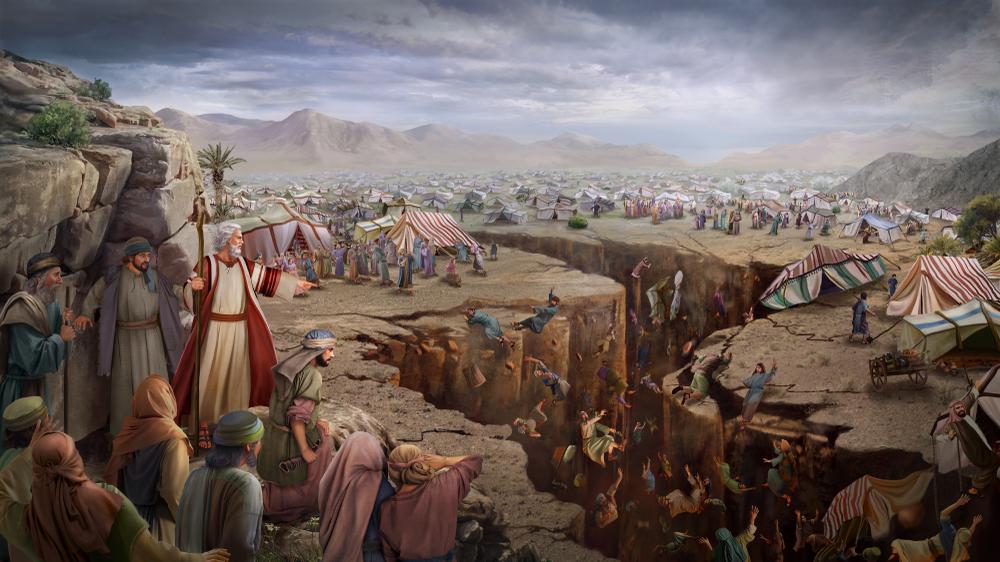
Pirkei Avot states: ‘An example of an argument not for the sake of heaven was Korah and his Assembly’. Rabbi Akiva in TB Sanhedrin went further to suggest that Korah lost his share in the World to Come. Rabbi Eliezer countered that Korah was eventually rehabilitated. Proof came when ‘the earth opened to swallow them’, his children were miraculously rescued, and several generations later, Korah’s most famous descendant was the prophet Samuel.
Another prominent Talmudic tale is about an Arab guide taking wayfarers to a crevice in the desert where could be heard voices from below proclaiming: “Moshe’s Torah is true, and we are liars!” The Midrash further embellishes the back story by casting Korah as a man with wealth beyond the imagination. Interestingly, this view resurfaces in the Quran, where ‘Qarun’ (Korah) is an example of a tyrant, epitomized by wealth-based arrogance.
And yet, despite his fabulous riches, Korah aspired to the priesthood. Was it narcissism that drove him to a premature demise, or was there something more? And, if we look for leadership role models from our scriptures, is Moshe’s response an example we should emulate today?
Korah may be the first populist Jewish leader manufacturing fake news, enlisting the vox populi to propel himself into power. But was Moshe’s response just a more lethal form of cancel culture? When facing dissent, how do we get back to dialogue? In an ever-more fractured world, how do we recover from polarisation and extremism? It is easy to label someone with whom we disagree a rebel. It is harder to have a conversation with them. But the Torah offers limited airtime to power-hungry demagogues. And, so, it seems, should we.

Keep community journalism free.
Jewish News is free for everyone. No paywall. No barriers. Just trusted journalism for anyone who wants to stay connected to Jewish life in Britain.
If you value that, please support us.
From as little as £5 a month, you can help keep our journalism free and accessible to all.
Every day, we report on the issues that matter to our community. We celebrate achievements, support charities, challenge antisemitism and ensure Jewish voices are heard more widely.
From as little as £5 a month, you can help us continue to:
- Report on the stories shaping Jewish life in the UK and beyond
- Bring our community together through shared stories, events and campaigns
- Celebrate the people, culture and moments that define our community
- Support organisations doing vital work across Jewish Britain
You can make a one-off donation or become a regular supporter. Every contribution helps keep our journalism free, independent and accessible to all.
If everyone who values Jewish News gave a small amount, it would make a real difference to our future.