Prefer Jewish News on Google

New Board of Deputies president takes inspiration from Elvis in leadership vision
Phil Rosenberg pledges, “A little less conversation, a little more action” at first plenary session of his presidency

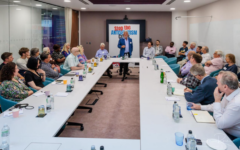
The new president of the Board of Deputies and the youngest in its 264-year existence has opened the first plenary session of his presidency with a raft of innovations.
Among Phil Rosenberg’s plans include an informal kiddush to welcome old and new deputies, representing synagogues and organisations across the Jewish community. Rosenberg has lined up sponsors to provide similar welcoming kiddushim for future plenary events.
But there was a touch of history to the opening session, too, as there was a traditional opening prayer, amended for the first time in 70 years, to relate to the King rather than the late Queen Elizabeth, asking for peace and prosperity for the community and the release of all captives.
Rosenberg and his team brought both music and humour to the proceedings, with the new president saying their watchword would echo that of Elvis Presley: “A little less conversation, a little more action” — and indeed, it was the Presley song which wound up the afternoon’s events as the deputies made their way out of JW3, the Jewish community centre for London.
Much of the business of the first session consisted of the new honorary officers — senior vice-president Adrian Cohen, vice-presidents Jeremy Michelson and Andrew Gilbert, and treasurer Ben Crowne — introducing themselves to the deputies, outlining their work and responsibilities, and inviting deputies to become involved with the different divisions of the Board.
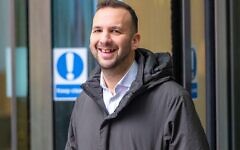
Rosenberg set out five key priorities for the next three years: “fighting antisemitism, standing up for peace and security in Israel and the Middle East, defending our religious freedoms, making our community more united, inclusive and more outward-looking, and celebrating our faith, heritage and culture as British Jews”.
Then it was the turn of the chief executive, Michael Wegier, to introduce the Board’s staff. Aware of the accusations that the new line-up of honorary officers were not just male but “pale and stale”, the team has pledged to address gender inequality by holding a Zoom meeting with all women deputies on July 1, with a view to getting women more involved with the work of the Board.
Nevertheless, for the first time, the entire plenary took place under the independent chairmanship of Karen Newman, a deputy for the Liberal Jewish Synagogue — a trial likely to be repeated in other plenary sessions.
There was little controversy in the questions to the honorary officers which followed: well-worn subjects such as the possibility of merging with the Jewish Leadership Council — Rosenberg would like it to happen but has promised to continue co-ordinating with the JLC — and slightly more unusual information such as Rosenberg’s announcement that after his election, he had received messages from “30-40 Muslim leaders saying they would like to work with the Board, to build resilience against hatred”.
Deputy Julian Pollard expressed concern about last month’s pro-Palestine event at St Pancras Church in which musicians Roger Waters and Cat Stevens, together with the rapper Lowkey, had appeared. Vice-president Andrew Gilbert acknowledged that interfaith work was a priority and that relations with Christian groups needed attention; his colleague, Jeremy Michelson, said other faiths such as Hindus and Sikhs also needed contact.
Student Daniel Grossman queried the wisdom of the Board president being pictured smiling with Israeli ambassador Tzipi Hotovely, who has expressed her opposition to the two-state solution. But the honorary officers said that “it is not credible for the Board not to have relations with whoever is the Israeli ambassador” and agreed to consider an invitation for her to address a future plenary session.
Deputy Mary Regnier-Leigh said that the Board had not been consulted on support for the proposed Holocaust memorial in Victoria Tower Gardens in Westminster. To applause, she said that there should be a memorial but that there was widespread disagreement within Westminster about the location, and she hoped for a debate on the issue.
And deputies were advised that an in-depth programme is being drawn up to mark the first anniversary of the October 7 massacres, which will take place over the weekend of October 5-7.

Keep community journalism free.
Jewish News is free for everyone. No paywall. No barriers. Just trusted journalism for anyone who wants to stay connected to Jewish life in Britain.
If you value that, please support us.
From as little as £5 a month, you can help keep our journalism free and accessible to all.
Every day, we report on the issues that matter to our community. We celebrate achievements, support charities, challenge antisemitism and ensure Jewish voices are heard more widely.
From as little as £5 a month, you can help us continue to:
- Report on the stories shaping Jewish life in the UK and beyond
- Bring our community together through shared stories, events and campaigns
- Celebrate the people, culture and moments that define our community
- Support organisations doing vital work across Jewish Britain
You can make a one-off donation or become a regular supporter. Every contribution helps keep our journalism free, independent and accessible to all.
If everyone who values Jewish News gave a small amount, it would make a real difference to our future.