
 Prefer Jewish News on Google
New laws ‘could allow Holocaust denialism to spread at UK universities’
Lord Mann labels an Office for Students consultation on the government's academic freedom laws as 'not fit for purpose', warning that pro-Hamas posters could remain on campus notice boards

New laws aimed at protecting free speech on university campuses are currently “not fit for purpose” and could remove “crucial and hard won safeguards for Jewish students” and “potentially allowing antisemitism to grow”, a senior government adviser has warned.
In a damning rebuke of a current Office for Students consultation on the Higher Education Freedom of Speech act, Lord Mann claimed that the proposed advice could leave it acceptable for posters saying ‘Intifada Until Victory’ to remain on approved university notice boards.
His warning about the Higher Education legislation – backed by Rishi Sunak to protect academic freedoms – came on the same day the Union of Jewish Students also expressed fears to communities secretary Michael Gove about the spread of Holocaust denial.

Speaking earlier at the JW3 centre in north London, Gove admitted that “a number of students” had also raised concerns about the impact of the new laws on the Jewish community on campuses.
Mann, the government’s own independent antisemitism adviser, also claimed it would be possible for a Holocaust Denial Society to register at a Freshers Fair, if the correct process under current guidance was followed.



The peer also claimed it would be possible for “free Palestine graffiti” to be scrawled on to a Jewish society poster “on an official noticeboard”.
In a further warning, Mann noted that as first revealed by Jewish News, the Office For Students director Professor Arif Ahmed has previously been “one of the leading critics of the IHRA definition.”
But, with regulatory advice on the Higher Education act due to be enacted on August 1, the former Labour MP claimed:”Current proposals are likely to lead to some universities revoking their use of the IHRA definition as a reference point in looking at antisemitism.”
He also expressed fears that antisemitism training on university campuses could also be impacted, as a result of the current guidance. And that university’s could fail to take necessary action against those who “intimidate Jewish students and staff.”
Mann said he was calling for the government to “pause the enactment of the free speech act until these issues have been resolved.”
Speaking to a Lords committee on Tuesday, he said: “I suspect that government and parliament would be horrified to discover in just over two months’ time, that it might be possible to defend Hamas’s unalienable right to commit the October 7 attacks.
“Or to argue that the Holocaust never happened in one of our universities, and not just to say such things, but to be able to do so by citing the government’s own as passed by Parliament legislation on free speech.
“Over the last 30 years, we’ve driven Holocaust deniers out of any legitimate space for debates. ”
He added:”The current flaw in the guidance that is circulating risks throwing away that agreed rejection of the falsification of the murder of six million Jewish men, women and children and many more Nazi victims.
“The minister at the time when this legislation was going through, stated there will be an explicit, I repeat the word explicit, rejection of Holocaust denial. But this hasn’t been forthcoming.”
He argued:”The crux of the problem for universities will be that this approach of purist free speech as the guidance currently works will lead itself to aggressive legal actions against universities.”
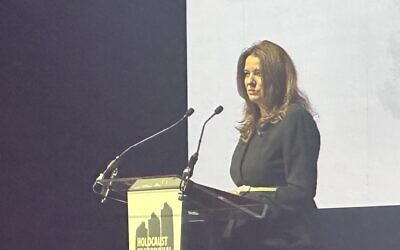
Mann warned this would divert universities from “safeguarding and strengthening inter-community relations”, and could “undermine the good work that has gone on challenging antisemitism and protecting Jewish students and staff.”
Mann spoke during a debate on the Industry and Regulators Committee report “Must do better: the Office for Students and the looming crisis facing higher education.”
After his appointment as Office for Students was confirmed in June 2023 , director Ahmed appeared to partially tone down his criticism of IHRA in an op-ed written for the newspaper.
He said:”The International Holocaust Remembrance Alliance’s working definition is an important tool for understanding how antisemitism manifests itself in the 21st century. Adopting it sends a strong signal to students and staff facing antisemitism. ”
But the same op-ed for The Times also featured a warning about IHRA, stating:”But it must not restrict legitimate political speech and protest. I will act impartially.”
Responding to concerns raised about the Higher Education legislation in regards to the spread of Holocaust denial, Gove said on Tuesday: “I do believe free speech is important, but I also believe countering prejudice is important.
“I know my colleagues Luke Hall and Gillian Keegan want to proceed with care by making sure that we can continue to have universities where people can have different views and where views can be challenged without it becoming intimidatory.”
Passed last year the the Higher Education (Freedom of Speech) Act 2023 was intended to delivers on the Government’s commitment to strengthen academic freedom and free speech in higher education, helping to protect the reputation of our universities as centres of academic freedom.
Registered higher education providers in England will have extended legal duties not only to take steps to secure freedom of speech and academic freedom, but also to promote these important values.
Students’ unions will also be held to the same legal responsibilities as universities and their colleges to take reasonably practicable steps to ensure lawful freedom of speech.
Higher education providers and students’ unions that fail to comply may face sanctions, including fines.
Free speech campaigners such as Toby Young welcomed the new laws.

Keep community journalism free.
Jewish News is free for everyone. No paywall. No barriers. Just trusted journalism for anyone who wants to stay connected to Jewish life in Britain.
If you value that, please support us.
From as little as £5 a month, you can help keep our journalism free and accessible to all.
Every day, we report on the issues that matter to our community. We celebrate achievements, support charities, challenge antisemitism and ensure Jewish voices are heard more widely.
From as little as £5 a month, you can help us continue to:
- Report on the stories shaping Jewish life in the UK and beyond
- Bring our community together through shared stories, events and campaigns
- Celebrate the people, culture and moments that define our community
- Support organisations doing vital work across Jewish Britain
You can make a one-off donation or become a regular supporter. Every contribution helps keep our journalism free, independent and accessible to all.
If everyone who values Jewish News gave a small amount, it would make a real difference to our future.





















