Prefer Jewish News on Google
Officials alarmed by antisemitic assaults in Argentina
Jewish umbrella group DAIA condemns attack on Rabbi Shlomo Tawil in Rosario as “brutal antisemitic aggression” and called for an investigation
Argentinean and international Jewish organisations are demanding action from local and regional authorities amid recent violent antisemitic attacks in the country.
The Argentinean Jewish political umbrella DAIA labelled Sunday’s attack on Rabbi Shlomo Tawil in Rosario as “brutal antisemitic aggression” and demanded an investigation into the climate that may have spawned such violence.
The attack on Tawil is the third physical antisemitic assault in the last two months. There other two took place in Buenos Aires, one in April and one in May.
Such assaults have been rare.
“Argentina isn’t an antisemitic country but has antisemitic episodes. Now these episodes are more violent and more frequents. This ongoing new reality is very worrying,” Ariel Gelblung, the Latin America representative for the Simon Wiesenthal Center, told the Jewish Telegraphic Agency.

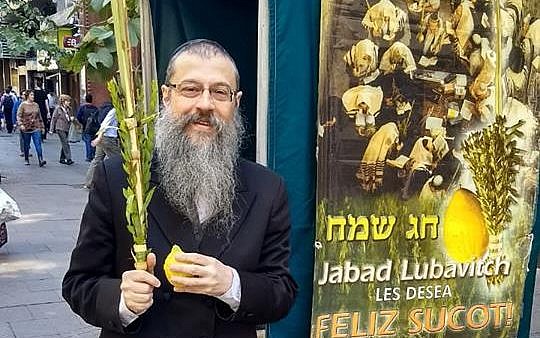
Tawil, of the local Chabad-Lubavitch organisation, was attacked Sunday night by three men in the city center of Rosario, located in the center of the country. The men shouted antisemitic epithets before removing the rabbi’s hat and trampling it on the ground, and then beating the rabbi, who was walking alone.
Tawil is recovering at home with his family, according to reports. Originally from Buenos Aires, he has served as the Chabad emissary in Rosario since 1987, and is married with eight children and two grandchildren.
Local Rosario city officials, members of the national government and opposition leaders condemned the attack. Argentina is holding presidential elections in October. For the first time, there is an accused neo-Nazi presidential candidate. Alejandro Biondini of the Patriotic Front party already said he would expel the Israeli ambassador if elected. In launching his campaign, Biondini reiterated his promise and threatened the country’s Jewish leadership.
“I said to the DAIA that this is Argentina … this is not Israel,” to applause and shouts from the crowd.
Argentina has about 180,000 Jews out of a population of over 44 million.
Antisemitic incidents in Argentina rose by 14 percent in 2017 over the previous year, according to a DAIA report, the most recent national statistics. Online antisemitic incidents made up 88 percent of the 2017 total, nearly double the 47 percent in 2014.
The attackers, if caught, could be punished under an anti-discrimination law that Argentina has had on the books since 1988.
“The violent attack and the pro-Nazi party in the election put us in alert. We are requesting Luis Almagro, secretary-general of the Organisation of American States to condemn these assaults on Jews as a first step in his endorsement, last week, of the IHRA (International Holocaust Remembrance Alliance) Definition of Antisemitism,” added Gelblung.
The OAS announced last week that it would adopt the IHRA working definition of antisemitism.

Keep community journalism free.
Jewish News is free for everyone. No paywall. No barriers. Just trusted journalism for anyone who wants to stay connected to Jewish life in Britain.
If you value that, please support us.
From as little as £5 a month, you can help keep our journalism free and accessible to all.
Every day, we report on the issues that matter to our community. We celebrate achievements, support charities, challenge antisemitism and ensure Jewish voices are heard more widely.
From as little as £5 a month, you can help us continue to:
- Report on the stories shaping Jewish life in the UK and beyond
- Bring our community together through shared stories, events and campaigns
- Celebrate the people, culture and moments that define our community
- Support organisations doing vital work across Jewish Britain
You can make a one-off donation or become a regular supporter. Every contribution helps keep our journalism free, independent and accessible to all.
If everyone who values Jewish News gave a small amount, it would make a real difference to our future.