Prefer Jewish News on Google
OPINION: Bibi’s Budapest embrace
As Netanyahu cosies up to Viktor Orbán — a leader accused of stoking antisemitic rhetoric — deeper questions emerge about Israel’s alliances, values, and moral direction
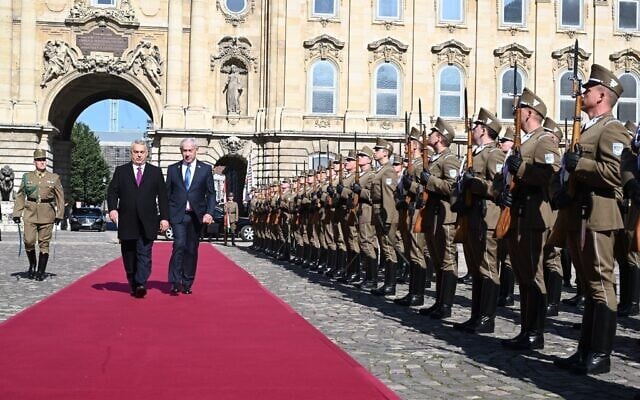
Why is Netanyahu cosying up to one of Europe’s most controversial leaders?
This week, Israeli Prime Minister Benjamin Netanyahu travelled to Budapest. He was warmly received by Hungary’s Viktor Orbán, who announced during the visit that Hungary would begin the process of withdrawing from the International Criminal Court. The timing was not subtle. Netanyahu is currently facing an ICC arrest warrant over alleged war crimes in Gaza, and Orbán’s gesture seemed designed to show solidarity with a political ally.
There’s a long context to this friendship, and I think it’s worth sitting with it for a moment.
Orbán’s government has spent years pushing back against the norms and values of the European Union. He has said that Hungary must remain “ethnically homogeneous” and “culturally pure.” He has called migration a threat to Europe and referred to refugees as invaders. In 2017, his government ran a campaign against George Soros that many critics described as having antisemitic overtones. At the same time, he praised Miklós Horthy, Hungary’s wartime leader who collaborated with the Nazis.
None of this seems to have deterred Netanyahu. In fact, the relationship between the two leaders has grown stronger since 2017, when Netanyahu became the first Israeli prime minister in decades to visit Hungary. That visit caused some discomfort, not just because of Orbán’s rhetoric, but because of what it seemed to symbolise: a willingness to overlook uncomfortable truths in favour of political alignment.




Since then, Hungary has become one of Israel’s most dependable allies in Europe. Orbán’s government has blocked EU statements critical of Israeli settlements, supported Israel at the United Nations, and in 2019 opened a diplomatic trade office in Jerusalem.
This latest move, withdrawing from the ICC, may be the clearest expression yet of how far Orbán is willing to go to back Netanyahu. But it also raises some questions that I think are difficult to ignore.
For Netanyahu, this is a moment of political and legal pressure. Support from Orbán helps him make the case that he still has international allies, that the ICC is acting unfairly, and that Israel will not be isolated. For Orbán, it’s another opportunity to challenge an international institution he has long criticised. The friendship works for both men.
But I can’t help wondering what it says more broadly. Netanyahu leads the world’s only Jewish state, a country whose founding was shaped by the Holocaust and the promise of refuge for a people repeatedly targeted throughout history.
So when he embraces someone who talks about racial and cultural purity, it matters. When he accepts public support from a leader whose government has been accused of fuelling antisemitic narratives, it has meaning beyond short-term diplomacy.
Some might argue that this is simply pragmatic. That in a world where Israel faces criticism from the UN and EU, friends are friends, no matter their politics. I understand that logic. But I think there is a line between strategy and values. Between cooperation and endorsement.
When the Israeli prime minister aligns himself so closely with someone like Orbán, what message does that send? To Jewish communities in Europe, some of whom have spoken out against Orbán’s rhetoric for years? To countries still wrestling with their own histories of nationalism, antisemitism, and populism? And even to Israeli citizens who may wonder what kind of alliances their leaders are building, and why?
These are questions I am asking, not because I believe I have all the answers, but because I think the symbolism matters. Because I think Israel’s moral authority, always contested, is shaped as much by who it stands with as what it stands for.
I’m not suggesting that Israel should cut ties with Hungary or refuse diplomatic engagement with leaders who hold different views. But I do think we should be cautious about turning a blind eye to rhetoric that, in other contexts, would cause deep alarm. Rhetoric about race and culture and purity. Rhetoric that echoes the kind of thinking many of us were taught to remember, to challenge, and never to excuse.
So yes, this week was a diplomatic success for Netanyahu. But it also asked something of the rest of us. To notice who he is standing next to. To think about what that says. And to ask — quietly, clearly, and seriously — whether this is the direction we want to see Israel going in.
I’m not here to condemn. I’m here to reflect. But I think it’s time more of us did.
- Josh Gaventa is head of social media at Jewish News, and account manager at 8original

Keep community journalism free.
Jewish News is free for everyone. No paywall. No barriers. Just trusted journalism for anyone who wants to stay connected to Jewish life in Britain.
If you value that, please support us.
From as little as £5 a month, you can help keep our journalism free and accessible to all.
Every day, we report on the issues that matter to our community. We celebrate achievements, support charities, challenge antisemitism and ensure Jewish voices are heard more widely.
From as little as £5 a month, you can help us continue to:
- Report on the stories shaping Jewish life in the UK and beyond
- Bring our community together through shared stories, events and campaigns
- Celebrate the people, culture and moments that define our community
- Support organisations doing vital work across Jewish Britain
You can make a one-off donation or become a regular supporter. Every contribution helps keep our journalism free, independent and accessible to all.
If everyone who values Jewish News gave a small amount, it would make a real difference to our future.