Prefer Jewish News on Google
OPINION: The Elephant Man in the room is Bradley Cooper’s prosthetic nose
There is no doubt that Bernstein deserves a biopic; but what neither he nor the Jewish community needs is a large prosthetic nose to exaggerate his Jewishness, writes Daniel Sugarman.

Leonard Bernstein was a musical genius, one of the greatest composers and conductors in 20th century America. His range was breathtaking – film scores, musicals (most famously ‘West Side Story’ and ‘On The Town’), orchestral symphonies, opera, ballet – the list goes on. The accolades, which included multiple Emmys, Tonys and Grammys – fell far short of his accomplishments. There is no doubt that he deserves a Hollywood biopic.
What he does not deserve, by any stretch of the imagination, is the actor playing him to don a large prosthetic nose. Yet that is what Bradley Cooper, the A-lister depicting Bernstein in an upcoming film, ‘Maestro’, appears to have decided to do.
Perhaps, you might say, this was a directorial choice? Perhaps it was, but Cooper is directing the film, too. Maybe the screenwriters insisted on it? Could be, but Cooper co-wrote the script.
Bernstein was, of course, Jewish. And this is why the decision to wear a prosthetic nose rankles as it does. The idea that Jews have big noses is a common stereotype, which usually contains explicitly antisemitic overtones. It was the way Jews were depicted in countless antisemitic caricatures, from medieval times, through the so-called “Age of Enlightenment”, and by both the Nazis and the Soviets.
Today it is regularly used online by Neo-Nazis and other assorted antisemites, whether via the use of the so-called “Happy Merchant” antisemitic caricature, the nose emoji employed as a descriptor for Jews, or the phrase “the nose knows”.



Offline, the half-Jewish leader of a key Italian political party, Elly Schlein, was recently subjected to antisemitic jibes about her nose (she responded saying that her nose was “typically Etruscan”.)
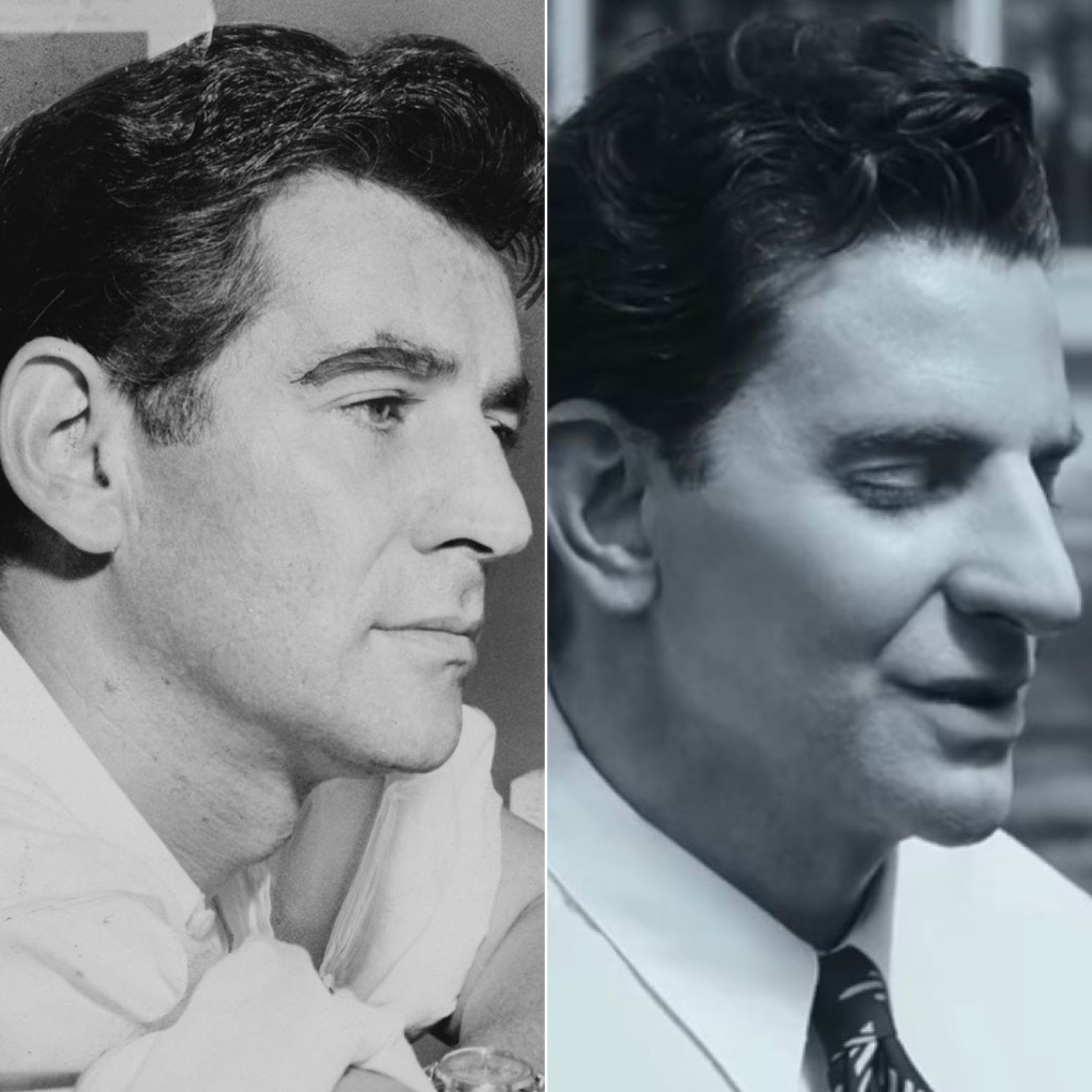
Which brings us back to Leonard Bernstein – whose nose, I find myself in the position of having to say, was not exceptionally big – and Bradley Cooper.
As a number of people have pointed out, a few years ago Cooper was in a London stage production of The Elephant Man.
He played the role without prosthetics. Now, as has also been flagged, the specific instructions for the stage role state that the character is meant to be played that way (the film version, although based on the life of the same individual, actually has no other connection to the play of the same name).
I have very little issue with the idea of a non-Jewish actor playing a Jewish individual, on stage or on screen.
But this simply raises further questions – Cooper, after all, has demonstrated that he is perfectly capable of playing a complex character meant to possess an actual facial deformity without any prosthetic or make-up. Are we meant to believe that he was incapable of playing Leonard Bernstein without this bizarre nasal caricature?
While I have a great deal of respect for many of those who feel otherwise, I have very little issue with the idea of a non-Jewish actor playing a Jewish individual, on stage or on screen.
Pretending to be someone you are not is, after all, the very essence of acting. Charlton Heston, for example, played Jews twice in two of the biggest blockbuster movies of the 1950s – The Ten Commandments and Ben Hur – without people raising an eyebrow.
My indifference ends, however, when the actors playing such roles decide to do so in a way which appears to embrace an erroneous public consciousness of what a supposedly “typical” Jewish person looks or behaves like. And that, by the way, is the traditional definition of “Jew-face”, an idea which has been present since the late 19th century.

It refers to the stereotypical depictions of Jewish people, either by dress, facial prosthetics or accent.
Given we are now in 2023, it doesn’t seem unreasonable for an actor not to don an exaggerated schnozz when portraying someone Jewish.
Cooper cannot be held entirely to blame. Maybe, after all, he genuinely had no idea that this was an issue. But his Maestro co-writer, Josh Singer, is Jewish, as of course is co-producer Stephen Spielberg and supporting actress Sarah Silverman (who herself has been a vocal critic of Jew-face in the past). It seems strange that none of them, at any point, might have flagged this as an issue.
No doubt the film will do fantastically well at the Venice Film festival, where it is due to be screened in a couple of weeks’ time. Presumably this will be followed by further plaudits. But for many Jews, a film about a man who literally brought music to our ears will leave a bad taste in our mouths – and all because of a misjudged decision about a nose.

Keep community journalism free.
Jewish News is free for everyone. No paywall. No barriers. Just trusted journalism for anyone who wants to stay connected to Jewish life in Britain.
If you value that, please support us.
From as little as £5 a month, you can help keep our journalism free and accessible to all.
Every day, we report on the issues that matter to our community. We celebrate achievements, support charities, challenge antisemitism and ensure Jewish voices are heard more widely.
From as little as £5 a month, you can help us continue to:
- Report on the stories shaping Jewish life in the UK and beyond
- Bring our community together through shared stories, events and campaigns
- Celebrate the people, culture and moments that define our community
- Support organisations doing vital work across Jewish Britain
You can make a one-off donation or become a regular supporter. Every contribution helps keep our journalism free, independent and accessible to all.
If everyone who values Jewish News gave a small amount, it would make a real difference to our future.