
The sushi chain that’s on a roll
From first idea to fast-growing brand, Candice Krieger discovers the secret ingredient that has led to the success of SushiDog
Most holiday ideas disappear before the flight home. Greg Ilsen and Nick Goldstein’s turned into one of Britain’s fastest-growing food businesses.
Their company, SushiDog, sells around 40,000 made-to-order hand rolls every week, employs more than 200 people and, with 17 sites open or about to launch, is rapidly rolling out across the country.
Recently named in this year’s Sunday Times 100 list of Britain’s fastest-growing private companies, the brand has grown from a single kiosk in Westfield London to targeting 50 locations by 2029.
Yet the idea behind SushiDog didn’t begin with sushi at all.
Greg and Nick, who became friends at Immanuel College, were in their early 20s when a holiday in Israel sparked a conversation about launching a business together.
“There was a restaurant concept there that we really liked,” Greg tells Jewish News. “We were talking about how cool it would be bringing it to the UK.
“That particular idea never materialised, but it got us thinking that we wanted to start a business together,” he says. “It could have been in any industry. It just happened to be that the first idea we spoke about was in hospitality.”
Instead, the pair looked to Australia’s grab-and-go sushi hand rolls and decided to adapt the concept for the UK, creating a made-to-order format that allows customers to build their own burrito-style sushi roll from a choice of proteins, toppings and sauces.
Both Nottingham graduates, Greg was working as a business project manager at Ocado at the time, while Goldstein was a geography teacher with Teach First when, at the end of 2017, they made the bold decision to leave their jobs and launch SushiDog.
“I remember my mum saying, ‘I think you should try and do it whilst staying at Ocado’ – probably like any Jewish mum would,” Greg says with a smile. “But I said; ‘If I’m going to do it, I’m going to do it properly.
“We didn’t have kids, or mortgages. It seemed the perfect time.”
Today, the 34-year-olds are both fathers – Ilsen has two children and Goldstein has three – making the prospect of taking the same risk feel very different.
With the help of the Government-backed Seed Enterprise Investment Scheme (SEIS), which encourages investment in start-ups through tax breaks, they secured early backing and opened their first kiosk in Westfield, which remains the company’s best-performing site.
Even then, there was no grand blueprint.
“We never thought it would get to anything like this,” Greg admits. “When we started it, it was really just, ‘Let’s get one open and see what happens,’ rather than, ‘Let’s build a huge business.’”
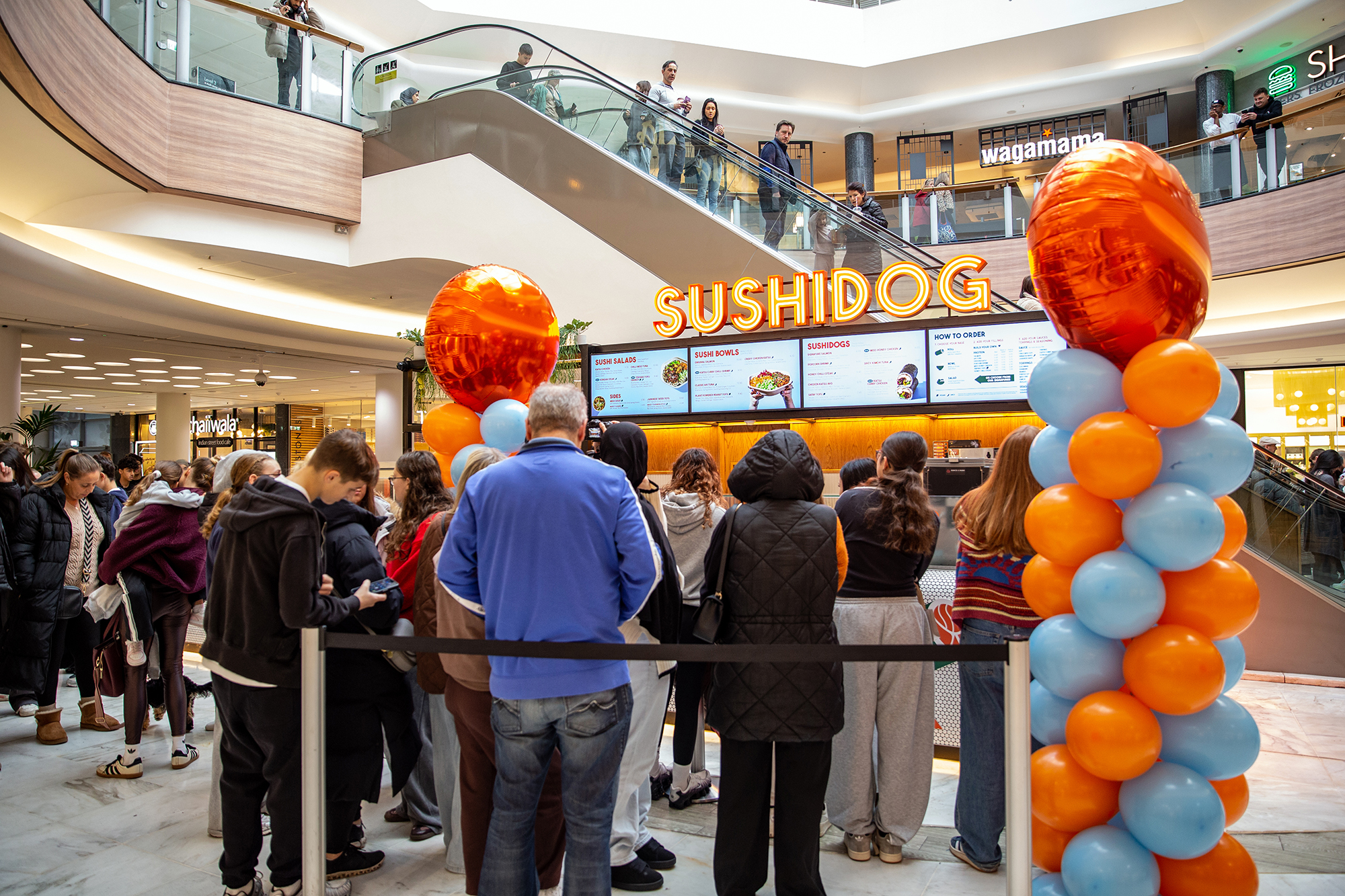
The first six months were relentless. The pair routinely worked 100-hour weeks, arriving at 7am and often not leaving until after 11pm.
“We were serving customers whilst also trying to do rotas, pay suppliers and run the company. It was the most exhausting thing I’ve ever done,” says Greg.
Rather than chasing rapid expansion, they chose to grow steadily.
“It has been eight years,” he says. “That’s a good amount of time to make a lot of mistakes, learn slowly and do lots of hard work.”
That patient approach is paying off. Earlier this year, SushiDog opened its first site outside London – in Birmingham, which has traded ahead of expectations, giving the founders confidence to accelerate their regional roll-out next year.
The business has also continued to grow in the capital. New sites have opened in Canary Wharf and Camden, with a further opening in St James’s, joining locations including Brent Cross, King’s Cross, Baker Street and The Strand.
The expansion comes at a time when much of the hospitality sector continues to face significant pressures.
While casual dining has struggled amid rising costs and weaker consumer spending, Ilsen believes quick-service restaurants (QSR) have proved more resilient as diners increasingly trade down from more expensive meals.
“We’re actually quite lucky,” he says. “VAT doesn’t affect us as much as it does a lot of the hospitality sector. For us, it’s more about business rates. As you open more stores, that’s what has the biggest impact on the business.”
To fuel that growth, SushiDog has raised around £2.5 million, predominantly from Middleton Enterprises across three funding rounds, including an £800,000 investment at the start of the year, that helped finance four new London openings.
The company has also built a loyal following online. Earlier this year, it launched its first app, giving away 2,018 free SushiDogs – a nod to its founding year. Every giveaway had been claimed within 90 minutes.
The app attracted 15,000 downloads in its first two weeks. At one point it ranked second in the App Store’s Food & Drink chart, ahead of McDonald’s, Wagamama and KFC.
Greg believes the business has succeeded by recognising changing consumer habits.
“We don’t claim to be at the super high end of healthy eating,” he says. “Gen Z customers are less interested in super-healthy salads. They’re focused more on having a nutritious, complete meal with protein, carbs and flavour.”
Rather than competing with traditional sushi restaurants, he believes SushiDog has created its own category.
“We’re a healthy grab-and-go QSR concept. But we offer customisation. If you’ve got a couple more minutes to spend, you can get something made exactly how you want it.”
Looking back, Greg says the support of experienced entrepreneurs helped to shape the business in its early years.
Among those he credits are hospitality entrepreneur Maurice Abboudi, whose career has included Domino’s, Ask Restaurants and Wagamama, and Sam Anstey, managing director at Mildreds Restaurant Group.
“They gave us brilliant guidance during SushiDog’s formative years.
“The great thing about being part of the Jewish community is there are so many people you’re introduced to and the vast majority are always willing to help.”
With 50 locations firmly in its sights, it seems this dog is really having its day.