Prefer Jewish News on Google
Woman ‘forced to pay husband £50k’ for get
Chained wife says she's been left with 'mental scars' as she hands over cash to end 15-year ordeal
A woman denied a religious divorce for more than 15 years has finally received a get – after fulfilling her former husband’s demands for £50,000.
Esther Kahan, a nursery practitioner at Noam Primary School in Wembley, claims she has been left with “mental scars that she knows she will carry for the rest of my life”, after her marriage to Shmiel Kahan.
She alleges the emotional upheaval during her marriage – and while she waited for her get – was so bad she ended up in hospital on a number of occasions.
Kahan, once an agunah, or chained wife, says she strongly believes “that the dayanim are simply not doing enough to deal with a major problem”. She feels that various British rabbinical courts “seem unable – or unwilling – to adopt more draconian measures against get refusers”, and says that that the tough penalties now imposed on recalcitrant husbands in Israel “are proof that more can be done”.
Esther and Shmiel Kahan were married in London in 1993, but after the couple had a family, the marriage broke down and Mrs Kahan obtained a civil divorce. But efforts to obtain a get were, she says, stonewalled by her ex-husband. She says: “I went through the usual channels to try to compel my former husband to give me a get, but was thwarted each time by Mr Kahan, who asked for vast sums of money in return, or attached near-impossible conditions.”



Mrs Kahan approached three
different Batei Din for help. Today, she declines to name them, but it is believed at least two were the London Beth Din and the Union of Orthodox Hebrew Congregations (UOHC).
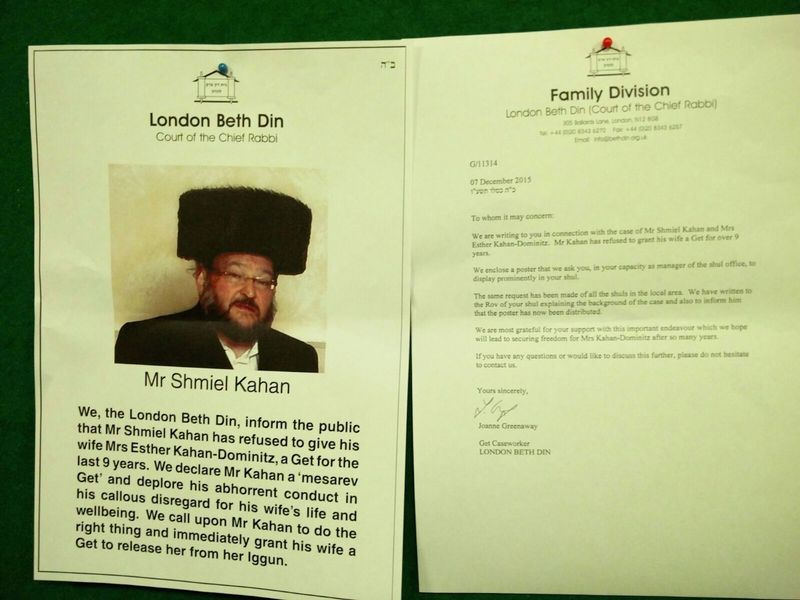
In 2015, in an effort to crack down on men who would not give their “chained wives” a get, the London Beth Din sent posters to a number of synagogues in Golders Green and Hendon, denouncing the “abhorrent conduct” of Shmiel Kahan. The posters said he had refused his wife a get for nine years and called on him to “do the right thing”. But Mrs Kahan said she was “unimpressed” by the campaign, and observed that a planned demonstration outside a synagogue which continued to support Mr Kahan, despite knowing he was withholding a get, never took place. She said one rabbi advised her “not to expect that she would ever obtain a get”, and says now that “I was never convinced they did all they could to help”.
However, Dayan Gelley, Rosh Beth Din of the London Beth Din, said: ““We were made aware in April that a get had been given to Mrs Kahan and we are very glad the situation has finally been resolved. The principle view of the London Beth Din, as in all other get cases, is that where a get ought to be given it should be given without any demands. Every effort was expended over many years by the Dayanim, Registrar and our dedicated get caseworker to resolve Mrs Kahan’s circumstances within the realm of halacha. While even one agunais one too many, the London Beth Din is pleased that over recent years, through perseverance and diligence, we have been able to successfully resolve a number of difficult cases.”
A spokesperson for the UOHC told Jewish News: “We are happy this case has been settled for the sake of both parties and their families.”
A friend of Mr Kahan’s said at the time that he had been trying to sort out the issue, and felt the condemnation was unfair. He had, said the friend, gone to the UOHC. “He has asked me to say he wants this matter settled, he wants to give a get, but outstanding matters have to be settled. He has taken halachic advice.” Despite that claim, nothing happened.
Mrs Kahan finally obtained her freedom in a dramatic way just before Pesach this year. Mr Kahan, at the time of the London Beth Din campaign, was said to be living in New York, but in March this year Mrs Kahan spotted him in London.
She made one last-ditch effort to see if he would release her. Through a friend, she asked what were his conditions for issuing a get. He asked for £50,000 — and Mrs Kahan raised the sum within three days. She said: “The get was quickly arranged by the UOHC before Mr Kahan could withdraw his offer.”
Mrs Kahan told Jewish News this week that “in the past he [Mr Kahan] had asked for a lot more money, which I was unable to give him. When he said he was willing to accept £50,000, I knew I had to try to raise that amount and thankfully I was able to”.
While financial settlements are common in civil divorces, they are extremely rare in cases such as this.
Mrs Kahan added: “There are other agunot who are suffering. I hope that telling my story will give them hope that one day they will be released from their situations.”
Jewish News called Mr Kahan this week but his UK phone line was disconnected.

Keep community journalism free.
Jewish News is free for everyone. No paywall. No barriers. Just trusted journalism for anyone who wants to stay connected to Jewish life in Britain.
If you value that, please support us.
From as little as £5 a month, you can help keep our journalism free and accessible to all.
Every day, we report on the issues that matter to our community. We celebrate achievements, support charities, challenge antisemitism and ensure Jewish voices are heard more widely.
From as little as £5 a month, you can help us continue to:
- Report on the stories shaping Jewish life in the UK and beyond
- Bring our community together through shared stories, events and campaigns
- Celebrate the people, culture and moments that define our community
- Support organisations doing vital work across Jewish Britain
You can make a one-off donation or become a regular supporter. Every contribution helps keep our journalism free, independent and accessible to all.
If everyone who values Jewish News gave a small amount, it would make a real difference to our future.