Prefer Jewish News on Google
60 percent don’t take a side on the Israeli-Gaza conflict, according to new poll
The majority of the population are losing patience with disruptive protests
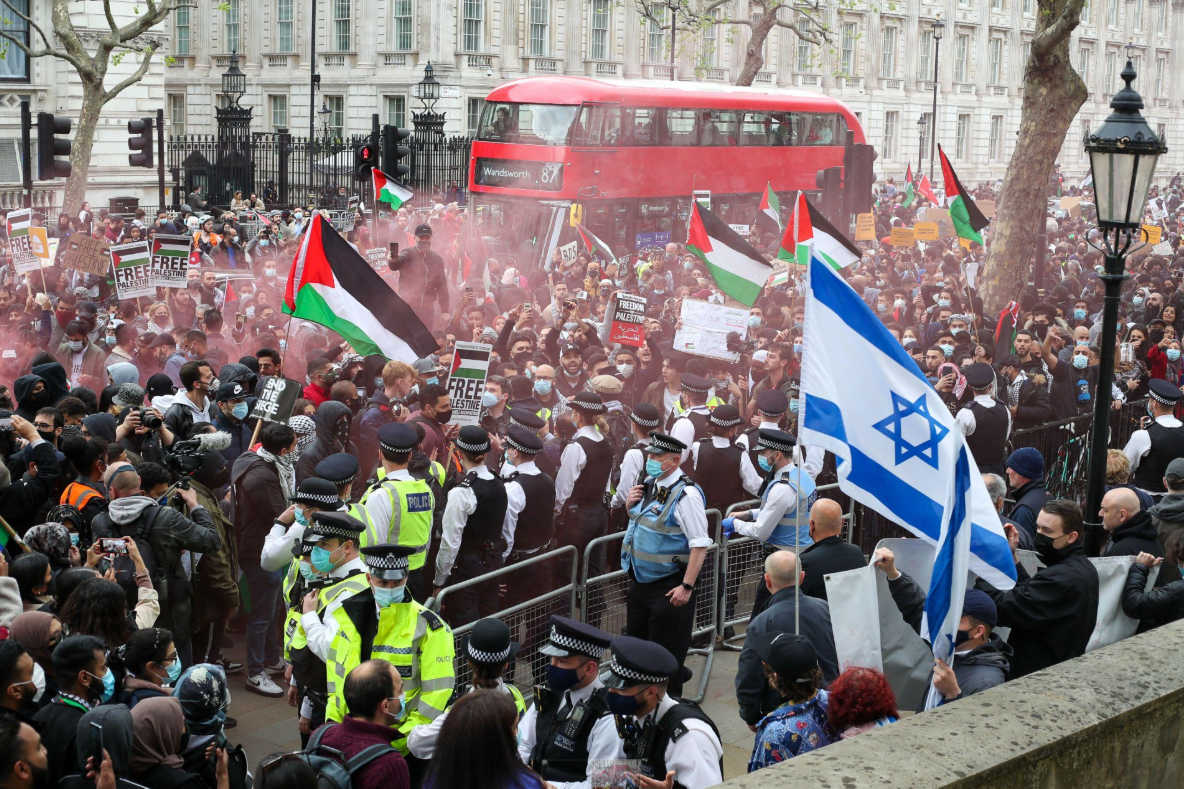
Polling of the British public on its view of the Israel-Gaza war has found that contrary to what those most emotionally affected may feel, the majority of the UK population – 60 per cent – do not take a specific side in the bitter conflict.
However, the polling – funded by the Pears Foundation over a two-year period – also shows that patience with disruptive protest is wearing thin, with two thirds of people now feeling some demonstrations are so troublesome that they should not be allowed.
Representative polling conducted by More in Common of more than 6,000 people in early November found that of the UK population as a whole, 26 per cent sympathise more with the Palestinians while 14 per cent sympathise with Israel. By comparison, in October 2023, that figure showed 18 per cent favouring the Palestinians more, compared with 16 per cent support for the Israelis.
In general, of the 60 per cent who don’t take a specific side in the conflict, the most prominent feelings were “there are good and bad people on both sides”; “both sides are as bad as each other”; or “the conflict is too complex”.
However, the polling found both those who are pro-Israel and pro-Palestinian significantly inflate the percentages of the general population whom they feel are actively engaged in supporting either side in the conflict.


Those who sympathised more with the Palestinians believed 51 per cent of the public backed the Palestinians and 19 per cent Israel, while those who sympathised more with Israelis believed 38 per cent of the population sympathised more with Israel, and 31 per cent with the Palestinians.
More in Common suggested the possibility “that people overestimate estimate how common their own viewpoints are is evidence that perhaps people are filtering into their own echo chambers on social media.”
After two years, More in Common found that the general public’s patience for disruptive protest was low; 27 per cent of Britons would think worse of someone for going to a pro-Palestine march, while 30 per cent would think worse of someone for going to a pro-Israel march.
More in Common also found that just 12 per cent of Britons have a positive view of the Israeli government, with more than half having a negative view. For most British people, however, that disapproval does not extend to Israeli civilians, with fewer than 20 per cent expressing a negative view.
The British public’s perception of Hamas is overwhelmingly negative – 63 per cent – while the percentage who have a somewhat positive view of the group are in the low single digits.
One group which is much more likely to express much higher rates of sympathy for the Palestinians were those categorised as “progressive activists”, who despite making up approximately 12 per cent of the population as a whole have played an outsized role in the debate in recent years, accounting for roughly a quarter of all people posting on social media about the conflict.
Another group where sympathy for the Palestinian side far outweighs support for Israel is in the 18-24 year old bracket, where 55 per cent sympathise more with the Palestinians versus just 3 per cent sympathising more with Israel.
Trust in mainstream media was far lower among those with strong views on the conflict. In particular, as More in Common outlines, those sympathising with Israel increasingly view it as pro-Palestine (particularly following controversies like the Gaza documentary narrated by a Hamas official’s son), while Palestine supporters have become slightly less critical.
In November 2023, 45 per cent of those who sympathised more with Israel felt the BBC was biased towards the Palestinian side, compared with 53 per cent today. By contrast, while in November 2023, 38 per cent of those who sympathised more with the Palestinians believed the BBC was biased towards the Israeli side, that number has declined to 27 per cent today.
The polling also shows that most Britons are uncomfortable with musical artists inciting political violence at concerts or festivals. Just eight per cent say they would like it if a musical artist said “death to the IDF” at a concert, compared with 64 per cent against.
Only four percent would support a musician saying “globalise the Intifada” on stage compared with 56 percent against, while a higher percentage (33 per cent) disapproved of a musician saying “Free Palestine” on stage than approved of it (29 per cent).
Luke Tryl, director of More in Common, said: “While debates about Israel-Palestine have dominated airtime over the last few years, the tenor of those debates is leading to the majority of the country switching off or withdrawing from the conflict altogether.”
Tryl described how “the majority of Britons… are shocked and appalled by the conflict, but do not take a side either way”, and that it is “Britain’s Jewish communities and Muslim communities who are bearing the brunt of rising hate”.
“The government, civil society, and those most engaged in the conflict need to do more to find ways out of the growing cycle of polarisation that risks inflicting lasting scars on social cohesion in the UK.”

Keep community journalism free.
Jewish News is free for everyone. No paywall. No barriers. Just trusted journalism for anyone who wants to stay connected to Jewish life in Britain.
If you value that, please support us.
From as little as £5 a month, you can help keep our journalism free and accessible to all.
Every day, we report on the issues that matter to our community. We celebrate achievements, support charities, challenge antisemitism and ensure Jewish voices are heard more widely.
From as little as £5 a month, you can help us continue to:
- Report on the stories shaping Jewish life in the UK and beyond
- Bring our community together through shared stories, events and campaigns
- Celebrate the people, culture and moments that define our community
- Support organisations doing vital work across Jewish Britain
You can make a one-off donation or become a regular supporter. Every contribution helps keep our journalism free, independent and accessible to all.
If everyone who values Jewish News gave a small amount, it would make a real difference to our future.