Prefer Jewish News on Google
Al Quds Day march ban due to risk of serious violence, says Met Police commissioner
Sir Mark Rowley tells The Times the situation faced by police this weekend was 'uniquely complex'
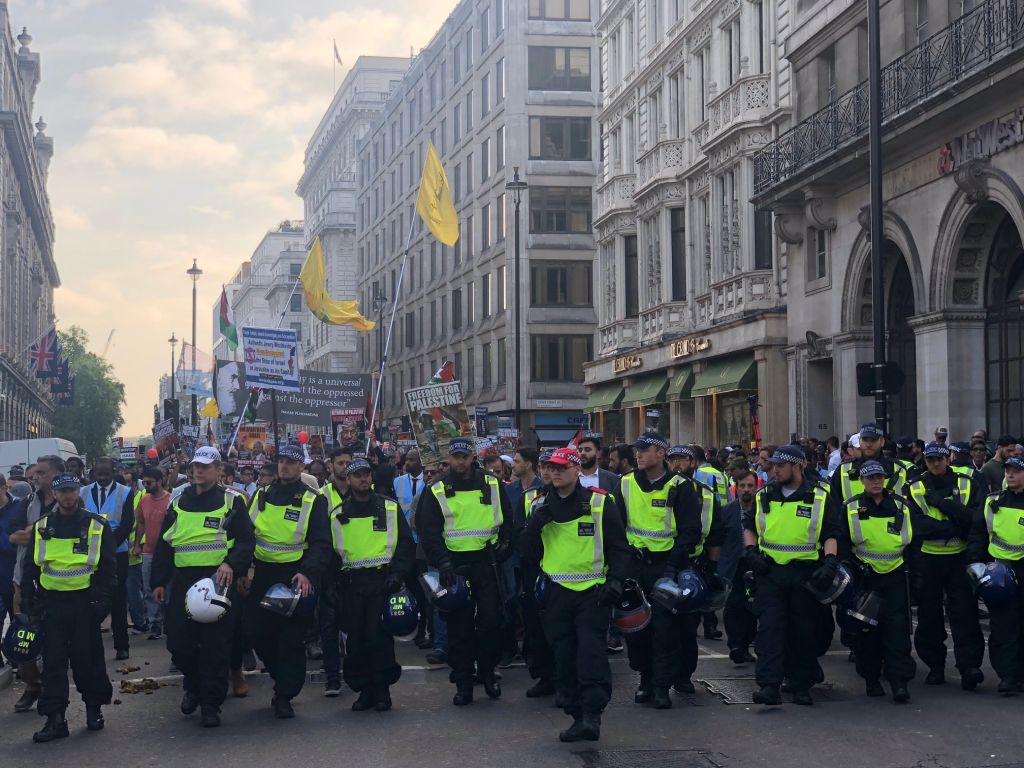
Metropolitan Police commissioner Sir Mark Rowley said he asked for the Al Quds Day march to be banned because of a “real risk of serious violence and disorder”.
The Home Secretary granted the police’s bid for a month-long ban of the annual march organised by the Islamic Human Rights Commission (IHRC), making it the first time such a restriction on protest had been imposed since 2012.
Shabana Mahmood told MPs that police cannot stop a static demonstration from taking place instead but can dictate its location and timing.
Police chiefs believe the demonstration could potentially attract 12,000 people or more when it takes place on Sunday amid the war in Iran.
Sir Mark said the situation faced by police at the weekend was “uniquely complex”.
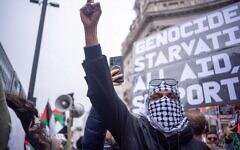
He wrote in The Times: “The main march and counter-marches were planned by groups with sharply opposing objectives in a global context that is unusually volatile and emotionally charged.
“These groups would have been operating in close proximity. Many hold profound grievances against one another. Some have clashed before.
“Our assessment is that this combination presented a real risk of serious violence and disorder, of a kind that could not be safely mitigated through conditions alone.”
The annual Al Quds Day march in London had drawn criticism over apparent backing for the Iranian regime after its organisers expressed support for the country’s late leader Ayatollah Ali Khamenei.
Several counter-protests had also been planned for the day.
The Metropolitan Police commissioner added: “This is not about ideology. It is not about policing taste or decency. And it is emphatically not about national security being used as the basis for banning a protest.
“National security issues shape the environment in which we operate but they are not part of the legal test and they are not the basis for this decision.
“Our assessment was focused solely on the operational realities: the mix of groups, their locations, their mutual antagonism and the likelihood that, together, at this moment, they would create a highly volatile and confrontational situation on London’s streets.
“The prohibition does not prevent people from assembling. They still can, but static assemblies are significantly easier to manage and contain. This is where our operational experience shows we can most effectively reduce violence.
“This is, and must be, an operational policing decision.”
Sir Mark said London had seen “extraordinary levels of hate crime, both antisemitic and anti-Muslim” as well as “unprecedented targeting of dissident voices from Iran and of Jewish communities”.
At least a thousand officers from the Metropolitan Police and forces around the country are being drafted in to patrol the crowds, with more made available if needed.
All protests and counter-protests will take place between Vauxhall and Lambeth bridges, and are permitted between 1pm and 3pm, the Met said.
Counter protesters can assemble on the Millbank side of the Thames.
Lambeth Bridge will be closed, with access only for emergency vehicles.

Keep community journalism free.
Jewish News is free for everyone. No paywall. No barriers. Just trusted journalism for anyone who wants to stay connected to Jewish life in Britain.
If you value that, please support us.
From as little as £5 a month, you can help keep our journalism free and accessible to all.
Every day, we report on the issues that matter to our community. We celebrate achievements, support charities, challenge antisemitism and ensure Jewish voices are heard more widely.
From as little as £5 a month, you can help us continue to:
- Report on the stories shaping Jewish life in the UK and beyond
- Bring our community together through shared stories, events and campaigns
- Celebrate the people, culture and moments that define our community
- Support organisations doing vital work across Jewish Britain
You can make a one-off donation or become a regular supporter. Every contribution helps keep our journalism free, independent and accessible to all.
If everyone who values Jewish News gave a small amount, it would make a real difference to our future.