Prefer Jewish News on Google
Altalena conclusively located after 78 years
Ship which played defining role in a key crisis of Israel's earliest days has been officially identified, despite the Israeli government knowing its exact whereabouts since 2012
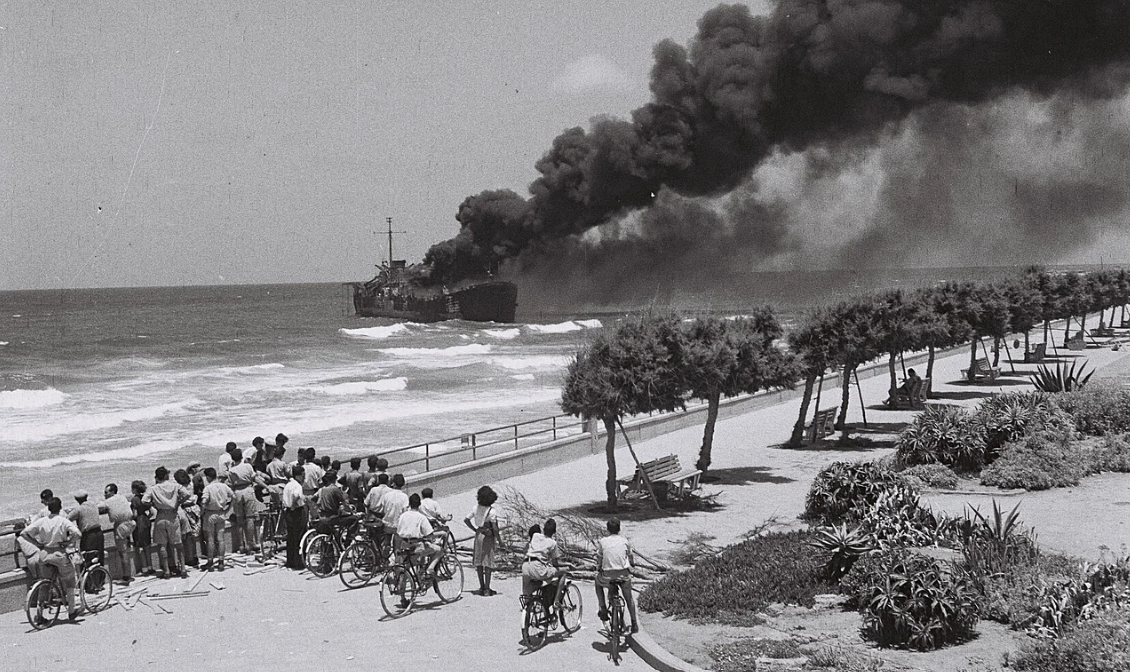
The remains of a ship which was attacked on the orders of Israeli Prime Minister David Ben Gurion in 1948 – a decision which risked igniting a civil war in the fledgling state – have been reached at the bottom of the sea after 78 years, with the country’s Heritage Minister describing the find as “a defining moment for our national memory”.
The Atalena, which was towed out to sea and sunk in 1949, was located via sonar approximately 20 kilometres off Israel’s coast, at a depth of 503 metres, the Heritage Ministry said. Although the Israeli government is understood to have known the exact whereabouts of the wreck since 2012, concerted efforts began last year to conclusively identify the ship. Amichai Eliyahu, the Heritage Minister, described having worked on this project “out of a deep-seated mission to reveal the historical truth and make the story of the ship’s heroes accessible to future generations.”
The language of Eliyahu’s statement lays bare the complexities of what is known in Israel as The Altalena Affair: one of the most notorious confrontations in the history of the State of Israel. In June 1948, approximately a month after the declaration of the State of Israel, the Altalena, having sailed from France, reached the coast of the newly independent country, having brought more than 900 recruits, as well as a large quantity of arms intended to help the Irgun, also known as Etzel – one of the paramilitary groups formed prior to the establishment of the state.
Although an agreement had been reached earlier that month to incorporate the Irgun into the newly formed IDF, there was still a great deal of distrust between the Irgun and the provisional government, which was largely made up of members of what had been the much larger paramilitary group in the British mandate, the Haganah. While the passengers on the ship disembarked and a significant quantity of the weaponry was brought ashore, there was suspicion within the provisional government that Menachem Begin, the leader of Etzel, was planning to set up a military power base of his own – maybe even as a prelude to a coup. Subsequently, an ultimatum was sent by Ben Gurion to Begin, who stalled for time. An impasse between the IDF and Irgun led to shots being fired, with both IDF and Irgun soldiers killed and wounded. Subsequently, the Altalena would run aground on Tel Aviv beach, with the IDF conducting a full-fledged military operation to capture the ship. The risk of civil war only abated when Menachem Begin specifically instructed Irgun members not to retaliate.
For the first 30 years of Israel’s existence, the government of Israel was led by Ben Gurion and his successors, forming left-wing coalitions. At that point, however, Menachem Begin became Prime Minister – since then, the balance of political power has shifted, with right wing coalitions mostly winning elections, with a variety of political figures seeking to cast themselves as the successors to Begin’s legacy, despite the fact that Begin was an implacable opponent of the ideals espoused by Meir Kahane, the forerunner of today’s far right parties in Israel.



Itamar Ben Gvir, leader of the far right “Jewish Power” party, said that the official rediscovery of the Altalena was “closing a historical circle on one of the most painful and formative events in the history of Israeli society.
“We have been dealing with this issue secretly for many years, and today the fruits of the intelligence and operational effort have borne exciting fruit for the sake of historical truth, the memory of the fallen, and unity with Israel.”
However, Ramon Ziv-Av, deputy director-general of activities at the Ben-Gurion Heritage Institute, told the Jerusalem Post that “The Altalena represented the peak of a severe internal confrontation. Ben-Gurion viewed this test as a threat no less serious than the dangers that came from outside: the danger of an armed force operating outside the authority of the state.”
“The Altalena affair did not end with the sinking of the ship, and its discovery in the depths provides another opportunity to hold an important discussion that remains relevant today,” he continued.
“If, together with the ship, the danger of civil war also returns, it would be better for that danger to remain at sea.”

Keep community journalism free.
Jewish News is free for everyone. No paywall. No barriers. Just trusted journalism for anyone who wants to stay connected to Jewish life in Britain.
If you value that, please support us.
From as little as £5 a month, you can help keep our journalism free and accessible to all.
Every day, we report on the issues that matter to our community. We celebrate achievements, support charities, challenge antisemitism and ensure Jewish voices are heard more widely.
From as little as £5 a month, you can help us continue to:
- Report on the stories shaping Jewish life in the UK and beyond
- Bring our community together through shared stories, events and campaigns
- Celebrate the people, culture and moments that define our community
- Support organisations doing vital work across Jewish Britain
You can make a one-off donation or become a regular supporter. Every contribution helps keep our journalism free, independent and accessible to all.
If everyone who values Jewish News gave a small amount, it would make a real difference to our future.