Prefer Jewish News on Google
Austria prepares for protest over Israel at Eurovision
Security around Jewish institutions in Austria is already among the highest in Europe, with armed protection commonplace outside synagogues, schools and major events
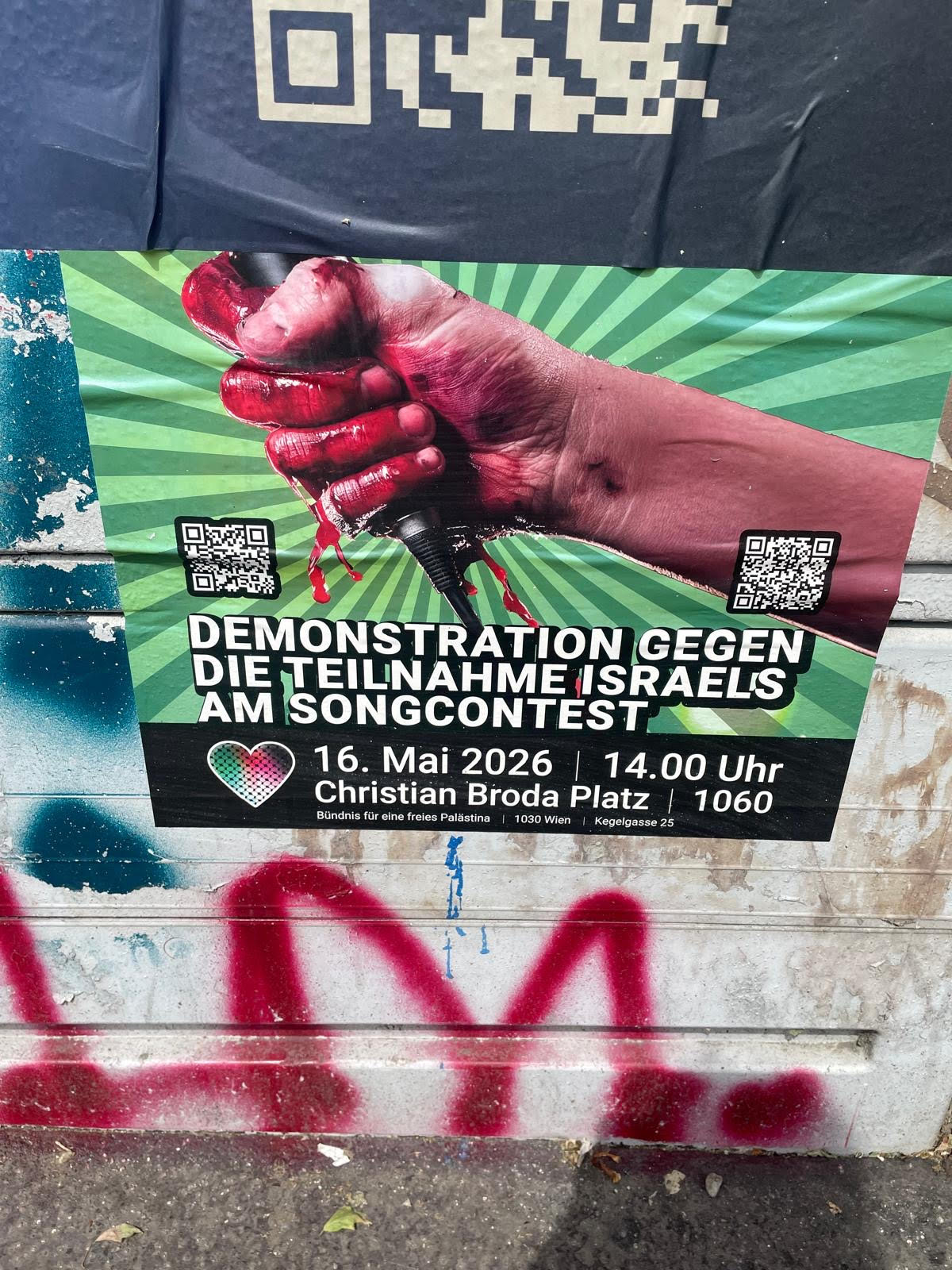
A poster featuring a bloody hand clutching a weapon has been plastered across walls in Vienna ahead of this year’s Eurovision Song Contest, heightening fears that the Austrian capital could become the latest flashpoint in the increasingly politicised battle over Israel’s participation in the competition.
The posters, calling demonstrators onto the streets on May 16, appeared as Israel’s contestant Yuval Raphael arrived in Vienna for rehearsals ahead of the contest and the Israeli Embassy joined Solidarity Israel Austria for a belated Yom HaAtzmaut reception.
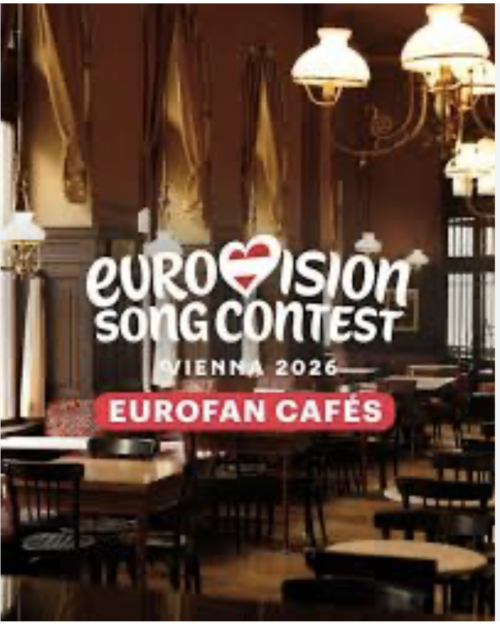
One of the clearest signs of tension in the city emerged from Vienna’s historic coffee houses, which as part of Eurovision celebrations were invited to “adopt” competing countries and celebrate them during the contest. Yet when organisers unveiled the initiative, one country was missing.
“No coffee house was prepared to take the patronage for Israel,” said Daniel Kapp, a co founder of Solidarity Israel Austria. “Quite frankly, because they were cautious about becoming a target of activism.” Eventually, one café in central Vienna agreed to host Israeli-themed events during Eurovision — but it will now do so under police protection.
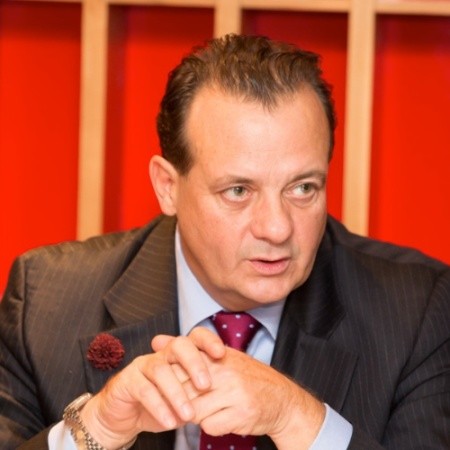
Thomas Stern, President of Solidarity Israel Austria, said demonstrations linked to the Gaza war have taken place almost weekly in Vienna since October 7, although organisers remain uncertain how large Eurovision-related protests will become.

“We don’t actually know what the turnout will be at the moment,” Stern said. “The question is whether the big official Muslim organisations are joining them. Then we will see what is coming.” While Austria has not witnessed demonstrations on the scale of London, Stern said some rallies had still drawn between 5,000 and 8,000 people.
Kapp said Austria’s activist movement remained relatively small but highly organised, centred around a coalition of far-left groups and Islamist activists, while larger immigrant communities, particularly Turkish groups, had so far largely stayed away from major mobilisation.
“What we expect around the Eurovision Song Contest is that this Austrian group of activists will receive support from international groups,” he said. “There will be people from Ireland and Spain even though the countries aren’t competing. Because this is an event of international attention, they will do their very best to disrupt it.”
Despite the tensions, Austrian officials have publicly backed Israel’s participation in the contest following what Stern described as “a very strong Austrian political debate”.
Kapp argued Austria remained markedly different from some other European countries because of the nation’s historical responsibility for the Holocaust.
“Austria is a country that participated in the Shoah,” he said. “So it’s thin ice for any mainstream politician to be harshly critical of the Jewish community or Israel.”
Security around Jewish institutions in Austria is already among the highest in Europe, with armed protection commonplace outside synagogues, schools and major events following decades of antisemitic terror attacks, including the 1981 machine-gun and grenade assault on Vienna’s Stadttempel synagogue and the 2020 Islamist shooting in the city centre near the same synagogue that left four people dead.
Stern, who was inside the Stadttempel synagogue during the 1981 attack, said Austria’s past has made the authorities acutely aware of threats against Jews and Jewish institutions — in contrast to countries “which were on the right side of history”.
“Every school, there’s police in front of the school. Every synagogue, there’s police. On the High Holy Days there’s military,” he said. “They take it seriously.”
Kapp added: “We have special police at any public Jewish event. The Jewish community is very satisfied with the cooperation with the Ministry of the Interior.”

Keep community journalism free.
Jewish News is free for everyone. No paywall. No barriers. Just trusted journalism for anyone who wants to stay connected to Jewish life in Britain.
If you value that, please support us.
From as little as £5 a month, you can help keep our journalism free and accessible to all.
Every day, we report on the issues that matter to our community. We celebrate achievements, support charities, challenge antisemitism and ensure Jewish voices are heard more widely.
From as little as £5 a month, you can help us continue to:
- Report on the stories shaping Jewish life in the UK and beyond
- Bring our community together through shared stories, events and campaigns
- Celebrate the people, culture and moments that define our community
- Support organisations doing vital work across Jewish Britain
You can make a one-off donation or become a regular supporter. Every contribution helps keep our journalism free, independent and accessible to all.
If everyone who values Jewish News gave a small amount, it would make a real difference to our future.