Prefer Jewish News on Google
BBC fails to tell viewers “Palestinian prisoner” is Al Aqsa Martyrs Brigade suicide bomb plotter
A BBC interview featured the weeping sister of a Palestinian prisoner finding out he was deported. They didn't mention he was a terrorist behind 2006 bombing that killed 4
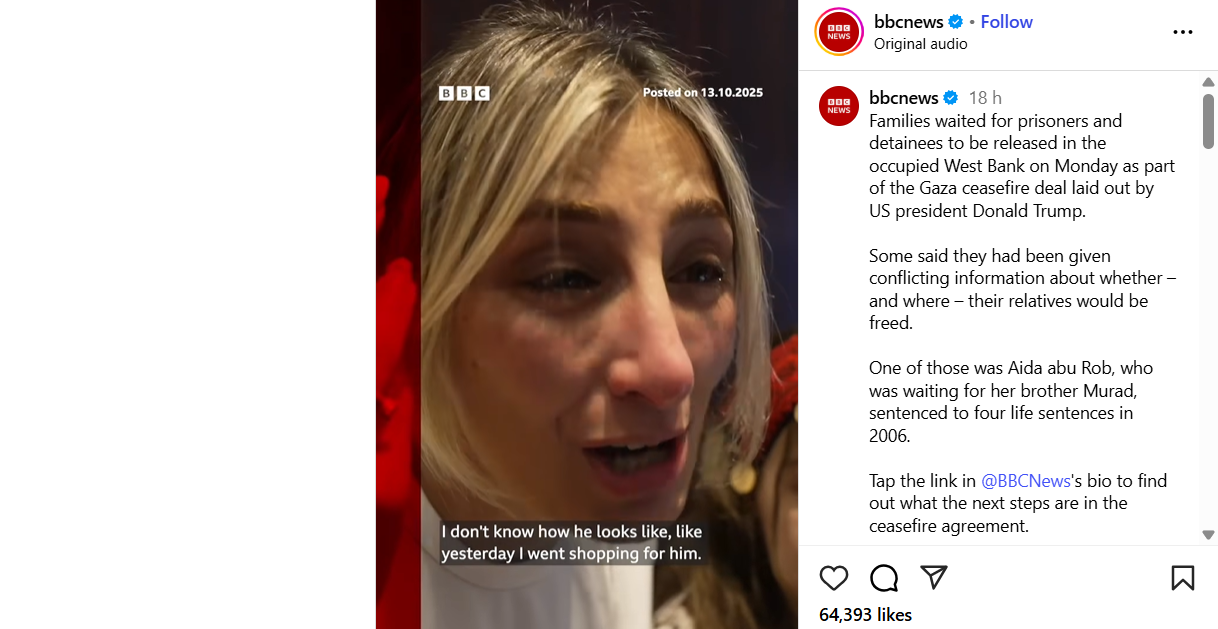
The BBC is facing questions as to why it aired an interview with the sister of a Palestinian prisoner featuring her crying as she finds out he is being deported rather than being released – without informing viewers that the prisoner in question is a terrorist responsible for a 2006 suicide bombing which killed four people.
In a video which was published across the BBC’s channels – including the 10 o’clock news on Monday night, the BBC News website homepage this morning and across the Corporation’s social media channels, Lucy Williamson, the BBC’s Middle East correspondent, interviewed a woman identified as “Aida abu Rob”. In written language accompanying the TV piece, it described her as “waiting for her brother Murad, sentenced to four life sentences in 2006.”
In the BBC video, flagged with a warning for “distressing content”, a tearful Aida says “I’ve waited 20 years for my brother to be released from Israeli jail…I don’t know what he looks like, yesterday I went shopping for him. He’s a big guy, he used to be a big guy, you know? So I tried to figure out, what size should I take for him, you know? I don’t know if it’s going to fit him today or not, I don’t know.”
The BBC video then shows Aida weeping as it turns out that Murad was not among the prisoners released back to the West Bank.
“They kidnapped my brother. They kidnapped him”, Aida claims.
The BBC voiceover from Williamson says that “After comparing three different lists of prisoners, we discovered Murad’s name, once slated for release, was yesterday moved to a list of deportees…our colleagues in Gaza looked for Murad among the hundreds of faces released there today. We still don’t know where he is.”
However, Marc Goldberg, a British-Israeli citizen and author, identified who “Murad” really is.
“There were two Murads released by Israel, only one of them has served 20 years; Murad Abu Al Rab, BBC names the sister as an ‘Aida Abu Rob’. ‘Murad’ is a member of the Al Aqsa Martyrs Brigade. His family have spoken about their pride in his actions”, Goldberg said, linking to a Palestinian Authority TV programme from 2021 called Giants of Endurance, which features members of the Al Rab family expressing pride in Murad.
Al Rab was sentenced to four life sentences in 2006 for his role in a suicide bombing at the Kedumim junction in the West Bank. A suicide bomber was disguised as a strictly orthodox Jew and sent out to hitch-hike. He was picked up by a car of civilians. At a petrol station near Kedumim, he blew himself up, killing three others in the car and one person nearby – Rafi Halevy, Helena Halevy, Re’ut Feldman and Shaked Lasker.
Commenting on the BBC TV segment, Goldberg said:
“Your video fails to give any information about who Murad is and what he did. Your journalist doesn’t even give his full name let alone inform the public of this important context. I found out that he was responsible for a suicide bombing in 2006 that murdered four people.
“The piece appears to offer an equivalence between the family of a terrorist with the Al Aqsa Martyrs Brigade who was tried in court, and Israeli hostages kidnapped by Hamas and other terror orgs due to no fault of their own.
“You have failed to inform the public of the context, you have failed to offer balance and as a result have likely increased sympathy for a man who was responsible for the murders of four people. How do you think the families of his victims feel at his release? Why didn’t your staff think to ask who the brother was and then they could have provided the necessary context? Why didn’t any of your other staff who worked on that video and then promoted it think to raise any concerns?
“This is a failure not just from the journalist on the ground but through the entirety of the team and their management who oversaw the processing and uploading of the video to a prominent place on your website and app. At the very least you should be making it clear that Murad and other released prisoners have been convicted of some terrible crimes that warranted long sentences in prison. That would have given a more honest view of the situation. What are you going to do to redress this?”
Jewish News contacted the BBC for comment – a BBC spokesperson responded by saying: “It was made clear that the prisoner had been serving four life sentences. The interview with his sister was in the context of Israel’s release of hundreds of prisoners as part of the ceasefire agreement and its impact on their families and communities.”
While wording accompanying the video on various social media platforms mentioned that Al-Rab was serving four life sentences, none of the versions of the video interview Jewish News has seen included even that information. At the time of writing, a shortened version of the video, available on the main page of the BBC News app and titled “Sister’s hopes dashed in long wait for Palestinian detainee brother’s release”, contained no language at all about the life sentences being served by Al-Rab. After Jewish News inquired, language about the life sentences was added to accompany the video on the BBC app.

Keep community journalism free.
Jewish News is free for everyone. No paywall. No barriers. Just trusted journalism for anyone who wants to stay connected to Jewish life in Britain.
If you value that, please support us.
From as little as £5 a month, you can help keep our journalism free and accessible to all.
Every day, we report on the issues that matter to our community. We celebrate achievements, support charities, challenge antisemitism and ensure Jewish voices are heard more widely.
From as little as £5 a month, you can help us continue to:
- Report on the stories shaping Jewish life in the UK and beyond
- Bring our community together through shared stories, events and campaigns
- Celebrate the people, culture and moments that define our community
- Support organisations doing vital work across Jewish Britain
You can make a one-off donation or become a regular supporter. Every contribution helps keep our journalism free, independent and accessible to all.
If everyone who values Jewish News gave a small amount, it would make a real difference to our future.