Prefer Jewish News on Google
BBC’s Lyse Doucet: I have no hesitation taking the side of the innocent people in Gaza war
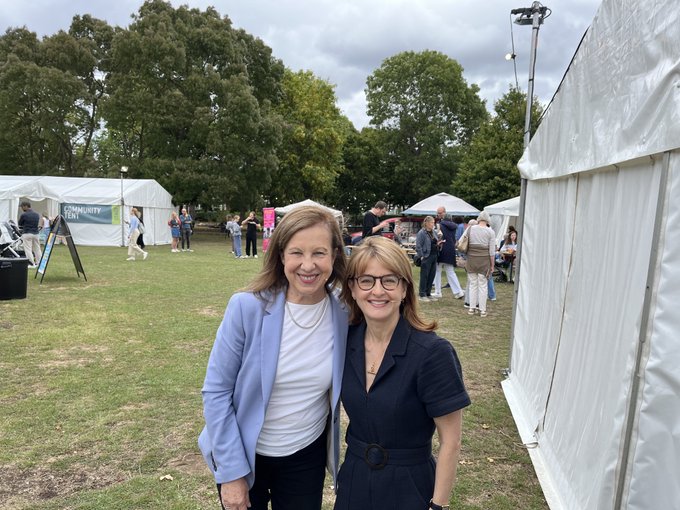
Speaking at the Queens Park Book Festival, the respected BBC News and Radio 4 journalist cites the hostages held by Hamas, and the children of Gaza

The BBC’s chief international correspondent, Lyse Doucet has admitted she has “no hesitation in taking the side of innocent people on both sides” covering the war between Israel and Hamas in Gaza.
As she defended the BBC against accusations of bias, “from all sides” over its coverage of the conflict, the 66-year-old journalist cited the hostages held by Hamas, and the children of Gaza as being among the innocents caught up in a war sparked by the October 7th 2023 attacks.
“Everyone wants you to take a side, and it becomes a defining identity if you like,” Doucet said, of her many years covering conflicts across the Middle East, Africa, Asia, and, more recently, from Ukraine.
“All sides accuse the BBC of taking sides, “she reflected.
“The BBC, the national broadcaster – you want them to be like you, to express what you think is right, or just.”
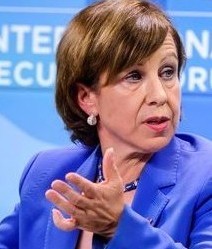
Recalling on the criticism of BBC reporting, which became intense during coverage of the civil war in Syria, in the same way it has with Gaza, Doucet stressed: “I have no hesitation in taking the side of the people.
“Whether one war after another, it’s the same. The children in Gaza, the hostages held by Hamas, the innocent people.
“There is nothing wrong with taking the side of innocent people.”
The BBC News and Radio 4 added: “And equally, there is nothing wrong with taking the side of the innocents on both sides – because I think that’s what all of us have to stand up for”.
Speaking at the annual Queens Park Book Fair, in north-west London, where she was promoting the publishing of her first book The Finest Hotel In Kabul, Doucet was also asked by a member of the audience if she thought the UK “would take stronger action against Russia than it is against Israel” over claims of a famine in Ukraine, than it is doing with claims of one in Gaza?
Doucet said she believed that “for a while” when leaders discussed Ukraine, “they spoke in different terms about attacks which killed civilians” there than they had about attacks which killed civilians in Gaza.
But she added, “But I think that has started to change – a famine is a famine, is a famine. ”

In conversation with ex-BBC presenter Rebecca Jones, Doucet defended the reputation of the UN-backed IPC, which had declared famine in Gaza City last week, sparking criticism from the Israeli government.
She said the IPC was a scientific organisation that carried out “very careful studies.”
Whilst it had not been permitted to go into Gaza, “there are enough people and aid agencies on the ground to determine – and they do it very carefully.”
She recalled being in Sudan last year in Darfur, adding: “That was one of the only places in the world where the IPC said there is a famine – they are very careful.”
Doucet noted that Israel does not accept the claims that there is a famine in Gaza City, and acknowledged they had the right to challenge the damining allegation.
But she said Prime Minister Keir Starmer and Foreign Secretary David Lammy “understand there is not enough food, that the food distribution system is not fit for purpose, and the situation has to change.”
She said “many questions are being asked” and “people will take an alternative view and agree with the Israelis that there is no famine, a man-made famine.”
But Doucet added: “I find that one of the most painful things is that we are arguing about whether or not there is a famine when we do know that people are going hungry.”
Reflecting on the ethos at the BBC, for whom she was first based in Kabul from late 1988 to the end of 1989 to cover the Soviet troop withdrawal and its aftermath, the Canadian-born journalist said, “even though we may not reach that gold standard,” it was still drilled into staff that they need to be impartial.
“We can’t take sides,” she reiterated.
Describing herself as a “died in the wool” BBC person, who had spent her entire career at the broadcaster, she said she remained proud of its output, and would “vouch for all” its journalists.
“I am not taking the professional high ground here, we do our best in the most difficult of circumstances,” she added, insisting that, despite the advances with social media, there is no replacement for old-fashioned face-to-face in the heat and dust of journalism where you feel the stories yourself”.
Having led BBC coverage of events ranging from the Arab Spring to the Sudanese Civil War, Doucet has again been at the heart of the BBC’s coverage of both the October 7th Hamas attacks and Israel’s subsequent war with Hamas in Gaza, and with Iran, where she reported from Tehran at the end of the 12-day-long conflict in June.
Her first book, which has already drawn favourable reviews, revolves around Kabul’s Inter-Continental Hotel, where she was based as a journalist from 1988, from which she vividly tells the stories of the many locals she had befriended over subsequent years in Afghanistan, a country she holds close to her heart, despite deadly conflict.
At times, Doucet has also been criticised by some in the Jewish community, having made the editorial judgement that, when Gazans say “Jews”, they mean “Israelis”, and for claiming Jews “want to believe they have a space” in Syria’s supposed “new chapter.”
But speaking to a sell-out audience at Saturday’s book festival, where communal criticism is not discussed, Doucet said that throughout her career, she just wanted to stand up for the innocent people impacted by deadly conflicts.
“Because I think that’s what all of us have to stand up for,” she said.
“The values and the rules of war. Even in war, there are rules. And in our time, in these forever wars, this is on our watch. The rules are being broken, sometimes on an hourly basis.”

Recalling the time spent writing her new book, focusing on the everyday life stories of those she encountered in Kabul, Doucet said: “When we sat down to write the book, it also coincided with what we struggle with at the BBC. And it has a name, and it’s called news avoidance.
“The news is so grim, you know? And I sometimes turn the dial away from Radio 4, Radio 5, and go to Radio 3 to listen to classical music.
“But of course, we can’t, we have to turn the dial back, because we’re citizens and one of the responsibilities if you live in a democracy is to know about what’s happening in our world.”
She continued: “And our world doesn’t stop at the boundaries of our neighborhood, as much as we love our neighborhood. Unfortunately, you know what’s happening in Gaza also affects all of us, or Ukraine, or Somalia or Sudan.
“I thought, I’m going to tell a story about Afghanistan. I want to tell it as a story that hopefully will describe my job as a BBC correspondent, of narrowing the gap between you and me.”
Her thoughts then return to the innocent people caught up in deadly wars.
“I’ve said for a long time – and I became really, really aware of it during the Syrian war that never left our headlines more than a decade ago,” said Doucet
“I had this realisation that no matter how complex and consequential a story is, if you drill down to what it’s about, it’s about fathers and mothers and children.”

Keep community journalism free.
Jewish News is free for everyone. No paywall. No barriers. Just trusted journalism for anyone who wants to stay connected to Jewish life in Britain.
If you value that, please support us.
From as little as £5 a month, you can help keep our journalism free and accessible to all.
Every day, we report on the issues that matter to our community. We celebrate achievements, support charities, challenge antisemitism and ensure Jewish voices are heard more widely.
From as little as £5 a month, you can help us continue to:
- Report on the stories shaping Jewish life in the UK and beyond
- Bring our community together through shared stories, events and campaigns
- Celebrate the people, culture and moments that define our community
- Support organisations doing vital work across Jewish Britain
You can make a one-off donation or become a regular supporter. Every contribution helps keep our journalism free, independent and accessible to all.
If everyone who values Jewish News gave a small amount, it would make a real difference to our future.