Prefer Jewish News on Google
One rule for Israel, Mr Miliband. What about everyone else?
Our government's attitude to both Morocco and Turkey, both of whom control territory deemed to be occupied, is completely different to its view of Israel
On Friday evening, the year turns. We’ll dip apples in honey, hear the shofar, wish each other a sweet year and mean it. Rosh Hashanah is the least mournful of the great days – a birthday for the world, the tradition says – and British Jews will spend it as we always have, in synagogues up and down the country, being unmistakably ourselves and unmistakably here.
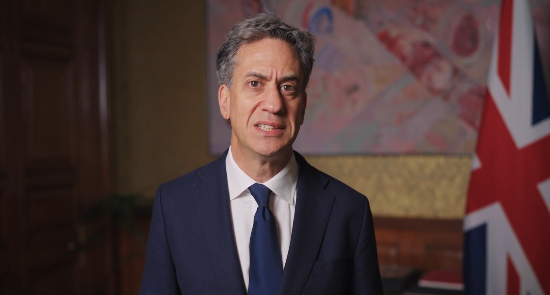
Three days before it, the Foreign Secretary told the Commons that Britain will ban imports from the settlements, act against services and advertising that supports them, widen its sanctions regime, and – for the first time – regard the occupation itself as unlawful, with implementation over six to nine months. He announced it jointly with France and Canada. The prime minister told President Trump on Monday. He did not tell the prime minister of Israel. Pat McFadden, when asked why, said he was sure the call would happen, and described Israel in the same breath as an important security ally. Mr Miliband told the House that Britain’s argument was not with the people of Israel, with whom it has unshakeable bonds, but with the conduct of its government.
I am not going to tell you what I think of the E1 tenders, or of settlements, or of the Israeli government. As a British Jew I am under no obligation to hold a public view on another state’s housing policy before I’m allowed to speak. I decline to audition. Here is my opinion, presented as a British citizen to my own government: treat Israel as you treat everyone else. That is all.
In December 2016 this country adopted the International Holocaust Remembrance Alliance’s working definition of antisemitism. Every government since has reaffirmed it. Among the examples the definition gives of antisemitism: applying double standards by requiring of Israel a behaviour not expected or demanded of any other democratic nation. Context matters, the definition says, and it’s right. So let’s look at the context, which is to say at Britain’s own recent conduct towards other states holding other people’s land.
Morocco has occupied Western Sahara since 1975. The United Nations has listed the territory as non-self-governing since 1963; the International Court of Justice affirmed the Saharawi right to self-determination in the same year Morocco marched in. In October 2019 Britain signed an association agreement with Morocco whose Annex E provides that goods originating in Western Sahara, under Moroccan customs control, enjoy the same trade preferences as goods from Morocco.
Campaigners took the government to the High Court over it. The government defended the arrangement and won, in December 2022. Then on 1 June 2025, in Rabat, the foreign secretary declared Morocco’s autonomy plan the most credible basis for a settlement, while continuing to profess support for self-determination, alongside investment agreements signed the same day. Preferential trade with the occupied territory, written into our own treaty, defended in our own courts, followed by endorsement of the occupier’s plan.
Fifteen months ago. For fifty years Britain’s official view was that the territory’s status was undetermined. This week it found the word “unlawful” for one occupation and has never applied it to that one.
Turkey invaded Cyprus in 1974 and has held the north ever since. Roughly half of its population now consists of settlers moved there from Anatolia since the invasion, and their descendants; the Council of Europe reported on the colonisation in 1992 and called on Turkey to stop it. This is population transfer into occupied territory, the exact charge laid against Israel under the Fourth Geneva Convention. Britain is a guarantor of Cypriot independence under the 1960 treaty.
Britain keeps sovereign bases on the island. Britain has never sanctioned Turkey, or a single Turkish minister, over it. Britain signed a free trade agreement with Turkey in 2020 and is negotiating a deeper one.
The government will answer with Crimea, where Britain does ban trade. Crimea was seized by a state that had invaded a member of the United Nations, and Britain sanctioned that state entire; the Crimea measure is one plank of treating Russia as an adversary. If the principle were that Britain does not trade with land held by force, Western Sahara proves it false. What Crimea actually shows is that this country knows perfectly well how to sanction an occupier when it decides to. Russia was treated as an adversary, coherently, across the board. Israel is called an important security ally and then singled out for a measure no other ally – not Morocco, not Turkey – has ever received. That is the double standard in miniature.
The government will say it acts with France, Canada and a dozen others. A double standard held by twelve states is still a double standard; the definition Britain adopted contains no safety-in-numbers clause. Not one of those twelve sanctions Morocco or Turkey either.
On what evidence? Last week the foreign secretary released a video. He had, he said, just come out of a meeting; people had told him stories of medicines blocked and children dying, and when you hear such accounts you know you have to act. The Israeli foreign ministry disputed the facts in detail. I don’t need to adjudicate that. The point is the standard. Coercive measures against a democratic ally, announced on the strength of what people told a minister in a meeting. In the Commons he cited settler violence and the E1 tenders. Settler violence has been sanctioned individually since 2024; the new measure is aimed at goods and at the occupation as such. Mr Miliband told the House that Britain now accepts the International Court of Justice’s 2024 opinion that the occupation is unlawful. Britain declined that opinion for two years. The same court found in 1975 that Morocco had no sovereignty over Western Sahara; Britain has had fifty years to act on that finding and instead endorsed the occupier’s plan. The government does not follow the court. It chooses which findings to follow. Nobody sanctions Morocco on a story. A tender for houses not yet built is answered with an import ban, while phosphate mined today in Western Sahara enters Britain on a preferential tariff.
So if the principle is real, what selects the one occupation it is applied to? The Times printed the answer alongside the announcement. The ban has strong support among Labour, Liberal Democrat and Green voters – the progressive alliance the prime minister is trying to assemble before the next election. More than 140 Labour MPs signed the letter demanding it; a motion is ready for conference this month. The prime minister, shortly before taking office, apologised that his party “didn’t get it right” and promised to do better. Better for whom is now clear. This is the calculation I described to my children a year ago, the one the state never makes aloud: it looked at who is growing and who is not, at where the marginal seats are, and it would rather have the votes than the Jews. Only this time somebody wrote the arithmetic down and put it in a newspaper. Downing Street itself calls the measures limited and symbolic, and Mr Miliband told the House he opposes BDS. A minister who rejects boycotts and announces a ban with nothing yet in force is describing a signal. A symbol is addressed to somebody; the polling says to whom.
And here is where the Jewish new year comes back in. On Yom Kippur last year, a terrorist drove a car at worshippers outside Heaton Park synagogue in Manchester, then came at the doors with a knife. Two men died: Melvin Cravitz, stabbed outside, and Adrian Daulby, struck by a police bullet as the congregation held the doors shut. The Community Security Trust recorded 1,926 antisemitic incidents in the first six months of this year, up 21% on the same period last year and the second-worst half-year since it began counting. British Jews will walk into synagogue on Friday past guards the state helps to pay for, at a level of security no other community in this country requires, and will be grateful for it. That security is not a favour. It is the state’s half of a covenant that our grandparents kept in full. The same state has just told the country, three days before the holiest week of our year, that the one democracy it will sanction for holding land is the Jewish one. It cannot ask us to accept the guards and the signal together and pretend they are not connected.
So, Mr Burnham, Mr Miliband: show us. Show us the Moroccan sanctions, or the Turkish ones, or the principle that explains their absence. Show us the day you declared Morocco’s occupation unlawful. Show us the legal distinction between the occupation you have named unlawful and the two you have not. Show us the evidence that survives a question, rather than the story that moved you in a meeting. Show us that a policy which polls well with the coalition you’re assembling, which 140 of your MPs demanded and which your conference will cheer, was reached by some route other than counting. You adopted a definition of antisemitism. One of its examples is a double standard applied to Israel and to no other democracy. You are holding the cudgel your own government named; show us you are not swinging it to bind an alliance of votes paid for with your Jews.
I am not asking Britain to defend Israel. I am not asking anyone to agree with a particular view on Israel, or what it should do. I am not asking anyone to agree or disagree with the Israeli government. From this article, my political views on Israel are completely indiscernible. I am, as a British citizen, just asking Britain to be Britain – the country that adopted a definition of antisemitism and might be expected to read it. Apply your Moroccan standard, or your Turkish one, or your Crimean one, but apply one standard. Choose it and hold to it and we will argue about it as citizens do. What we will not do is nod along while the only exception is us.
Shanah tova. A sweet year, and an equal one.
Ashley Hirst is a deputy and has worked at UJS, UJIA and now works in the financial sector. He is passionately proud of being part of the worldwide Jewish people

Keep community journalism free.
Jewish News is free for everyone. No paywall. No barriers. Just trusted journalism for anyone who wants to stay connected to Jewish life in Britain.
If you value that, please support us.
From as little as £5 a month, you can help keep our journalism free and accessible to all.
Every day, we report on the issues that matter to our community. We celebrate achievements, support charities, challenge antisemitism and ensure Jewish voices are heard more widely.
From as little as £5 a month, you can help us continue to:
- Report on the stories shaping Jewish life in the UK and beyond
- Bring our community together through shared stories, events and campaigns
- Celebrate the people, culture and moments that define our community
- Support organisations doing vital work across Jewish Britain
You can make a one-off donation or become a regular supporter. Every contribution helps keep our journalism free, independent and accessible to all.
If everyone who values Jewish News gave a small amount, it would make a real difference to our future.