Prefer Jewish News on Google
Communal leaders and the Tories slam Miliband’s West Bank trade ban
Tom Tugendhat accuses Ed Miliband of 'acting without prudence in the week before Rosh Hashanah and the High Holy Days'
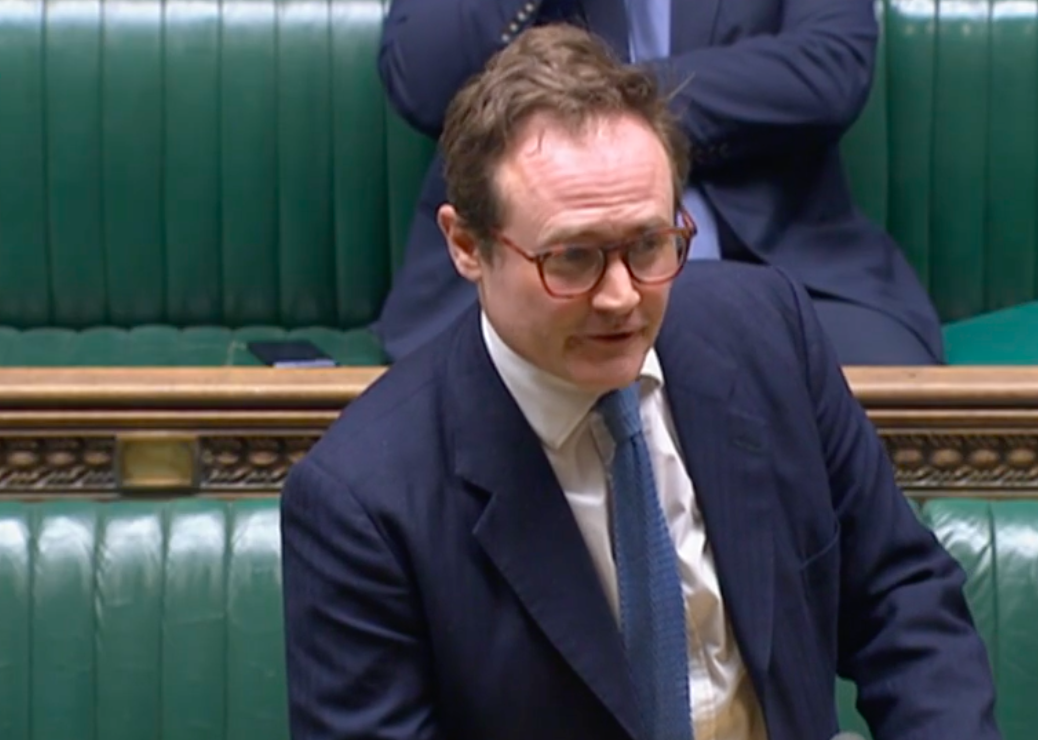
Communal groups have joined Conservative shadow foreign secretary Tom Tugendhat in accusing Ed Miliband of “acting without prudence in the week before Rosh Hashanah and the High Holy Days” by announcing West Bank trade sanctions.
Chief Rabbi Mirvis, responding to the government’s statement, said: “This is truly a dark day for British Jews. Today our Government has chosen to ignore the deep concerns expressed by so many of us. The measures announced amount to little more than political flag bearing for mendacious anti-Israel rhetoric and those who harbour a dangerous obsession with the Jewish State.”
He described how the measures laid out by the government “will succeed only in bolstering the very extremism they seek to target. On the eve of Rosh Hashanah and at a time when our community is more vulnerable than ever to the wave of extremism that has been building over recent years, these sanctions do nothing to advance the cause of peace. Nor do they make anyone safer – quite the contrary.
“Gesture politics of this kind feeds into an increasingly hostile discourse about Israel, and the cumulative effect of such punitive policies is to further embolden those, at home and abroad, who use hatred as a weapon against Jews.”
Responding to the Foreign Secretary’s statement, Tom Tugendhat, who served security minister in the last Conservative government, accused Andy Burnham’s government of “turning Israel into a pariah,” warning that it “will risk sectarian division in our own country and risk a further rise in antisemitic violence on our own streets.”


Tugendhat also voiced concern that with next month’s Israeli election approaching, “many have argued correctly that this action will help the extreme candidates’ campaigns, and not help those who are making the moderate argument for a united Israel.”
He further warned that Israeli retaliation could impact UK goods, including “pharmaceuticals that keep many British patients alive.”
Jewish News had previously revealed how Tory leader Kemi Badenoch had accused Labour of “singling out Israel” for internal political reasons with sanctions.
Criticism from the Tories was echoed by the Jewish Leadership Council (JLC), which said in a statement: “The government’s increasingly punitive and unbalanced approach towards Israel does nothing to advance peace, risks harming Jewish life in Britain, and damages the UK’s relationship with a vital ally.
“The Foreign Secretary says that he will not accept the destruction of the two-state solution. Yet, through the trade ban announced today, the government is placing the overwhelming responsibility for that on Israel.
“There can be no genuine partner for peace while the Palestinian Authority continues its ‘pay to slay’ policy—handing monthly stipends to the families of terrorists—and while its education system incites violence and antisemitism. If the government is genuinely committed to upholding international law, it must be even-handed and recognize that decades of Palestinian terror have been a major contributor to the current situation.
“A ban on trade with goods from settlements also risks becoming a de facto boycott of Israel, giving legitimacy to those who reject Israel’s very existence.”
The JLC added: “In the run-up to the High Holy Days, placing this increased target on British Jews is deeply irresponsible.”
The Board of Deputies also said:”We followed the Foreign Secretary’s statement today with deep regret. Before the Jewish New Year festival of Rosh Hashanah, with concerns for communal security at their highest levels, this will be felt particularly acutely by British Jews.
“As we have told both governments over recent weeks, the deteriorating relationship between the UK and Israel has the potential to negatively impact the two countries’ security and their economies, and further inflame community tensions here too.
“As proud Brits who love our country, and who also have a deep religious, cultural and family ties to Israel, we feel a deep sense of anguish about this breakdown in relations.
“We are also impacted directly by heightened rhetoric about the conflict, including policies that focus on the actions of the Israeli government, and do not sufficiently address responsibilities of Palestinian leaders and malign actors in the region.”
Israeli opposition leader Yair Lapid also criticised the sanctions, saying: “The British government’s decision to impose boycotts and sanctions on Israel is a grave mistake. It is a wrong and dangerous policy, at the wrong time and for the wrong reasons.
“The decision made today will strengthen the extremist voices in Israel just before the Knesset elections and provide encouragement to Hamas and the terrorist organisations.
“It is clear to everyone that this is a decision driven by considerations of domestic politics in Britain, where a cynical attack on Israel is used to please disappointed voters.”
But there was praise for the measures from UK communal advocacy group Yachad, which said: “The UK government’s announcement today that it will ban trade in goods with Israeli settlements in the occupied West Bank, and expand sanctions beyond violent extremists to include those responsible for deepening and entrenching the occupation, is an important and necessary development.
“We believe it should be supported by those who support the rights of the 7 million Israelis and 7 million Palestinians to live with freedom, dignity and security.
These new policies do not target Israel; they target the occupation. They draw a clear distinction between the legitimacy of the State of Israel and the settlement enterprise, which is illegal under international law.
“Distinguishing settlements from Israel proper is not a judgment on where a border will ultimately fall; it’s a recognition that unilateral facts on the ground should not be allowed to decide that question in advance.”
Supporters also pointed out that the United Kingdom is acting in unison with France and Canada, both of which have also announced today that they will ban trade with settlements.
Significantly the Tory shadow foreign secretary later said:”But adds:”What we reject here is not the intent, but the performative politics, the acting, the acting without the wideness of support that leaves our invoice weaker and their voices irrelevant.”
He also said that “a full international action that might actually work.”
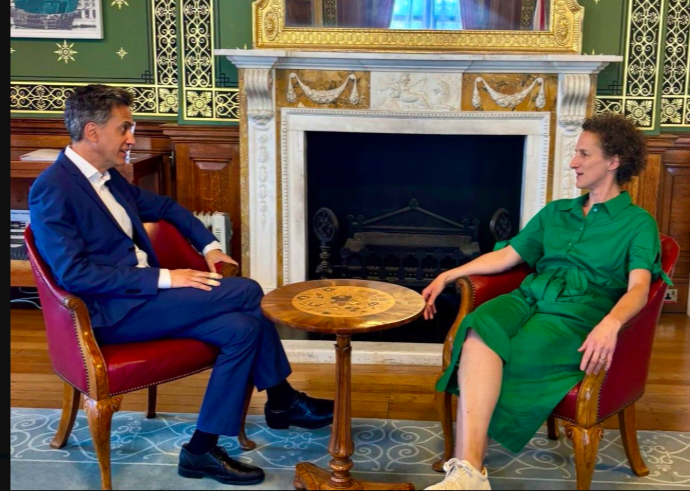
Responding to Tugendhat, Miliband rejected claims of targeting Israel, saying there are UK sanctions regimes on a number of other countries.
The Foreign Secretary also said the sanctions “will be focused on the settlements in the occupied territories, and we will absolutely ensure it does not hit Green Line Israel.”
He rejected claims that the safety of UK Jews was being put at risk by the move, adding: “We can disagree with the government of Israel, we can take action with the government of Israel, and at the same time, be absolutely steadfast in protecting Jews across Britain and across the world.”
Earlier US Ambassador to Israel Mike Huckabee called sanctions an “irrational action”.
“I feel like it’s discrimination against the Israeli government. It’s a discrimination against the Jewish people,” he told the BBC’s Today programme.
He added: “I also would tell you that I don’t know if they have thought it through. It’s like throwing a stone and not having an idea of where it’s going to land.
“And I realise, look, the UK is a sovereign country, they can do what they want, but so is the US.”
Israeli president Isaac Herzog said UK sanctions “would be a gross interference in the democratic elections of a sovereign nation” as the country prepares to go to the polls next month, and also said such a step would harm Palestinians.
“If this happens – and other nations may join – I believe it will prove to be a grave miscalculation, a decision that will fall on the wrong side of history,” he said.
Israeli foreign minister Gideon Saar meanwhile warned: “If Britain acts against Israel, Israel will act against Britain.”
Itamar Ben-Gvir, Israel’s hardline public security minister, called on Mr Netanyahu to publicly recognise the Falkland Islands as “Argentine territory under occupation, which the British violently steal from the Argentine people”.

Keep community journalism free.
Jewish News is free for everyone. No paywall. No barriers. Just trusted journalism for anyone who wants to stay connected to Jewish life in Britain.
If you value that, please support us.
From as little as £5 a month, you can help keep our journalism free and accessible to all.
Every day, we report on the issues that matter to our community. We celebrate achievements, support charities, challenge antisemitism and ensure Jewish voices are heard more widely.
From as little as £5 a month, you can help us continue to:
- Report on the stories shaping Jewish life in the UK and beyond
- Bring our community together through shared stories, events and campaigns
- Celebrate the people, culture and moments that define our community
- Support organisations doing vital work across Jewish Britain
You can make a one-off donation or become a regular supporter. Every contribution helps keep our journalism free, independent and accessible to all.
If everyone who values Jewish News gave a small amount, it would make a real difference to our future.