Prefer Jewish News on Google
Ed Miliband given ecstatic welcome by Labour Friends of Palestine – but no cabinet speaker for LFI
EXCLUSIVE: Neither the Foreign Secretary or any member of Andy Burnham's cabinet are set to speak at Labour Friends of Israel reception
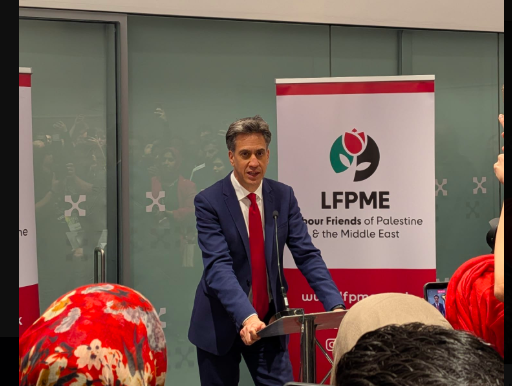
Foreign Secretary Ed Miliband delivered the keynote speech at the Labour Friends of Palestine and the Middle East (LFPME) annual reception during the Labour conference in Liverpool.
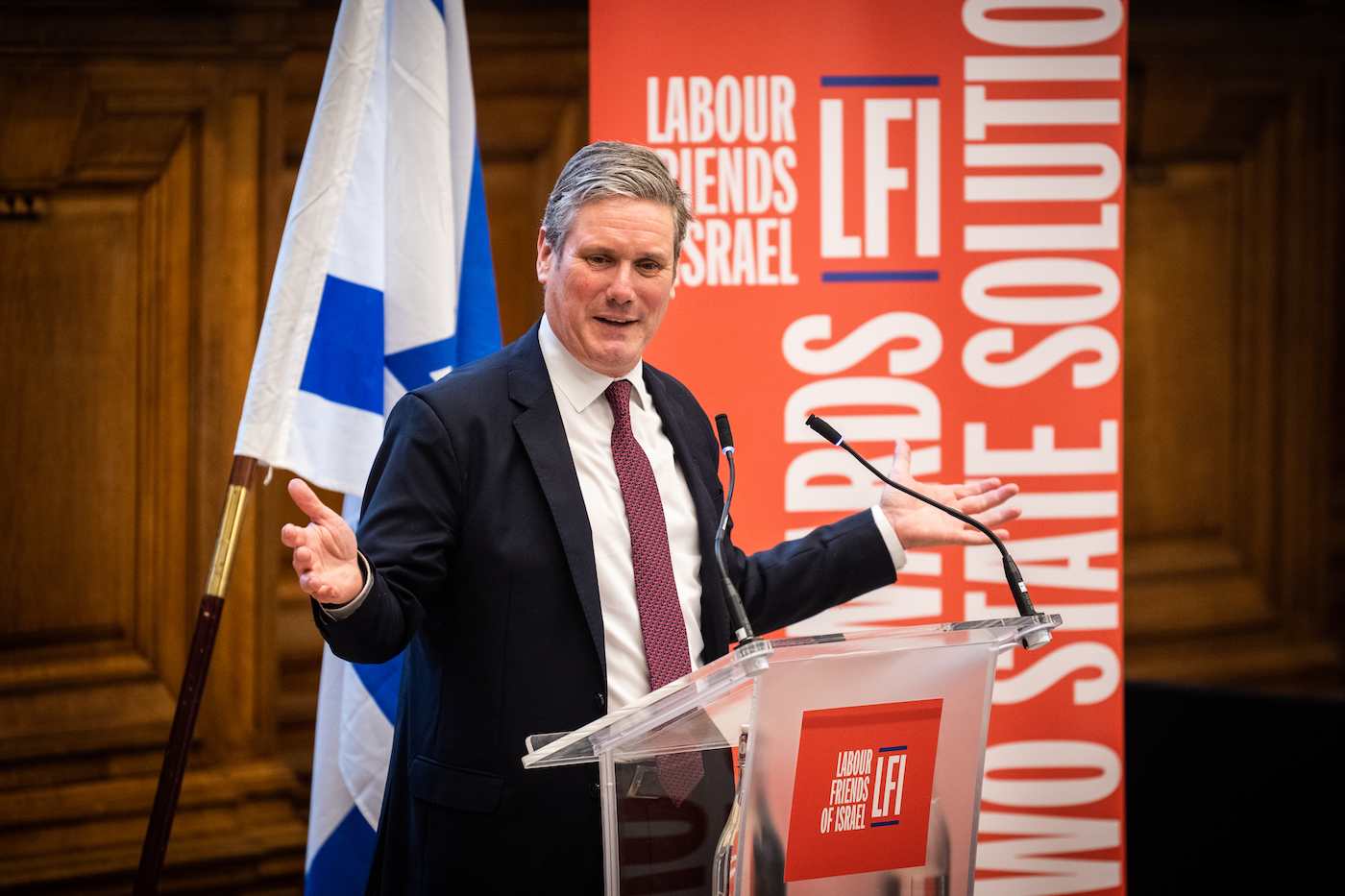
But in a notable move, neither Miliband nor any member of Andy Burnham’s cabinet will attend or speak at Labour Friend of Israel’s annual reception event on Tuesday evening.
This absence signals a growing gulf between the party leadership and LFI, which in recent months has sharply criticised the government’s decision to proceed with sanctions against Israel over its West Bank settlement policy.
The Israeli embassy in London is also not believed to have sent any representatives to Labour conference this year, meaning they will also be absent from the LFI event.
Addressing a packed audience at the LFPME event—attended by Palestinian ambassador Husam Zomlot and Middle East minister Stephen Doughty—Miliband praised those present for having “all kept the flame of justice burning” by calling out the suffering in Gaza and the West Bank “when we were not calling it out.”


“We’ve reset our approach because of justice, because we believe in justice, and we believe it ends in suffering,” Miliband said. “It’s as simple as that.”
He continued: “It’s not politics, it’s democracy. It’s democracy when people tell you the government’s got it wrong; they’ve got to change. That isn’t politics. It is politics, but it’s the right sort of politics.”
Miliband explained that he had spoken to Palestinian ambassador Husam Zomlot ahead of the sanctions announcement, telling him: “This is about security, dignity, and freedom for the people of Palestine and the people of Israel.”
In a clear sign of his frustration with LFI, Miliband and the rest of the cabinet will be absent from the organisation’s annual conference event.
Middle East minister Stephen Doughty will serve as the government’s most senior representative at the LFI gathering.
Andy Burnham, an LFI supporter himself at the time of his failed 2015 leadership bid, has also declined to address the group’s reception this year as PM.
By contrast, in the previous two years, former Chancellor Rachel Reeves delivered the main address, and after the October 7 Hamas attacks, Prime Minister Keir Starmer and nearly every senior cabinet member attended a major LFI conference event.
Even Jeremy Corbyn had previously spoken at LFI events, before relations broke down with the community.
But on Monday, Miliband reaffirmed his commitment to the new policy at the Friends of Palestine event: “I’ve heard people say to me, ‘We are pleased with what you have done, but are you going to retreat now?’ I said, ‘We’re not going to retreat. We’re here to follow this through.’”
He also acknowledged Israeli suffering, stating: “You know, there are lots of people in Israel who are also yearning for freedom and dignity and peace. There are lots of people in Israel that we know were very damaged, not just people killed by that mass attack of October 7, but also traumatised by the attack of October 7. And I know we have solidarity with that, and I think it’s really, really important.”
Middle East minister Doughty, who also spoke at the LFPME event, revealed he met with Israeli members of Labour’s sister party at the conference.
Recalling time spent in Israel, he described meeting Jews and Muslims “committed to making peace work.” Doughty noted there was significant support for the government’s actions within Israel and argued the sanctions were “having an impact,” adding pressure for a renewed commitment to a two-state solution.
He emphasised the government’s desire to “strengthen” relations with those seeking peace in Israel and to ensure these partnerships “flourished.”
Ahead of the sanctions announcement, LFI had joined other communal organisations—including the Board of Deputies and Jewish Leadership Council—in urging Miliband to delay any decision until after the Israeli elections on October 27.
The LFI leadership also raised concerns about potential domestic repercussions, with vice-chair Peter Prinsley MP publicly warning Miliband that the sanctions carry a “real risk of increased chances of attacks on the British Jewish community” by emboldening anti-Israel sentiment. LFI further argued the trade ban is “deeply damaging to the UK national interest” and counterproductive for the region.
Despite these criticisms, Miliband robustly defended the government’s policy shift, describing the settlement trade ban and expanded sanctions as an essential, legal, and moral necessity to preserve the prospects for a two-state solution.
Miliband, who has frequently referenced his own Jewish but non-religious upbringing, insisted his actions are not motivated by hostility toward Israeli citizens, but rather by what he called a “survivor’s responsibility” to stand against injustice and, in his words, “ethnic cleansing” by extremist settlers.

Keep community journalism free.
Jewish News is free for everyone. No paywall. No barriers. Just trusted journalism for anyone who wants to stay connected to Jewish life in Britain.
If you value that, please support us.
From as little as £5 a month, you can help keep our journalism free and accessible to all.
Every day, we report on the issues that matter to our community. We celebrate achievements, support charities, challenge antisemitism and ensure Jewish voices are heard more widely.
From as little as £5 a month, you can help us continue to:
- Report on the stories shaping Jewish life in the UK and beyond
- Bring our community together through shared stories, events and campaigns
- Celebrate the people, culture and moments that define our community
- Support organisations doing vital work across Jewish Britain
You can make a one-off donation or become a regular supporter. Every contribution helps keep our journalism free, independent and accessible to all.
If everyone who values Jewish News gave a small amount, it would make a real difference to our future.