Prefer Jewish News on Google
Experience not speed is now powering Israel’s tech sector says Waze founder
Uri Levine tells Candice Krieger how the country’s ecosystem is maturing as companies stay private for longer, focused on scaling up into market leaders

For more than a decade, Israel has been known as the Startup Nation – a reflection of its extraordinary ability to produce new companies at speed and at scale. But as the ecosystem matures, a different question is starting to surface: could Israel also soon be known as the Scale-Up Nation?
The evidence is compelling. Israel is known for producing more startups per capita than any other country, and also tops the charts for unicorns per capita, with roughly four to five unicorns per million people. Founders are hanging on to companies for longer, reaching higher valuations and, in some cases, becoming significant public-market players, pointing to an ecosystem built not just for formation, but for scale.
Few are better placed to reflect on this shift than Uri Levine, the co-founder of Waze, two-time unicorn builder and one of the most influential figures in Israel’s technology ecosystem.
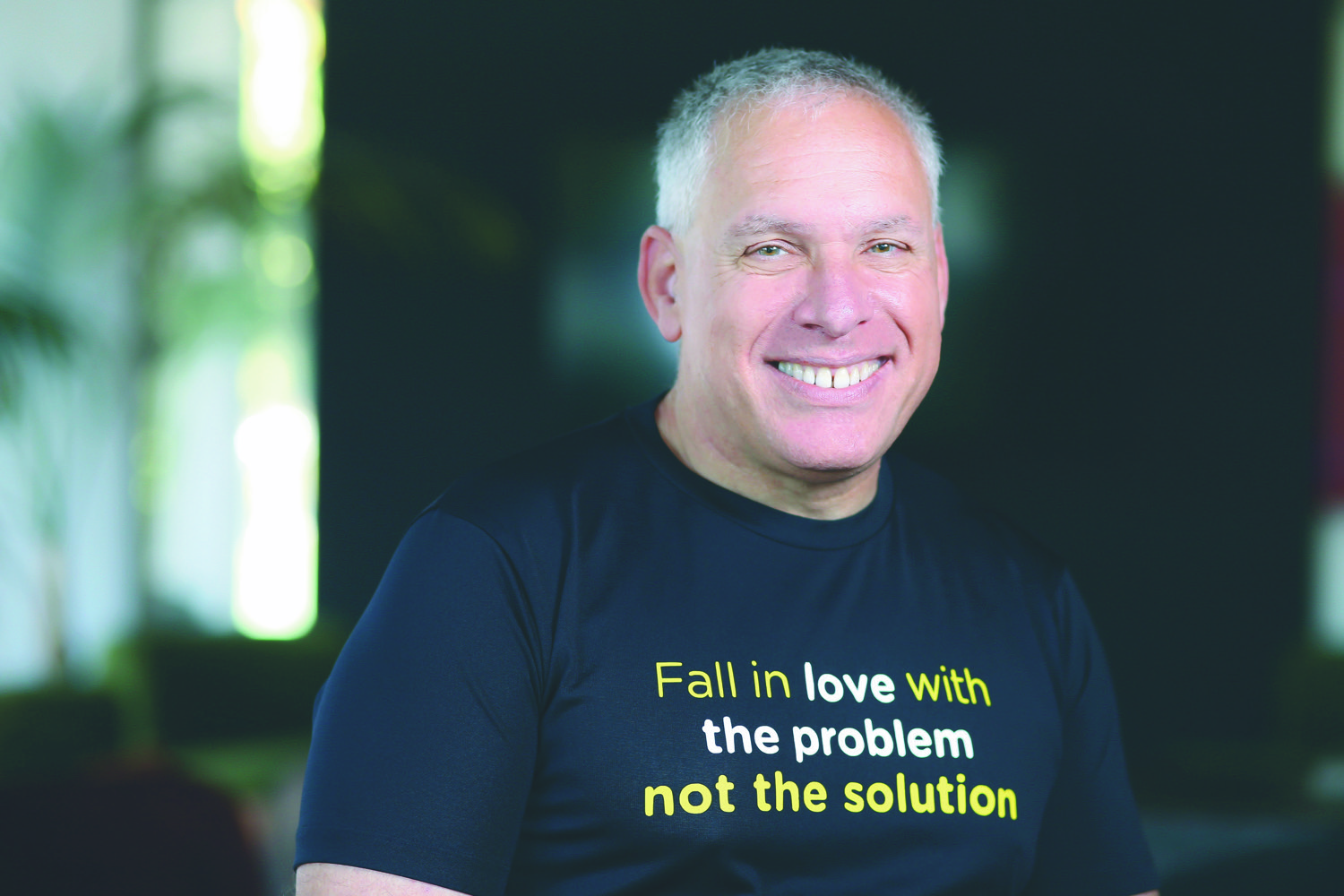
Photo by Orel Cohen
“The Israeli ecosystem is definitely maturing,” says Levine. “People used to focus on the fact that we had more startups per capita than anywhere else. What’s more interesting today is that we have more unicorns per capita, and companies that are staying in the market for longer.”
For Levine, the change is driven by experience. “Entrepreneurs who succeed once are more likely to go again and succeed a second time,” he says. “That changes the overall quality of companies being built.

“This is significant for the maturity of an ecosystem,” he adds. “Experience takes time. There are no shortcuts.”
Levine co-founded Waze in 2007 to help drivers navigate congestion in Tel Aviv. It grew to become one of Israel’s most successful technology companies and was bought by Google in 2013 for $1.15 billion.
Then came Moovit, a kind of Waze for public transport, which he sold to Intel in 2020 for around $1 billion.
Today, Levine leads and invests in multiple companies and works closely with founders as a mentor. He is also the author of Fall in Love with the Problem, Not the Solution, a handbook that draws on his own successes and failures to offer a practical guide to building lasting businesses.
Levine says Israel’s shift towards a scale-up ecosystem has been driven by several forces strengthening at the same time.
“The first is the entrepreneurs themselves. Israeli founders have far greater awareness of global markets and a much lower fear of failure. More people are trying to build companies,” Levine says, “because years of building businesses have shown that failure is part of the process.”
The second is investors. While Levine acknowledges that investment has become more challenging amid war and global uncertainty, he says capital has continued to flow into Israeli tech. Government policy has also played a role, with tax incentives and grants helping to support risk-taking and longer-term company building.
The third cornerstone is engineering talent. “Israel’s deep pool of engineers, shaped in part by early exposure to complex technology, remains one of the ecosystem’s defining strengths. “We have a very strong engineering ecosystem. That hasn’t changed.”
The fourth is experience – the factor Levine believes now separates Israel from where it was a decade ago. “This is where everything changes,” he says. “Experience comes back into the ecosystem. People help other entrepreneurs become more successful. That’s what makes an ecosystem mature.”
One of the clearest expressions of that maturity is a shift in how Israeli founders think about exits.
“Where earlier generations often sold at the first serious offer, today’s founders are increasingly comfortable saying no.” Levine admits that Waze itself received multiple offers before ultimately selling to Google. More recently, cloud security firm Wiz made headlines when it initially rejected acquisition interest from Google in order to continue scaling independently. It has since agreed to a sale by the tech giant.
“If you get to the level where someone wants to acquire you, you’re already becoming significant,” Levine says. “If you keep building, you can become even more significant.”
That mindset has been reinforced by the growing use of secondary share sales, which allow founders to gain liquidity without giving up control or ambition.
“When founders can sell secondary shares, it gives them the power and the desire to keep going. We’re seeing this more and more.”

2025 was a record year for the Israeli tech ecosystem, driven in large part by mega cybersecurity deals: the sale of cyber security company Armis to US enterprise software giant ServiceNow for $7.75 billion, Google’s $32bn agreement to buy Wiz and Palo Alto Networks’ $25bn acquisition of CyberArk.
Still, Levine is clear that success is not sector-dependent.
“If you want to be successful, it really is very simple,” he says. “You need to create value.
That philosophy underpins Double Down, the investment fund Levine recently launched alongside long-time friends and business partners Ariel Sacerdoti and Pasha Romanovski.
The fund is designed to invest in Levine’s own portfolio companies and is targeting a total size of around $30–40 million, with plans to close its first round in later this month (January).
Rather than investing broadly, Double Down is designed to back a tight group of Israeli companies where Levine is already closely involved as a founder, chair or coach, businesses that have “found product-market fit” and are now entering the scale phase.
The portfolio comprises WeSki and Oversee, both travel-tech platforms; Clinii, which applies AI to healthcare; Pumba, a parking app; Dynamo, a software business; SeeTree, an AI-driven farming platform; and Pontera, a pension-management platform that Levine believes has the potential to reach unicorn status.
“When you invest at the beginning, you have the passion but not the confirmation,” Levine says, the author of Fall in Love with the Problem, Not the Solution: A Handbook for Entrepreneurs, a book that Apple co-founder Steve Wozniak wrote the foreword for.
“Once you’ve figured out product-market fit and you know you’re creating value, the opportunities become bigger.”
And while Levine continues to build and invest, he is just as focused on helping others navigate their own journey to success.
Splitting his time predominantly between Israel and Madrid, Levine now spends much of his time mentoring founders, coaching CEOs and lecturing at universities.
“My purpose is about creating value.”
Levine expects 2026 and 2027 to break even more records, as companies that have already found product–market fit move deeper into the scale phase.
“We’re going to see more companies and better results. And more unicorns being built, as the ecosystem’s accumulated experience begins to compound.”
Any of his own? “There’s a good chance one could become a unicorn in 2026,” he says with a smile. “If not, then 2027.”
But for Levine, a unicorn is “just a milestone. It’s part of the journey. If you reach it, it usually means you’re becoming a market leader, but it’s still just a number. What matters is sustained value creation. Scale follows from that.”
Whether Israel formally trades the “Startup Nation” label remains to be seen. What is clearer is that the ecosystem it describes has changed, with more companies now being built to last.
“If you’re creating real value, you don’t need to rush,” Levine says. “Good companies take time.”

Keep community journalism free.
Jewish News is free for everyone. No paywall. No barriers. Just trusted journalism for anyone who wants to stay connected to Jewish life in Britain.
If you value that, please support us.
From as little as £5 a month, you can help keep our journalism free and accessible to all.
Every day, we report on the issues that matter to our community. We celebrate achievements, support charities, challenge antisemitism and ensure Jewish voices are heard more widely.
From as little as £5 a month, you can help us continue to:
- Report on the stories shaping Jewish life in the UK and beyond
- Bring our community together through shared stories, events and campaigns
- Celebrate the people, culture and moments that define our community
- Support organisations doing vital work across Jewish Britain
You can make a one-off donation or become a regular supporter. Every contribution helps keep our journalism free, independent and accessible to all.
If everyone who values Jewish News gave a small amount, it would make a real difference to our future.