Prefer Jewish News on Google
Fifty years on, Six Day War paratrooper on the iconic photo that ‘eternalised history’
Izack Ifat speaks to Jewish News about one of the most famous snaps in Israeli military history, next to the Western Wall upon the unification of Jerusalem
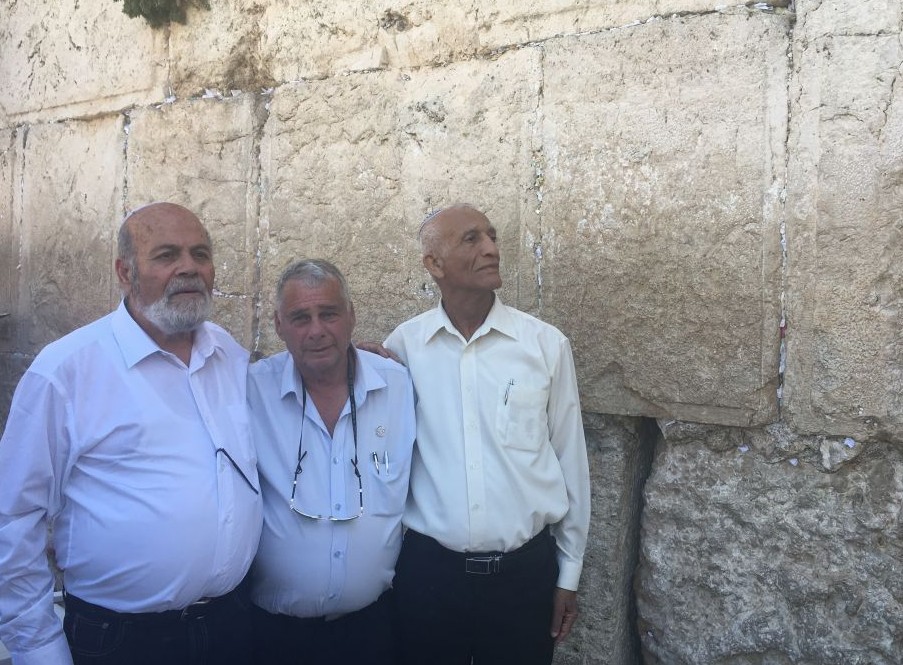
It’s the iconic photo taken in the immediate aftermath of brutal fighting in Jerusalem at the end of the Six-Day War in 1967: three Israeli soldiers first looking upon the Western Wall.
For Izack Ifat, the 24-year old paratrooper in the middle, it was a moment he may never have had, having only an hour earlier survived a bayonet charge from a Jordanian adversary in the battle of Ammunition Hill in East Jerusalem.
Now a retired gynaecologist living in Rishon Lezion, Dr Ifat has ever since answered questions about that photo, and his troop’s fight for the city almost 50 years ago, having become instantly famous as the centre of a trio snapped by photographer David Rubinger.
The photo itself was never really valued by Rubinger, who died earlier this year. At the time he thought little of it and gave it to the Israeli Government’s press office, whose officers disseminated it far and wide. The rest, as they say, is history.
In March, Israeli President Reuven Rivlin said the photo “eternalised history as it will be forever etched in our memories,” and for Ifat, in London this month, those memories are still crystal clear.
“We were planning an operation in Egypt, but as we were about to go in, we were told that the Jordanians had launched an attack on Jerusalem, so we had to get in the bus and go, to everyone’s disappointment,” he recalled this month.
“We arrived with no plan. We were welcomed by women offering coffee, then Jordanian bombing. We approached the west-side of Ammunition Hill under heavy fire, then face-to-face fighting with Jordanian soldiers. It was like hell. I had many friends killed.”
![David Rubinger's famed photograph of IDF paratroopers at Jerusalem's Western Wall shortly after its capture. From left to right: Zion Karasenti, Yitzhak Yifat, and Haim Oshri.[a]](https://static.jewishnews.co.uk/jewishndev/uploads/2017/05/Soldiers_Western_Wall_1967.jpg "David Rubinger's famed photograph of IDF paratroopers at Jerusalem's Western Wall shortly after its capture. From left to right: Zion Karasenti, Yitzhak Yifat, and Haim Oshri.[a]")
“One guy in front of me was hit in the buttocks, he was going to be shot again but I shot the Jordanian soldier first before he could do so. Then all the bullets of my rifle were finished. I wanted to refill it but a Jordanian soldier came at me with a bayonet. Somehow I grabbed it, kicked him between the legs, overcame him and shot him.”
More than 100 soldiers from both sides were killed during the battle, but the Israeli paratroopers who survived continued on through Lion’s Gate, into the Old Town, said Ifat, not knowing where they were going.
“We were in narrow lanes, with Arab house, we didn’t know where, and suddenly we came through a small iron gate and saw it – the Kotel. It wasn’t open as it is now, it was surrounded by houses on all sides.”
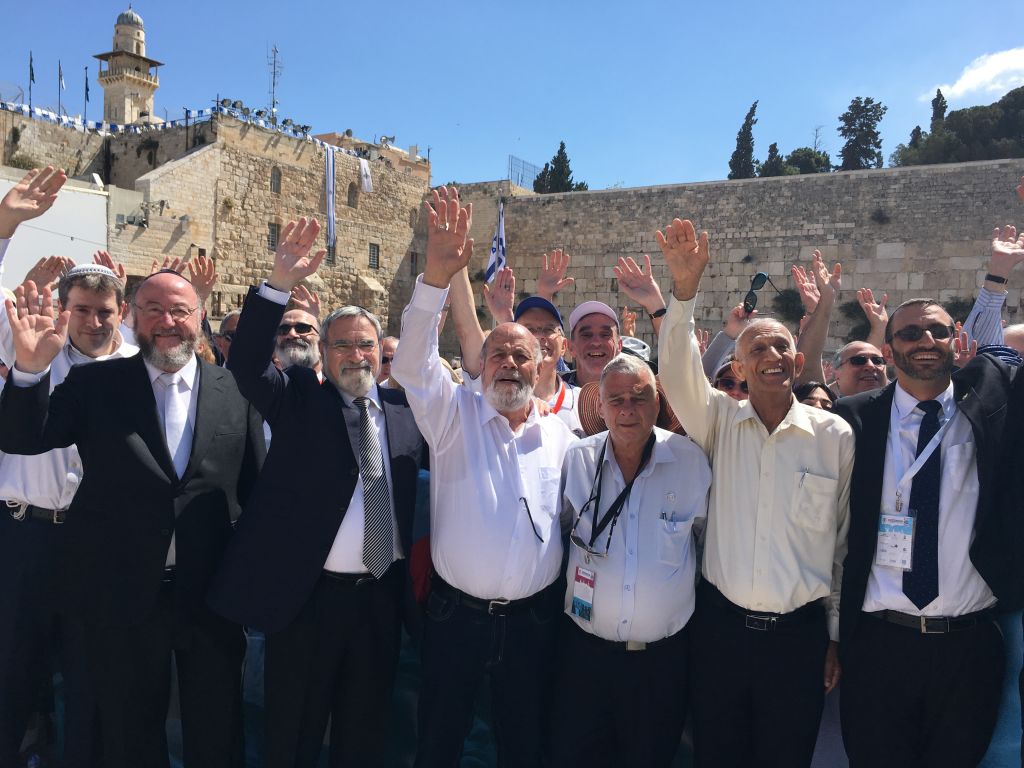
The moment was “very exciting, very emotional,” he said, recalling events. “We didn’t realise we were going that way. My friends had tears in their eyes when they realised what was happening, that we came to the place we’ve been waiting for for 2,000 years.”
An hour later, photographer David Rubinger arrived and took a photo of three soldiers, Ifat and his two fellow paratroopers – Yemen-born Chaim Oshri and Zion Karasenti. Ifat, helmet removed, looks deep in thought. What was he thinking of?
“I was thinking of my grandfather, of Jewish history, of all the stories I was told, all this history was coming to my head. Then I thought of my friends who had just died, including my best friend, Yair Goldberg. We were all so close, like a big family.
“We made a small monument of stones to those who died, then we crossed over to the other side and built another for the Jordanians, because they fought bravely. People forget we did that, because it was taken down, I don’t know by who, but we did. It was important. But it was important also that Jerusalem was now in Jewish hands. For me, it must always be.”

Keep community journalism free.
Jewish News is free for everyone. No paywall. No barriers. Just trusted journalism for anyone who wants to stay connected to Jewish life in Britain.
If you value that, please support us.
From as little as £5 a month, you can help keep our journalism free and accessible to all.
Every day, we report on the issues that matter to our community. We celebrate achievements, support charities, challenge antisemitism and ensure Jewish voices are heard more widely.
From as little as £5 a month, you can help us continue to:
- Report on the stories shaping Jewish life in the UK and beyond
- Bring our community together through shared stories, events and campaigns
- Celebrate the people, culture and moments that define our community
- Support organisations doing vital work across Jewish Britain
You can make a one-off donation or become a regular supporter. Every contribution helps keep our journalism free, independent and accessible to all.
If everyone who values Jewish News gave a small amount, it would make a real difference to our future.