Prefer Jewish News on Google
For almost 50 years, the women of Iran have fought a regime intent on silencing them
While much of the world focuses on the Islamic Republic’s dangerous foreign policy, we must not lose sight of the terror it inflicts at home.
March marks International Women’s Month, and as we mark this moment, we cannot forget the women of Iran, whose struggle for basic freedoms has endured for nearly half a century.
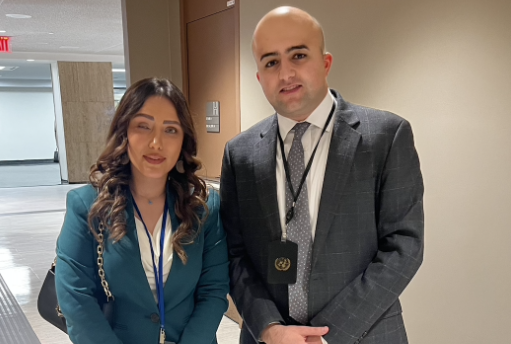
This week at the United Nations, I had the distinct honour of welcoming extraordinary Iranian women—true lionesses—who shared their harrowing testimony about life under a callous regime that has, for the past 47 years, made the subjugation of women central to its identity.
One of them was Raheleh Amiri, a trained psychologist from the south-eastern Iranian city of Kerman. On November 15, 2022, two months after the killing of Mahsa Amini ignited the nationwide “Woman, Life, Freedom” protests, Raheleh joined a demonstration against the regime. What happened next changed her life forever.
She was shot in the right eye at close range by security forces, leaving her permanently injured.
In the aftermath, threats from the authorities intensified not only against her but against her family as well. Faced with relentless intimidation, Raheleh was forced to flee Iran in April 2023. Since then, she has sought medical treatment in Turkey, Italy, and the United States in a desperate effort to repair the damage inflicted by a regime determined to silence dissent.
Yet Raheleh does not speak like someone who has been defeated.



Like many Iranian protesters who have survived the regime’s brutality, she wears her injury as a mark of resistance. On social media, she shows no regrets for standing up to the regime, despite the lifelong consequences she now faces. If given the chance to turn back time, she says she would make the same choice again.
Raheleh was joined at the United Nations by another remarkable voice: Shiva Amini, a former member of Iran’s national futsal team who was forced to flee the country after images circulated online of her playing abroad with her hair uncovered. For that supposed “crime,” she faced relentless threats from the regime.
“My whole life I’ve been threatened by the regime—with rape, death, lashes, and imprisonment,” Amini said.
As a young girl determined to play the sport she loved, she often disguised herself as a boy. She even adopted the male nickname “Shahin” to participate in games from which girls were excluded. Her story is a stark reminder of how deeply the Islamic Republic polices not just women’s bodies but their ambitions, talents, and dreams.
Their testimonies served as a powerful reminder that while much of the world focuses on the Islamic Republic’s dangerous foreign policy—its errant missile launches, drone attacks, and destabilizing proxy activities across the Middle East—we must not lose sight of the terror it inflicts at home.
For millions of Iranian women, the regime’s repression is a daily reality.
This reality, however, did not begin with the protests that followed Mahsa Amini’s death in September 2022. Iranian women have been resisting the Islamic Republic from the very beginning.
On March 8, 1979, tens of thousands of Iranian women took to the streets of Tehran and other cities demanding something profoundly simple: the right to choose what to wear.
It was the first International Women’s Day in post-revolutionary Iran. The demonstrations grew into a six-day standoff between Iranian women and the newly empowered clerical leadership seeking to impose strict Islamic dress codes.
Women marched without headscarves, chanting for freedom and equality, even as they faced harassment, intimidation, and violence from fundamentalist clerics.
What began as a rally became one of the earliest signals that the nascent revolutionary government many had supported was being hijacked.
For many of the women marching that week, the realisation was painful but immediate: the revolution they had helped to materialise #was turning against them.
That moment marked the opening chapter of a resistance movement that has now endured for nearly five decades.
In the years that followed, the Islamic Republic systematically rolled back women’s rights. Family law was rewritten to favour men. Men were granted more rights over women in marriage, divorce, child custody and legal inheritance. Strict dress codes were enforced by morality police tasked with policing women’s appearance in public.
But repression never extinguished resistance. Iranian women continued to push back. They documented abuses as journalists. They challenged norms through literature, art, and activism. Even small acts, like loosening a headscarf, entering male-dominated professions, or singing or dancing in public, became forms of protest.
At times, these acts of defiance erupted into nationwide movements.
The protests sparked by Mahsa Amini’s death in September 2022 became one of the most significant challenges to the Islamic Republic in decades. Women and girls led the uprising, removing their hijabs in public, cutting their hair in symbolic acts of mourning and protest, and confronting security forces on streets and university campuses across the country.
In my book, Unveiled: Inside Iran’s #WomanLifeFreedom Revolt, I explore how this movement represents both the continuation of a decades-long struggle and a profound generational shift. Young Iranian women who grew up under the Islamic Republic are now rejecting the system outright.
Their bravery echoes the courage of the women who marched on International Women’s Day in 1979.
The connection between those two moments is not accidental. From its inception, the Islamic Republic’s authority has been deeply tied to controlling women’s bodies and restricting their freedoms. And gender oppression became a pillar of the regime’s ideological identity.
With Iranian women now challenging that control, they have challenged the legitimacy of the regime itself. That is why the state responds so harshly, with beatings, imprisonment, disappearances and executions.
And yet the resistance continues.
The women who spoke at the United Nations this week, women like Raheleh Amiri and Shiva Amini, represent the unbreakable spirit of a movement that refuses to disappear.
Nearly half a century after tens of thousands of women marched through Tehran on International Women’s Day demanding the freedom to choose their own future, their daughters and granddaughters continue the fight with remarkable bravery.
Their message remains as powerful today as it was in 1979: freedom cannot be permanently suppressed, and those who fight for it will not be silenced.

Keep community journalism free.
Jewish News is free for everyone. No paywall. No barriers. Just trusted journalism for anyone who wants to stay connected to Jewish life in Britain.
If you value that, please support us.
From as little as £5 a month, you can help keep our journalism free and accessible to all.
Every day, we report on the issues that matter to our community. We celebrate achievements, support charities, challenge antisemitism and ensure Jewish voices are heard more widely.
From as little as £5 a month, you can help us continue to:
- Report on the stories shaping Jewish life in the UK and beyond
- Bring our community together through shared stories, events and campaigns
- Celebrate the people, culture and moments that define our community
- Support organisations doing vital work across Jewish Britain
You can make a one-off donation or become a regular supporter. Every contribution helps keep our journalism free, independent and accessible to all.
If everyone who values Jewish News gave a small amount, it would make a real difference to our future.