Prefer Jewish News on Google
‘Gap’ in law being filled to enable government to proscribe Iran’s Revolutionary Guard
Foreign Office minister Hamish Falconer was pressed in the Commons on a government pre-election pledge to ban the IRGC

The government’s independent reviewer of state threats legislation has identified a “gap” in law which is now being filled to enable the proscription of Iran’s Revolutionary Guard Corps, a minister has said.
Foreign Office minister Hamish Falconer was pressed in the Commons on a government pre-election pledge to ban the organisation which has been directly linked to at least 20 foiled terror plots in the UK since 2022, according to MI5’s director-general Ken McCallum.
In a report published earlier this year Jonathan Hall KC recommended that the Government should be able to issue “statutory alert and liability threat notices” against foreign intelligence services.
“By way of example, this strong power would be available for use against the Islamic Revolutionary Guard Corps”, he wrote, referring to the Iran-backed organisation.

It would be a “new proscription-type power”, similar to existing terrorism legislation used to ban organisations such as Hamas and National Action, the reviewer said.


When Labour MP for Newcastle-under-Lyme Adam Jogee asked Falconer to “elaborate a little more on what that means”, the minister replied: “A state in this case has proved a persistent threat in the UK using methods unlike those usually employed by a state.”
He said the Government was “seeking to fill” the gap in the law.
For the Conservatives Dame Priti Patel has urged ministers to “come off the fence” over whether US air strikes on Iran “were absolutely necessary” last month.
The Conservative frontbencher pressed Falconer for details about the “UK’s response to the actions of the Iranian regime” in the Commons on Monday.
It followed Operation Midnight Hammer last month, an air raid when US defence forces attacked Iranian nuclear sites near Fordo, Natanz and Isfahan.
“Two weeks have passed since the US air strikes against Iran’s nuclear facilities,” shadow foreign secretary Dame Priti said.
“Does the minister have an assessment of their impact, and what is his response to the Iranian regime now prohibiting co-operation with the IAEA (International Atomic Energy Agency) and their inspectors leaving Iran?
“Given Tehran’s refusal to co-operate, is the minister and the department in discussions with the partners about snapback sanctions being applied (by reinstating UN sanctions on Iran removed through the 2015 Iran nuclear deal) and other measures?
“Is he concerned that demonstrates that Iran will continue to pursue nuclear weapons and their entire programme?
“And with the information received from discussions with America, Israel and other intelligence partners, will the Government finally come off the fence about those strikes and agree with this side of the House that they were absolutely necessary?”
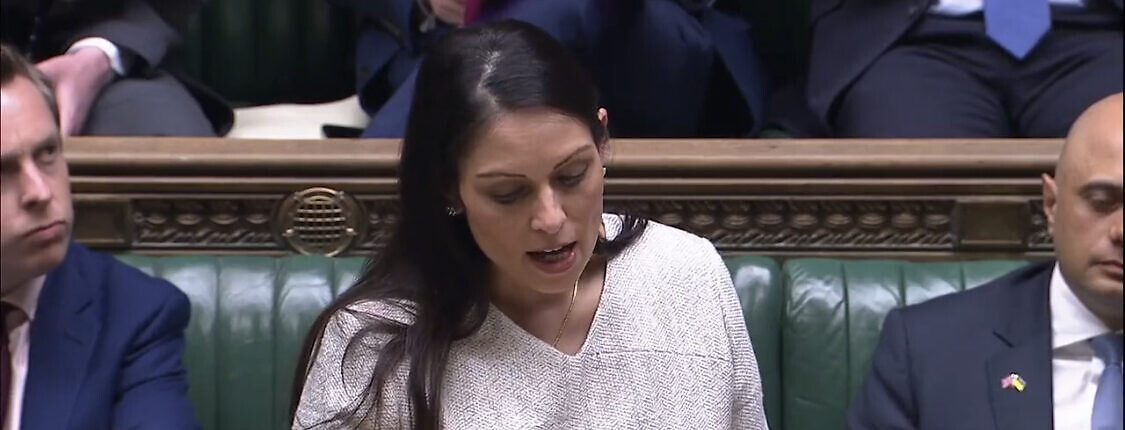
Falconer replied: “I won’t provide, I’m afraid, a detailed commentary from the despatch box on the extent of damage from the strikes, for reasons that I’m sure (Dame Priti) and the rest of the House will understand.
“I can confirm we are in discussions about the snapback mechanisms. As the Prime Minister (Sir Keir Starmer) has said, as the Foreign Secretary (David Lammy) has said, as I have said, we cannot see Iran get a nuclear weapon – snapback is an important lever.
“We’re talking with our E3 partners and indeed the Americans about what role snapback can play.
“We hope to see a diplomatic solution. That is ultimately the most enduring way to ensure that Iran does not get a nuclear weapon, but we will continue to consider all diplomatic tools including snapback.”

Keep community journalism free.
Jewish News is free for everyone. No paywall. No barriers. Just trusted journalism for anyone who wants to stay connected to Jewish life in Britain.
If you value that, please support us.
From as little as £5 a month, you can help keep our journalism free and accessible to all.
Every day, we report on the issues that matter to our community. We celebrate achievements, support charities, challenge antisemitism and ensure Jewish voices are heard more widely.
From as little as £5 a month, you can help us continue to:
- Report on the stories shaping Jewish life in the UK and beyond
- Bring our community together through shared stories, events and campaigns
- Celebrate the people, culture and moments that define our community
- Support organisations doing vital work across Jewish Britain
You can make a one-off donation or become a regular supporter. Every contribution helps keep our journalism free, independent and accessible to all.
If everyone who values Jewish News gave a small amount, it would make a real difference to our future.