Prefer Jewish News on Google

Golders Green, antisemitism and Passover
A major incident of hate hits differently when you know the neighbourhood
On 9 October 2023, 48 hours after Hamas infiltrated southern Israel and carried out its own personal vision of what a “free Palestine” should look like, residents of Golders Green, which has one of the largest Jewish communities in Britain, woke up to find those two words daubed above railway bridges in the neighbourhood.
As with so many things, context matters. And the fact that someone had seen fit to scrawl those words at that time and place, above the motor and pedestrian traffic of Golders Green Road and Finchley Road, was obviously antisemitic. Why? Because those responsible were sending a clear message to as many Jews as possible, 2 days after the largest massacre of Jews since the Holocaust. They might as well have written “you’re next”.
And they had written it a 5 minute walk from the house where I grew up.
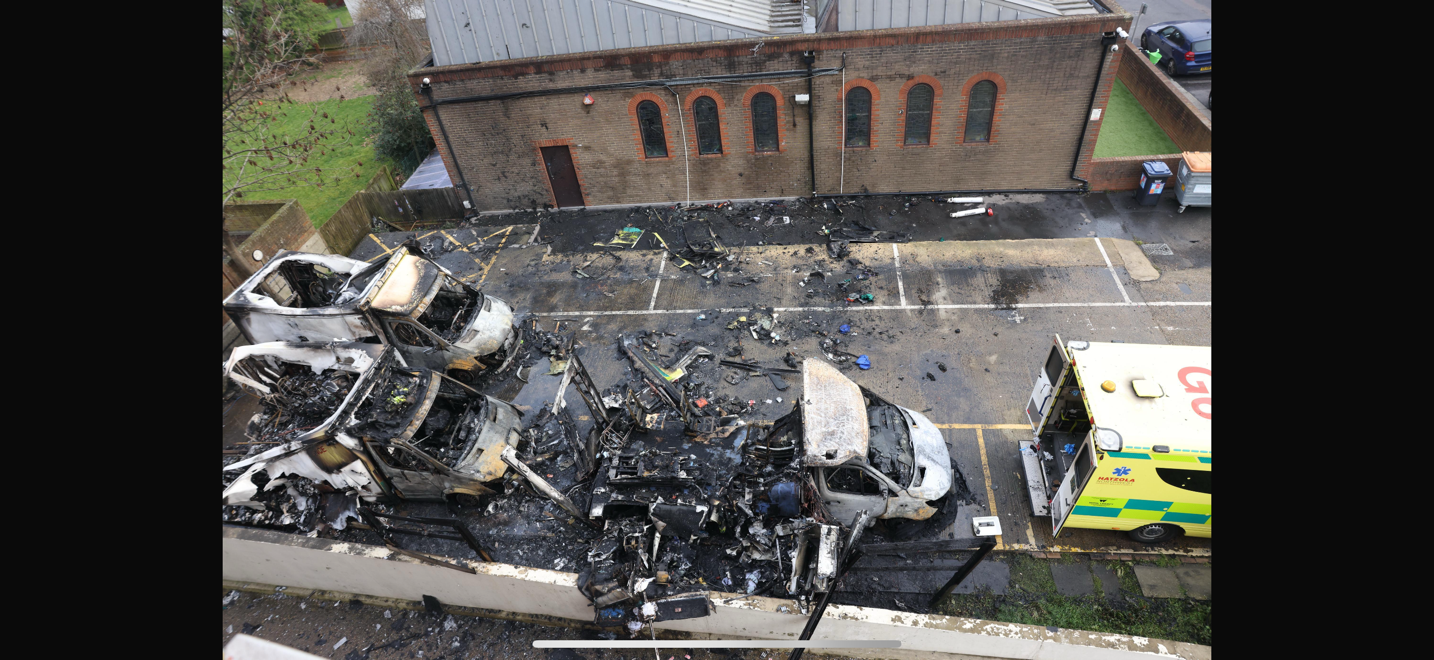
A major incident of hate hits differently when you know the neighbourhood. Fast forward two and a half years to today, where in the early hours of this morning, Hatzola ambulances in their lot in Golders Green were firebombed.
This afternoon, a Detective Chief Superintendent of the Metropolitan Police gave a speech in front of that lot. Behind him was the Machzikei Hadath Synagogue – and yes, there were the stained glass windows. I used to sit on the other side of one of them, because my grandfather was a member of that Shul and I used to go there with him sometimes on Shabbat, when I was little. The ambulances were parked there at that time as well, but I never really thought about them being there – why would I? They were just present, a part of life – and then suddenly they were there no longer, replaced by one of the most senior police officers in London and representatives of every major news outlet in the country.

Except in the most heinous cases, I rarely think about the aftermath of a hate crime on the surrounding location. What we might call ‘low-grade’ antisemitic hate crime was a fixture of life for me growing up in Golders Green, and if I wanted, I suppose I could go around the neighbourhood fixing various points in my mind – this was the spot on Golders Green road where someone yelled “Free Palestine, f***ing Zionist” at me late on a Friday night as I walked home, dressed in my suit and black hat (I grew up strictly Orthodox). This is the location further up the same high street where a man approached myself, my father and mother, flicking his cigarette lighter in our faces before sneering, “f***ing Jew” and walking off. The 83 bus was at this particular place on the route when a group of teens started shouting “Jew” at me on the bus, increasingly aggressively (fortunately I was getting off at the next stop and was by the exit doors.) The bigotry was dispensed liberally, by people from a variety of different ethnicities – their hate was the one thing they all had in common.
But this time it felt different. The ambulances were parked on Highfield Road – around a minute’s walk from the largest Kosher supermarket in North West London. The thoughts that run through your mind as you are processing this sort of attack can be disjointed, and among the considerations that went through mine was “this is going to wreak havoc on people’s Passover shopping.” It wasn’t an entirely random thought – I was there yesterday morning, in that shop, doing my own pre-Pesach bulk buy of Matzah and marvelling at the sheer range of foodstuffs that are now kosher-for-Passover, catching myself channelling older generations as I found myself telling my 5-year old daughter, “when I was your age, they didn’t have any of this Passover Pizza nonsense.” I just hope that one day, years from now, she’ll be able to visit the same shop with her child and tell her something similar. But these days I’m far less certain of our future here than I once was.
In a little more than a week, we will sit at the Passover table to conduct the seder. We will tell our children the story of the Exodus from Egypt. The people of Israel were honoured in Egypt – Joseph served as the Imperial viceroy – until it all came crashing down. What happened? The book of Exodus, quoted in the Haggadah, the telling over of the Passover story, tells us. “A new king arose, who did not know Joseph”. Did he literally not know who Joseph was? Unlikely. But Joseph – and his service to Egypt, helping protect the populace from the ravages of famine – meant nothing to him. The Bible goes into detail about what was the first instance of antisemitism in history – the charge, repeated so many times down the millennia, of dual loyalty.
“Let us deal wisely with them”, says Pharaoh to his people. “In case they increase in number and a war befall us and they join our enemies and wage war against us.”
A little later on in the Haggadah, we will read the paragraph of Vehi Sheamdah, which says “in every generation, our enemies rise up to destroy us”. It would be taken as paranoia were it not demonstrably true. The last few years have seen a sickening sanitisation of Jew hate in public life. In an era where every antisemitic attack is followed by a tidal wave of accusations of false flags and dual loyalty, where Jews are blamed for the very attacks they are targeted by, this takes on a new meaning.
That paragraph of the Haggadah ends by saying “and the Holy One, blessed be he, rescues us from their hands.” Returning momentarily to my charedi upbringing, the word for “rescues us” – matzilenu – has the same Hebrew root as the name of the organisation whose ambulances were firebombed – hatzola – literally, “rescue”. At the time I write this, more than £1 million has been been raised for Hatzola NW, raised by thousands of people, Jewish and non-Jewish alike – and the government has pledged to replace all the ambulances that were destroyed.
Those who seek to intimidate us and bring us down will find it far harder to do so than they think.

Keep community journalism free.
Jewish News is free for everyone. No paywall. No barriers. Just trusted journalism for anyone who wants to stay connected to Jewish life in Britain.
If you value that, please support us.
From as little as £5 a month, you can help keep our journalism free and accessible to all.
Every day, we report on the issues that matter to our community. We celebrate achievements, support charities, challenge antisemitism and ensure Jewish voices are heard more widely.
From as little as £5 a month, you can help us continue to:
- Report on the stories shaping Jewish life in the UK and beyond
- Bring our community together through shared stories, events and campaigns
- Celebrate the people, culture and moments that define our community
- Support organisations doing vital work across Jewish Britain
You can make a one-off donation or become a regular supporter. Every contribution helps keep our journalism free, independent and accessible to all.
If everyone who values Jewish News gave a small amount, it would make a real difference to our future.