Prefer Jewish News on Google
Hidden Jewish medieval cemetery discovered beneath Barbican
EXCLUSIVE: An interfaith group launched over tea at St Giles’ Rectory is championing the history of the 1,000 year old site with support of grant from Corporation of London

A medieval cemetery hidden beneath the Barbican for hundreds of years is being brought back to life by a dedicated group of volunteers.
The Jewish Square Mile project is shining a light on a beautiful, but neglected space by the remains of the City of London’s ancient wall, a wall begun by the Romans and re-built and expanded during the Dark Ages and the Middle Ages.
The Barbican Estate’s Thomas More Garden marks the furthest southwards extent of the 1,000 year old Jewish cemetery, the first Jewish burial ground in England.
The cemetery existed until the Jews’ expulsion from the country in 1290, an edict announced on Tisha B’Av of that year to be completed by All Saints’ Day. After that, the cemetery and the generations buried in it were neglected, desecrated and then forgotten.

Howard and Gaby Morris, founder members of the The Jewish Square Mile project, tell Jewish News: “The burial ground existed as a rumour, a legend. Now the ancient burial ground has been found. Gaby and I heard the story when we moved into the Barbican but it was Father Jack Noble of St Giles Cripplegate, the very old church actually in the Barbican (where Oliver Cromwell was married) who, by word of mouth, drew together a group of Jewish residents to find out if there really was a cemetery and its location.”



The group now comprises people of all faiths and none who live and work in and around the Barbican area, including a medievalist historian and writer, researchers, architect Jan-Marc Petroschka, plus musicians and composers.
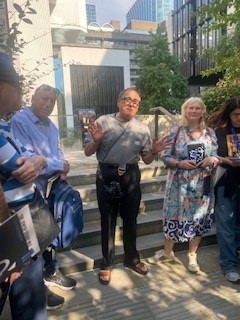
Howard says: “The Jews were brought to London by William soon after the Norman occupation. They weren’t free but lived under the protection of William. They didn’t even own the hair on their heads. They were permitted a place to bury their dead according to our customs and beliefs. That must have given them some sense of permanence and community.”
The goal of the Jewish Square Mile project is to “rediscover those people, their lives and the contribution they made to the City.”
The group aim is to “help show the impact and contribution of Jewish Londoners then and since” and in so doing “move on from the stereotypes of medieval Jews like Isaac and Rebecca in Ivanhoe or Shylock, as usurers.”

On 5 June next year, the project launches a two week exhibition within the church of St. Giles, alongside the unveiling of a plaque in the Barber-Surgeons’ Garden.
A Jewish choir will sing some liturgical music in the Moat Theatre of the City of London School for Girls.
Howard Morris adds: “The exhibition will go far beyond simply identifying the location of the cemetery and the dates of its history. We will bring the medieval Jewish community to life, show the contribution they made to the success of the City following the conquest of England by William and over the next 200 years until Edward I expelled the Jews from the country.

“We’ll cover the massacres and persecutions and the expulsion but also explore the lives of the people, how the community lived, their families, their education, their culture and in this way aim to get past the ghastly stereotype of the Jewish usurer.”
This will all take place within the Barbican estate, and Morris adds that “importantly, the project is the work of residents of the City and Jews who work in the City.”

The Reverend Canon Jack Noble of St Giles Cripplegate tells Jewish News: “I initiated this project and gathered the beginnings of what would become the Jewish Square Mile team over tea in St Giles’ Rectory, because it was so clear that this was important, and needed responding too. It came as a surprise to many of them!”
Commenting that the project “unearths vital realities of our Jewish heritage, not just for The City, but of national significance”, Reverend Noble adds: “I am honoured to be something of a ‘token gentile’ in this amazing group of people – residents, workers, academics, school children, musicians, historians – who have become friends as we reveal and share this Jewish Square Mile story. What will success look like? Well, a joy of this project has been celebrating the past, present and future of Jewish life in the Square Mile, for the good of all.”
Other parts of the historic site lie below the City of London School for Girls and adjacent lake stretching south below Mountjoy House, the Barber-Surgeons’ Gardens and the former Museum of London. The only publicly accessible part of the burial ground lies below the Gardens although the entire area can be viewed from the Defoe House and Wallside Highwalks.
- To find out more, visit https://www.thejewishsquaremile.org/

Keep community journalism free.
Jewish News is free for everyone. No paywall. No barriers. Just trusted journalism for anyone who wants to stay connected to Jewish life in Britain.
If you value that, please support us.
From as little as £5 a month, you can help keep our journalism free and accessible to all.
Every day, we report on the issues that matter to our community. We celebrate achievements, support charities, challenge antisemitism and ensure Jewish voices are heard more widely.
From as little as £5 a month, you can help us continue to:
- Report on the stories shaping Jewish life in the UK and beyond
- Bring our community together through shared stories, events and campaigns
- Celebrate the people, culture and moments that define our community
- Support organisations doing vital work across Jewish Britain
You can make a one-off donation or become a regular supporter. Every contribution helps keep our journalism free, independent and accessible to all.
If everyone who values Jewish News gave a small amount, it would make a real difference to our future.