Prefer Jewish News on Google
SPECIAL REPORT: The man who saw 168 people return from hell
Glenn Cohen, drafted into the IDF’s Hostage Negotiations Unit after 7 October, tells a UK audience: 'We need to see the returning hostages not as victims, but as survivors'
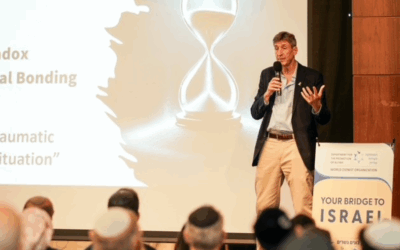
“I met 168 people who went to hell and came back.”
Glenn Cohen doesn’t mince his words. Frantically drafted into the IDF’s Hostage Negotiations Unit when disaster struck Israel, the former chief psychologist of the Mossad’s gentle mannerism masks a steely resolve.
“There was no protocol on 7 October. It was complete chaos.”
Cohen’s task was daunting: the first mental health professional to debrief the hostages upon their return. A responsibility, seemingly, full of contradictions.
“We had to balance giving the hostages a ‘soft landing’, but we also needed to secure critical, life-saving intelligence about others left behind. There are tensions between these goals.



“I had a powerful memory of the trauma faced by POWs coming back in 1973 after facing captivity during the Yom Kippur War. Their biggest trauma wasn’t their captivity. It was the way they were treated upon their return.
“They were locked up in a compound and interrogated for two weeks. I said to myself, we must make sure this is a different experience.”
Cohen’s response was to draft an unprecedented new protocol. He coined a new phrase: ‘humanitarian intelligence’.
“Imagine a diver resurfacing after scuba diving. They go through a slow, decompression process as they surface.
“Similarly, little by little, we exposed the released hostages to stimuli, people and noises.”
Critically, the first people the hostages met upon their release into Israel were their families.
“One of the most important things is to bring comfort to the families and this is based on our Jewish values. Humanitarian intelligence is important as well as operational intelligence.”
Only thereafter would his team debrief the hostages for critical information. No other country in the world treats hostages this way, Cohen proudly explained.
Addressing over 300 people at an evening event co-hosted by the JLC, World Zionist Organization and BEACON, with Jewish News as the media partner, there were numerous audible gasps as Cohen recounted unimaginable stories of resilience from the hostages.

Remarkably, some hostages developed the exact same survival tactics taught to specially trained elite units in the IDF.
“We need to see the returning hostages not as victims, but as survivors. These people are incredibly resilient.
“Captivity is traumatic, but it is also interpersonal. Your captor is still a person. If you realise that then you can influence them, get on their good side and get your captor to do things which makes your captivity easier.”
Cohen explained that there are five core common denominators exhibited by many of the hostages: belief, realism, emotional intelligence, control and togetherness.
He cited the example of one hostage who acted like a handyman for his captors. They consequently looked after him, becoming so reliant on him that they struggled once he was freed.
Another hostage found control even in captivity. Looking for ‘small wins’- a critical survival tactic according to Cohen- one individual who was only afforded a shower once a month for two minutes found a way to extend their shower to three minutes.
Another ensured they put their own shackles on. This avoided the captors’ forcing chains on them too tightly.
A 15-year-old hostage started a ‘push-ups’ competition with his captor. Other children in captivity made up amusing nicknames for their captors.
Perhaps most remarkably, Cohen added, many of the hostages found moments of growth in captivity.
“Most of the hostages won’t experience Post Traumatic Stress Disorder (PTSD)- some will even experience Post Traumatic Growth.”
For every remarkable claim, Cohen cites an example, each more startling than the next. For example: “One of the hostages learnt Arabic whilst in captivity. He is now returning to the IDF in a more senior position.”
Concluding the evening, Cohen nonetheless warned of substantial challenges ahead during what he termed the “aftershock”.
“Conservative estimates state that there are around 500,000 Israelis living with PTSD. The reality is that nearly every household either witnessed something on 7 October or has a family member in combat.
“This is a huge problem and, unfortunately, we don’t have enough resources to support everyone individually.
“We don’t need equipment anymore. We now need help on the softer side of our nation’s recovery.”
BEACON is a Jewish professional community with over 1,200 members networking together. Partners include leading real estate, legal and accountancy firms.

Keep community journalism free.
Jewish News is free for everyone. No paywall. No barriers. Just trusted journalism for anyone who wants to stay connected to Jewish life in Britain.
If you value that, please support us.
From as little as £5 a month, you can help keep our journalism free and accessible to all.
Every day, we report on the issues that matter to our community. We celebrate achievements, support charities, challenge antisemitism and ensure Jewish voices are heard more widely.
From as little as £5 a month, you can help us continue to:
- Report on the stories shaping Jewish life in the UK and beyond
- Bring our community together through shared stories, events and campaigns
- Celebrate the people, culture and moments that define our community
- Support organisations doing vital work across Jewish Britain
You can make a one-off donation or become a regular supporter. Every contribution helps keep our journalism free, independent and accessible to all.
If everyone who values Jewish News gave a small amount, it would make a real difference to our future.