Prefer Jewish News on Google

I told Cambridge Union the truth about Palestine many did not want to hear
Jonathan Harounoff argued against a Cambridge Union motion last week that 'This House Believes that the international community has failed/betrayed Palestine'. Here is his speech
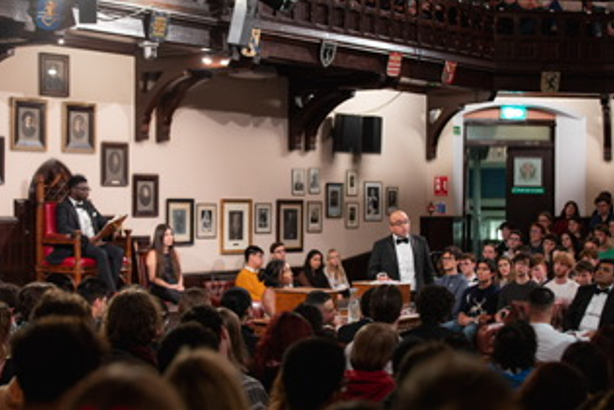
Good evening and thank you for the invitation to be here tonight.
Mr President, quite frankly, the narrative before us has become so familiar, so repetitive, that it is hardly questioned anymore.
It is auspicious that this Saturday marks 78 years since a moment that could have rewritten history entirely — Resolution 181, the UN Partition Plan.
Two states. Two homelands. A shared land. A shared future.
The Jewish leadership accepted the plan — not because it was perfect, but because peace demanded compromise.



As early as 1937, David Ben Gurion wrote to his son Amos: “All our aspiration is built on the assumption – proven throughout all our activity … that there is enough room in the country for ourselves and the Arabs.”
By contrast, the Arab leadership rejected any attempt at peace outright and rejected the existence of Israel in any borders at all.
Much will no doubt be said tonight about how the Partition Plan was “unequal,” “unfair,” or “drawn to favour the Jews.” But that critique ignores the actual history, and that most of the land the Jews were to receive was the barren Negev desert.
The very concept of partition only emerged after the 1936–37 Arab Revolt in which hundreds of Jews and numerous British officials were murdered, and in which it became unmistakably clear that Arab leaders would not accept any arrangement that involved sharing the land with a Jewish minority.
Partition became necessary because Arab violence made coexistence impossible.
Even on the eve of the UN vote, borders and percentages of land were not the issue occupying the minds of the Arab representatives. Aba Eban (a Cambridge alum) recalled speaking with the Arab League Secretary General at the time, which was representing the Arab population of Palestine during negotiations.
The Secretary General told him plainly that quote “War is absolutely inevitable.” That this was a matter of quote “historic pride.” Historic pride, NOT independence, were the operative motivations behind the ensuing war. Victory over what they saw as “the weak Jews”, not a sovereign Palestine.
From that ‘inevitable war’ for ‘historic pride’, the Jewish people faced the death of more than one percent of their global population, having already suffered the genocidal devastation of the Holocaust.
Simultaneously, hundreds of thousands of Palestinian Arabs were displaced due to the refusal of Arab leaders to see Jews as equal partners in the long struggle for self-determination.
The Partition Plan and its collapse marked the first concrete step the international community took to secure Palestinian statehood and self-determination. But it would not be the last.
So if we are to decide whether the international community failed Palestine, then we must examine each opportunity and how the bodies representing the Palestinians failed, time and again, to reach a peace deal and thereby failed to reach self-determination.
History shows clearly that from 1947 onward, the most decisive blows to Palestinian national aspiration came not from outside, but from within: from Arab states storming into war at every opportunity, from factionalism and widespread corruption, and from leaders far more committed to eliminating Israel than to building a viable state.
Criticism today from mainstream bodies usually focuses on Gaza and the West Bank/Judea and Samaria but people forget the twenty years of relentless Arab opposition when Israel did not govern these areas at all.
They were under Egyptian and Jordanian control. During those two decades, an independent Palestinian state was barely discussed, because Pan-Arabism, not Palestinian nationalism, ruled the day.
This evening, it is worth talking about agency and accountability, and about ending the pretence that the absence of Palestinian prosperity is solely the fault of outsiders, while absolving Palestinian leaders of every decision they themselves made.
But I know how debates like this one unfold. I saw it as a student here ten years ago when this Chamber voted that Israel was a rogue state. I watched speaker after speaker in favour of the motion demonise and delegitimise Israel, without once asking why Palestinian leaders had betrayed their own people and failed to deliver the freedom they promised.
Some in this room still criticise the United States and the Trump administration for its role in the region – as if President Trump did not just secure a breakthrough in achieving the release of all the living hostages held by Hamas in Gaza and in pressuring Hamas to negotiate.
And yet there is barely a word of condemnation for the genocidal jihadists who slaughtered Israelis on 7 October and kidnapped civilians from their homes and subjected them to starvation, torture and sexual abuse for more than seven hundred days.
It is almost as if the “Ceasefire Now” activists who flooded the streets of London, Cambridge, New York, and other cities these past years were not actually interested in peace, but in something far darker.
We dissect every Israeli mistake under a microscope, while Palestinian leadership is granted an impunity that would be unthinkable if we truly believed Palestinians deserved accountable government.
Israel is not perfect. No democracy is. But it is the only state in the Middle that has repeatedly offered peace at the end of wars it did not begin; the only state that has endured invasion, boycott and terror, and still said: “Let us talk. Let us find a way to live together.”
Now contrast this with Gaza’s political history. Hamas won an election in 2006, and then elections ceased. Because Hamas shut the ballot box. And that election took place at a time when Hamas was throwing its Palestinian political opponents off rooftops and shooting them in ambulances.
After that came the rockets. Came the tunnels. Came a jihadist dictatorship cloaked as “resistance.” Gaza became a bunker state — its leaders living in luxury hotels abroad, its people left to struggle. Dissent was criminalised. Citizens silenced. And when courageous Gazans dared to rise up against Hamas this past May? They were rounded up and executed in the streets.
Since the Oslo process began in the 1990s, forty billion dollars in foreign aid has been distributed to the Palestinians. Aid that could have built a functioning economy, a stable state and a real future.
But those billions disappeared into corruption, tunnels, rockets and stipends rewarding murder. And the world looked away.
If your neighbour elected a militant organisation openly committed to your destruction, would any state on earth lift restrictions and allow unfettered shipments of Iranian missiles through its ports? Of course not.
No one here would argue that Britain should have allowed the IRA to import explosives uninspected. No one would argue that France should have permitted ISIS supply chains through Marseille. And yet Israel is expected to do exactly that: a moral exceptionalism applied only to the world’s one Jewish state.
Now let us remember 7 October, 2023 – the worst massacre of Jews since the Holocaust.
That day also marked the deadliest concert attack in recorded history.
A day so barbaric that many still cannot bring themselves to describe it fully.
It was an unthinkable tragedy for Israelis and, yes, for Palestinians too.
Because Hamas provoked a war it could never win. Hamas showed the world it cared more for its own murderous aims than for the safety of Gazan civilians.
Ask any Gazan today what Hamas is negotiating for: aid trucks they already had before the war; movement they already had before the war; IDF pullbacks to lines that already existed. Their so-called “resistance” produced nothing but ruin.
Meanwhile, in Judea and Samaria/West Bank, Mahmoud Abbas governs the Palestinian Authority in the nineteenth year of his four-year term. His approval rating is fifteen percent. Palestinians overwhelmingly want him to resign. Tens of billions in aid have vanished while Ramallah’s elite live in palatial villas.
And yet the accusation persists that the international community somehow failed Palestine, rather than Palestinian leaders failing their own people.
That brings us to the United Nations: the great moral stage where I work.
Year after year, resolution after resolution, more condemnations of Israel than the Islamic Republic of Iran, North Korea and Venezuela combined.
Palestine is not neglected at the UN. It is exalted. It is championed. It is politically fashionable. In diplomatic terms, supporting “Palestine” is the lowest-cost foreign policy stance one can take.
And yet what concrete outcomes came from this indulgence? What new hospitals? What infrastructure? What state? What future?
Even UNRWA, the agency created to safeguard Palestinian welfare, does not resettle refugees, it preserves refugee status indefinitely, across generations. No other refugee agency on earth does this. No other people are told their displacement is hereditary, eternal and unresolvable.
How did we get here? Because Palestinian leadership has insisted that the international community continue to enable, stand in solidarity and excuse, rather than demand the reform, responsibility and accountability that it takes to govern.
That is the real failure. The protection rooted in the low expectations of leaders who have no objective other than murder and/or personal enrichment.
The peace process did not collapse because the world lacked will. It collapsed because when Israel said yes to Camp David in 2000, Arafat walked away and launched the Second Intifada. When Israel offered near-total withdrawal in 2008, Abbas declined.
As President Clinton said of the 2000 process: “Arafat walked away from once-in-a-lifetime peace opportunities. You cannot walk away from peace and then, twenty-five years later, complain the doors have closed.”
The truth, if we are willing to speak it, is this: the international community gave Palestinians opportunity after opportunity – and their leaders refused to walk through the door.
So let us be honest tonight. This motion is seductive because it absolves everyone. Everyone except Israel. It creates a narrative in which Palestinians are passive objects, not political agents; where history is something done to them, never by them. But that narrative strips Palestinians of political dignity. It says: “You are not responsible for your future, OTHERS are.”
And I reject that.
I stand here tonight not against Palestinians, but for the future they could have had. A future robbed by their leaders, not the generous and sometimes naïve nations that put their faith in jihadists.
Peace will not emerge from fantasy. It requires accountability.
The international community did not fail Palestine. Palestinian leaders failed Palestine: repeatedly, consistently and catastrophically.
And until this truth is spoken, until we stop infantilising Palestinians and start expecting from their leaders what every sovereign people demands of its own, there will be no free Palestine.
So, Mr President, for the sake of truth, for the sake of peace, and for the sake of both peoples, I urge this House to oppose the motion.

Keep community journalism free.
Jewish News is free for everyone. No paywall. No barriers. Just trusted journalism for anyone who wants to stay connected to Jewish life in Britain.
If you value that, please support us.
From as little as £5 a month, you can help keep our journalism free and accessible to all.
Every day, we report on the issues that matter to our community. We celebrate achievements, support charities, challenge antisemitism and ensure Jewish voices are heard more widely.
From as little as £5 a month, you can help us continue to:
- Report on the stories shaping Jewish life in the UK and beyond
- Bring our community together through shared stories, events and campaigns
- Celebrate the people, culture and moments that define our community
- Support organisations doing vital work across Jewish Britain
You can make a one-off donation or become a regular supporter. Every contribution helps keep our journalism free, independent and accessible to all.
If everyone who values Jewish News gave a small amount, it would make a real difference to our future.