Prefer Jewish News on Google
INTERVIEW Sir Sajid Javid: We must get Holocaust lessons into more schools than ever before
EXCLUSIVE: Ex-Conservative minister tells Jewish News of his ambitious goals as Holocaust Memorial Day Trust chair
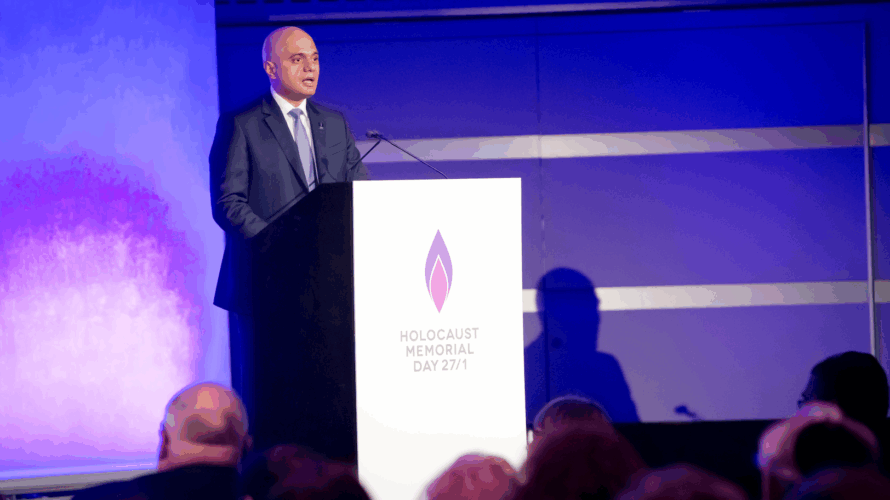
Former Conservative minister Sajid Javid has given his first full interview since becoming chair of the Holocaust Memorial Day Trust (HMDT), setting out his determination to get the number of school children engaged with learning the lessons of the Shoah back up to levels “higher than ever before”.
Javid, 57, who took over from Laura Marks CBE as the organisation’s new chair last July, told Jewish News how the “weaponisation” of the word genocide since the October 7 Hamas attacks in 2023 had been the “number one reason” for a worrying decline in the number of schools signing up for events commemorating Holocaust Memorial Day.
The former Home Secretary, Chancellor, and Communities Secretary, who developed a close relationship with Jewish communal organisations throughout his political career as he regularly spoke out against rising antisemitism, also gave a unique insight into the importance he has placed on teaching his own children about the horrors and lessons to be learnt from the Nazi Holocaust.
In a wide-ranging interview, Javid disclosed that one of his daughters was left distraught after an online assembly on the Holocaust she hosted at her school was infiltrated by US neo-Nazis, who beamed a swastika onto her projections.
With his first Holocaust Memorial Day events only days away, Javid was both realistic about the challenges ahead, but also very driven to achieve new successes for HMDT.



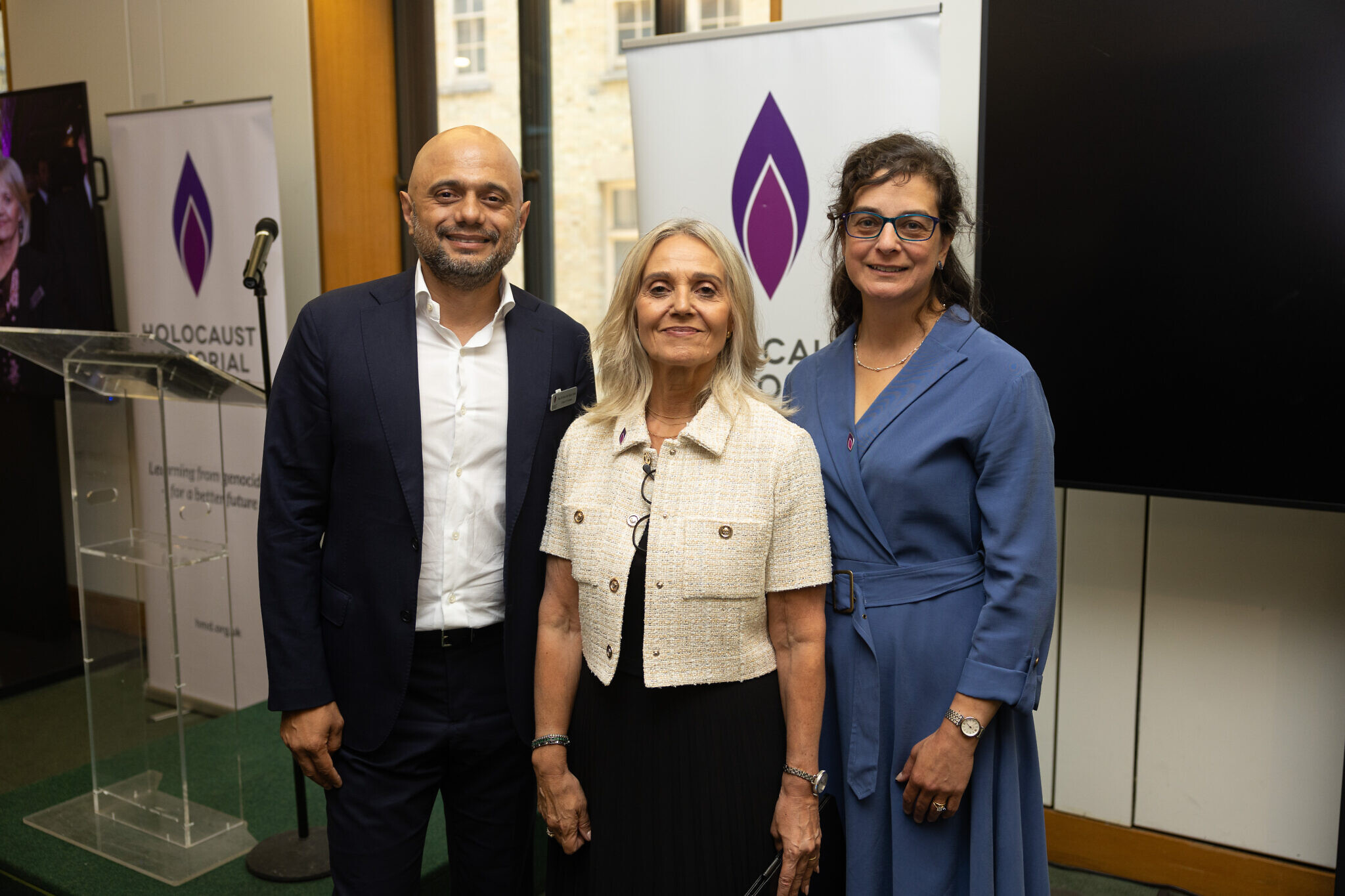
He acknowledged how, since the October 7 Hamas terror attack, there had been a drop in the number of schools participating in Holocaust Memorial Day events.
“Sadly, the numbers [of schools marking Holocaust Memorial Day] have gone down in the last couple of years,” he admitted. “First, I want to have an ambition to get it back up to where it used to be. But then, even go beyond that… It’s ambitious, but that’s what we’re about.”
A report in The Times revealed more than 2,000 secondary schools around the UK had signed up to events commemorating Holocaust Memorial Day in 2023, which takes place on January 27, according to data from the Holocaust Memorial Day Trust.
Until that year, those taking part had increased annually since 2019. But since the terrorist attacks by Hamas, the number of participating schools fell to fewer than 1,200 in 2024 and 854 in 2025—a reduction of nearly 60 per cent. There are signs that this decline has begun to stabilise this year, though.
Asked about recent figures, Javid said, “We hope [numbers have stabilised], because that’s our intelligence at the moment. Obviously, on the one hand, stabilisation is better than going down, but it’s still not good enough, because we need to go back in the other direction, in an upward direction.”
Addressing the impact of the political rhetoric in the aftermath of October 7, Javid was blunt. “Sadly, the word ‘genocide’ has been weaponised,” he said.
“It’s being massively misused, and it has had an impact on Holocaust commemoration and education, but specifically for us, on Holocaust Memorial Day, and getting more participation in schools. So I would say the number one reason is that the use of that word has led to us having fewer schools.”
He continued: “As an organisation, we are absolutely clear that anyone who attaches the word genocide to Gaza is a gross misuse. It’s weaponisation, it’s political in many cases. And we’re not going to have any trouble with that, and we’re not part of that in any way.”
Looking ahead, Javid said of his goals in his first three years as HMDT chair, “I’d love to be able to look back in a few years, in the role I’ve played, and feel that I’ve made some difference.
“And where I’d like to make a difference is in two big areas. Number one: schools. I really believe passionately that the more we can get the younger generation engaged and involved in this, the better.
“So I want to focus on schools. I want to get those school numbers higher than they’ve ever been before, despite what’s happened. Number two, help bring about more cooperation in the sector, so that we can leverage each other’s limited resources more and collectively impact more people. I hope I’m well-trusted and respected enough that I can help bring people together.”
Javid was quick to praise his predecessor, Laura Marks, who had been HMDT chair for the maximum nine years, and credits her for encouraging him to take the role.
He had shocked Westminster in 2022, quitting Boris Johnson’s government and stepping down as an MP ahead of the next election.
“I’ve always worked really hard to do everything I can to fight antisemitism, to fight racism. In every job I had in government, I tried to do something,” Javid said, recalling his time in politics, adding: “So part of that meant I wasn’t surprised that the door was asking, would I be interested?”
But he also acknowledged, “I’m not Jewish, right, and every chair before that at HMDT had been Jewish.”
Javid continued: “Laura made a really good point. She said, ‘Listen, honestly, we are trying to reach the 99.5% of the population that are not Jewish in this country and convince them about the horrors of the Holocaust.
“‘What’s relevant is, you know, will you do a great job for us and make a difference, right?’
“And that’s why I was happy to take it.”
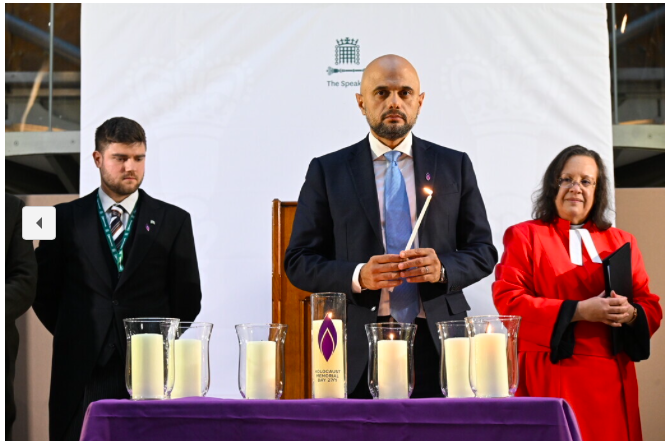
With next week’s Holocaust Memorial Day approaching, Javid said, “This is my first Holocaust Memorial Day itself.
“This stuff next week, I’m very much looking forward to that. We’ve got fantastic plans. We’ve got a brilliant team, led by Olivia Marks-Woldman, and I think this year’s Holocaust Memorial Day will be both poignant and will make an impact.”

Javid balances the Trust with his finance career and co-chairs the Independent Commission on Community and Cohesion with Jon Cruddas.
“Part of the Commission’s job is to try and bring people together in this country’s division,” he said. “Naturally, at this time—November, December, now January—is the height of involvement, because we’re working towards a national ceremony, all the HMD ceremonies around the country that will happen in schools, workplaces.”
He also explained how he hoped to place a renewed focus on partnership.
“A very important part of our job is to support schools, but one of the initiatives that we will have going forward is to really focus a lot more on schools to get those numbers up… I also want to work more closely and cooperate more with other charities, organisations that support our broad aims… HET, the Anne Frank Trust, they are great charities, and they work in schools a lot,” he said.
Javid said he wished to emphasise the organisation’s shared mission. “Our centrality for all three of us is the importance of both, of course, commemorating the Holocaust, never forgetting, but also using it to educate the living, especially young people,” he added. “So I want to cooperate more as well.”

He also reflected on the dwindling number of Holocaust survivors, as the years pass since the horror of the Second World War.
He said:“As time goes on, sadly, we lose witnesses, survivors. I’ve been very lucky, a privilege in my life so far, to meet many survivors during my government days and now. For example, in our national ceremony next week, we will hear some testimony from survivors. I think that is important.”
As a result he described the need for HMDT and other organisations to foster “second-hand witnesses”
“I have long believed that when a young person, for example, hears directly from a survivor, they must become like a second-hand witness,” he said.
“One survivor I’m very close to is Harry Spyro… I took my children, all my children, to meet with him, because I wanted them to hear from him directly about what happened to him, his story. It was so impactful. They studied the Holocaust.
“They heard about it, of course… but to hear from Harry, and I will say, I’m not embarrassed to say that my girls, they were in tears, and one of them then went with HET to the Auschwitz visit. Became an ambassador with HET.”
Javid also shared a deeply personal and troubling incident involving one of his four children – daughter, Rania.
“She did a Holocaust Memorial Day for her school for the very first time,” he recalled. “It was during COVID, and she asked her school whether she could hold a Holocaust Memorial Day for the first time at her school.
“The head said, yes, absolutely. Very supportive, but they had to do it online because of COVID.
“She did a presentation, a video, and everything that she presented to the whole assembly. And then after it ended, she came to me in tears.
“I said, ‘What’s happened? How did it go?’ She said, ‘I was doing my presentation live to all the students, showing my slides. And suddenly the screen changed, and a swastika appeared on the screen.’”
Javid continued, “They called me to explain, and he said we called the police, and the police investigated what they found—it was a neo Nazi group in the United States that had seen an online event in the school’s online calendar. They worked out how to get into Zoom and do that. And I sat her down, and I said, ‘Rania, this actually underlines the importance of what you did today. But the fact that some antisemites did what they did, yes, it shows you why you need to keep doing this.’”
He said this harrowing experience inspired the Trust’s Next Generation Ambassadors Programme.
“Because learning from Rania, I thought we should get ambassadors in schools to specifically, you know, to be in school children to say, I will be in charge of working towards Holocaust Memorial Day each year from my school, my neighbouring school, stuff,” said Javid.
“So we’ve just started that this year, and you’ll be hearing a lot more about that,” he explained.
Javid also highlighted his belief in the importance of meaningful participation.
“We also get people to sort of participate and do something rather than just listen, which is important, obviously, the more they feel part of it,” he said.
“And that’s why we have the Light the Darkness moment on Holocaust Memorial Day at 8 pm—the whole country to light a candle in their window, or even a digital candle, to appeal to young people.
“And we hope the participation in that will be the highest ever. We’re going to advertise that—you’ll be seeing billboards around the UK, hearing adverts on the radio, and stuff.”
Reflecting on his broader hopes for unified approach to tackling division and hatred in society Javid said, “What I would like to see is everyone, regardless of their background, their race, their religion, no religion, whoever they are, to unite against bigotry and racism of all types—antisemitism, but also anti-Muslim hatred, also racism against black people—whoever.
“All racism is wrong, and I abhor, I think, like, hopefully, like most people, all types of racism. But we are also, sadly, operating in a world where there’s more division, and there’s growing antisemitism.”
He continued; “Holocaust Memorial Day—it can’t be just about commemorating the dead. That is hugely important to always do that, but it’s just as important, if not more important, to educate the living, right?
“The Holocaust was the murder of six million Jewish men, women, and children who were murdered by the Nazis and countless others.
“But in today’s world, when you look at what happened in Cambodia, Rwanda, Bosnia, Sudan—that kind of race-based atrocities, they continue.”
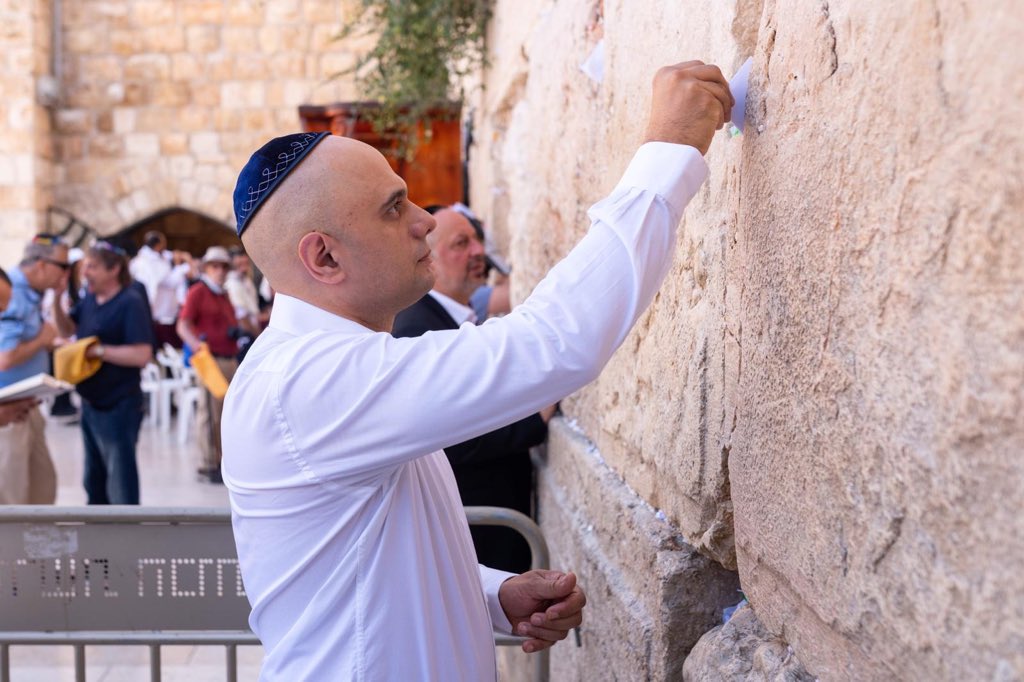
In the midst of such awful global conflicts Javid called for deeper collaboration between the charities in this country working on bringing home to young people in particular the need to challenge hatred.
“First of all, I don’t think there’s competition; there’s definitely more scope for cooperation and working together. Whether it’s what we do, HET does, Anne Frank does, Weiner Library does—right?
“We are all trying to remind British people, especially, of the horrors of the Holocaust, and educate the next generation, educate people today, and we’re doing it in different ways.
“For example, what HET does—the visits to Auschwitz for school children, like my own children, I think, is super important.
“The Weiner Library, what they do, what Anna Frank does on prejudice, and what we do, obviously, around HMD itself. But I do think we can cooperate more.”
He added, “I’m surprised that there isn’t a joint database that we all have, of what schools we’re in, who we’re talking to, what we’re doing.
“It’s pretty basic, right? Share the information so we can leverage each other’s resources. Make that money go further and impact more lives if we cooperate more.”
Turning to the rise of extremism and populism, both on the far-right and far-left of the political spectrum Javid said, “I’m very concerned. Back to my point about division.
“Unfortunately, today, we’re in a world where people—social media especially—promote using comments of people who take extreme views and then magnify them.
“Populism, whether it’s on the left or the right, is equally damaging. Just the other day, I saw someone show me on social media, it was a video of US influencers… singing Hitler songs. When you step back and think about that, what has the world come to?”
As a result, he said he remains firmly focused on the Trust’s mission.
“What that does is underline the importance of the work that we’re doing,” he reasons. “It’s never been so important in living memory. Holocaust commemoration, education, and remembrance have never been more important than they are today.”

Keep community journalism free.
Jewish News is free for everyone. No paywall. No barriers. Just trusted journalism for anyone who wants to stay connected to Jewish life in Britain.
If you value that, please support us.
From as little as £5 a month, you can help keep our journalism free and accessible to all.
Every day, we report on the issues that matter to our community. We celebrate achievements, support charities, challenge antisemitism and ensure Jewish voices are heard more widely.
From as little as £5 a month, you can help us continue to:
- Report on the stories shaping Jewish life in the UK and beyond
- Bring our community together through shared stories, events and campaigns
- Celebrate the people, culture and moments that define our community
- Support organisations doing vital work across Jewish Britain
You can make a one-off donation or become a regular supporter. Every contribution helps keep our journalism free, independent and accessible to all.
If everyone who values Jewish News gave a small amount, it would make a real difference to our future.