Prefer Jewish News on Google
Ireland’s Chief Rabbi slams country’s ‘demonisation’ of Israel over settlements bill
The Irish government has downplayed the possibility of severe economic ramifications from the United States if such a bill is passed
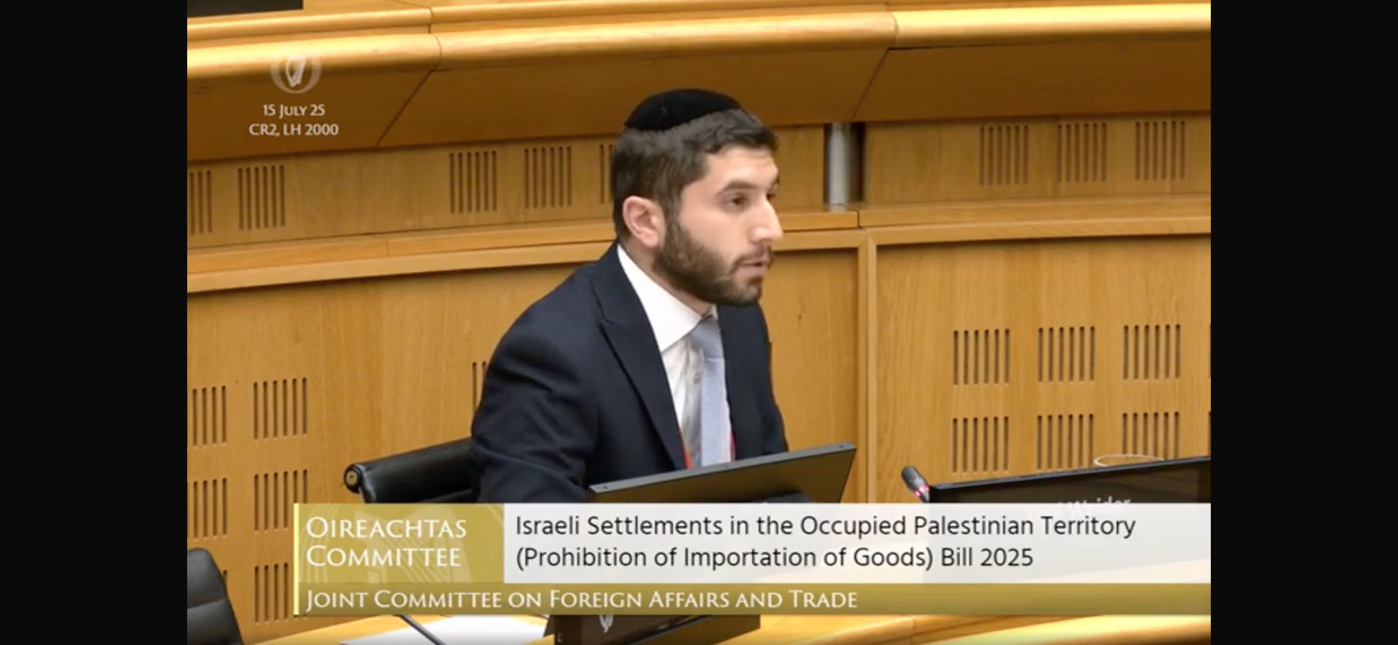
The Chief Rabbi of Ireland has accused the country’s leadership of “demonising” Israel while “courting” the Iranian regime, as the Irish government considers a national ban on West Bank settlement goods.
The proposed ‘Occupied Territories Bill’, which is currently being debated in the Oireachtas [Irish Parliament] foreign affairs committee, seeks to specifically ban trade in goods between Ireland and Israeli settlements. It does not currently include a ban on trade in services, although it is widely anticipated that committee members will attempt to add that to the intended legislation. The Bill enjoys bipartisan support in Ireland and is expected to go before the Dail [the lower, principal chamber of the Irish Parliament] in autumn.
It is understood that one of the goals of the legislation is to start a precedent for more EU states to pass similar boycotts, mostly of a symbolic nature .
The Chief Rabbi of Ireland, Yoni Wieder, who addressed the Irish Parliament’s Foreign Affairs Committee on the issue last week, told Jewish News: “This bill, like much of the political rhetoric that has emerged from the Oreichtas in response to the war, singles out and demonises Israel, while doing nothing to hold Hamas accountable”
“Ireland has warmed its relationship with the Iranian regime, an actor deeply complicit in the events of 7 October. Less than a year after Iran facilitated the Hamas massacre, Ireland opened an embassy in Tehran.

“In July of last year, President Higgins sent a condolence letter to Iran for the death of Ebrahim Raisi—a dictator responsible for torture and mass murder and many other evils.
“This is the regime Ireland is courting diplomatically, while intensifying condemnation of Israel.”
Israel withdrew its ambassador, Dana Erlich, from Dublin last year in protest of the Irish government’s anti-Israel stance—one of the reasons cited was the governing party, Fianna Fáil, allowing this Bill – originally proposed by independent Senator Frances Black – to be taken forward by the legislature.
While Ireland is unlikely to feel ramifications in the EU if it passes such as bill, there is a significant possibility of severe repercussions affecting its relationship with the United States.
More than 30 US states have passed strict anti-BDS laws , including bans on investment of state funds in companies that support BDS activities. In some cases, there are also prohibitions on companies which support BDS operating in or doing business with such states.
Jewish News understands that a legal analysis distributed to Ireland’s foreign affairs committee by B’nai B’rith International, a US-based Jewish advocacy and social service organisation, specified these laws in a document distributed to the Oireachtas foreign affairs committee.
It said: “A company doing business in Ireland, and required to comply with the 2025 Act, may find itself unable to comply with the laws of US states with which they do business, or be subject to divestment by state pension funds.”
Federal United States law regarding Israel boycotts is even stricter. Nationally, since 1977, the Export Administration Regulations and Internal Revenue Code 999 bans American-run companies from taking actions “with intent to comply with, further, or support any boycott fostered or imposed by any foreign country, against a country which is friendly to the United States and which is not itself the object of any form of boycott pursuant to United States law or regulation.”
What the Irish Bill defines as occupied includes areas that the US recognises as part of Israel, including, allegedly, the neighbourhood in Jerusalem in which the US embassy is located.
The same B’nai B’rith analysis stated: “Given US state and federal anti-boycott laws, the current US administration’s strong political support for Israel, and its antipathy for BDS activity, enactment of the 2025 Act will create significant liability risks for companies including, as always, from the inevitable negative publicity attendant to the investigation of alleged violations of US federal or state laws.”
US ambassador to Israel Mike Huckabee went so far as to accuse the Irish government of being drunk, posting on X: ““Did the Irish fall into a vat of Guinness and propose something so stupid that it would be attributed to act [sic] of diplomatic intoxication? It will harm Arabs as much as Israelis. Sober up Ireland! Call the Israeli Ministry of Foreign Affairs and say you’re sorry!”
Tens of thousands of Palestinians, albeit in low-wage jobs, are believed to currently work on Israeli West Bank settlements.
According to a poll published in today’s Irish Times, the country’s public has become slightly more cautious of the bill upon being informed of the potential economic consequences from the United States.
Currently there are 971 registered United States companies operating in Ireland, employing over 300,000 people and investing more than 41 billion euros into the Irish economy, according to the US Chamber of Commerce. Ireland is well known as a low corporate tax haven for multinational companies, including Accenture, Apple, Google, Microsoft and Pfizer – many of whom have based their European headquarters in Dublin as a result
The Irish government has maintained that the economic ramifications of passing its settlements bill would be “minimal” .

Keep community journalism free.
Jewish News is free for everyone. No paywall. No barriers. Just trusted journalism for anyone who wants to stay connected to Jewish life in Britain.
If you value that, please support us.
From as little as £5 a month, you can help keep our journalism free and accessible to all.
Every day, we report on the issues that matter to our community. We celebrate achievements, support charities, challenge antisemitism and ensure Jewish voices are heard more widely.
From as little as £5 a month, you can help us continue to:
- Report on the stories shaping Jewish life in the UK and beyond
- Bring our community together through shared stories, events and campaigns
- Celebrate the people, culture and moments that define our community
- Support organisations doing vital work across Jewish Britain
You can make a one-off donation or become a regular supporter. Every contribution helps keep our journalism free, independent and accessible to all.
If everyone who values Jewish News gave a small amount, it would make a real difference to our future.