
 Prefer Jewish News on Google
Israel tops region in Global Talent Index against challenging backdrop
The UK slips to 12th place as Singapore overtakes Switzerland for the number one spot

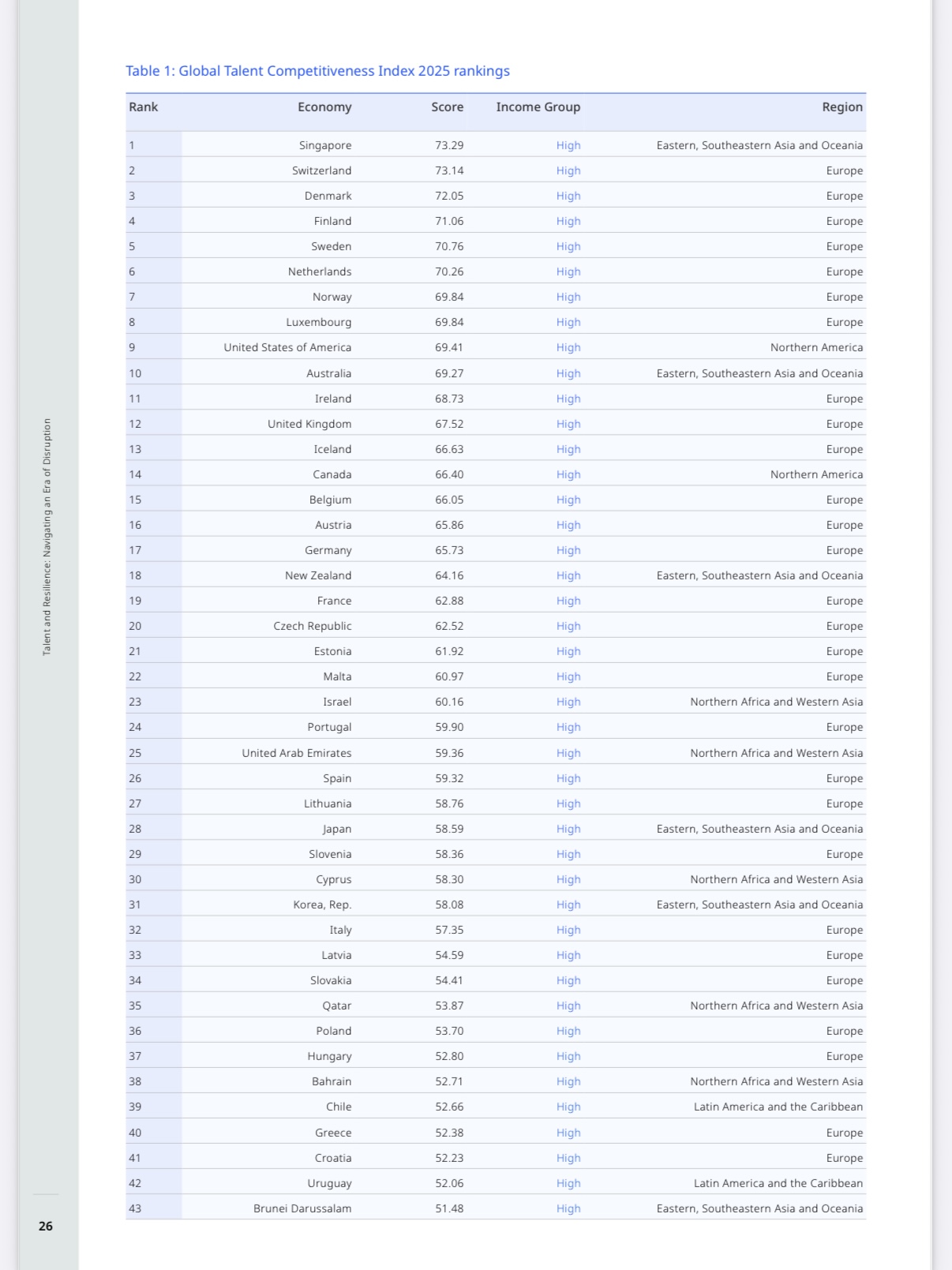
Israel has been ranked 23rd in the world for its ability to attract and retain skilled workers, according to the latest Global Talent Competitiveness Index (GTCI) from INSEAD, the leading French business school. The startup nation also claims first place across the entire North Africa and Western Asia region, beating countries with far larger economies.
Themed “Resilience in the Age of Disruption”, this year’s GTCI – the 11th since 2013 – examines how nations and economies are building talent systems capable of weathering disruptions.
Published in collaboration with the Portulans Institute for Research in Washington, it ranks 135 economies based on 77 indicators, including AI-worker concentration to leadership skills, digital readiness and innovation capacity.
The report highlights Israel’s world-class talent ecosystem, especially in R&D, high-tech skills and its ability to retain senior and technical talent. Israel’s workforce ranks strongly in both mid-level and high-level skills, reflecting the country’s long-standing strengths in innovation, engineering and managerial capability.
According to the report, Israel “demonstrates particular strength in retaining talent, as well as in both mid-level and high-level skills, reflecting a workforce equipped for professional, managerial, and leadership roles.”
But the strong regional result comes with a sting. Israel’s national score is being dragged down sharply by concerns over political instability and low tolerance toward immigrants. Israel plunged to 124th out of 135 countries on the stability indicator, one of the weakest performances recorded among otherwise advanced economies.
The United Kingdom, meanwhile, has fallen out of the global top ten, landing in 12th place in the 2025 index.
The UK still performs well on education, talent attraction and business environment, but its decline mirrors a wider European pattern of slipping competitiveness amid global shifts in migration, digital skills and openness.
Singapore took the number one spot worldwide, overtaking long-time leader Switzerland for the first time. Wealthy European nations still dominate much of the top tier – Switzerland, Denmark, Finland, Sweden, the Netherlands, Norway and Luxembourg all sit in the top 10, but the rise of Singapore underscores how agility, digital infrastructure and government efficiency increasingly shape global talent power.
Israel’s 23rd-place finish positions it well above many larger economies and reflects the country’s sustained strength in nurturing a high-tech workforce, even amid political uncertainty and security challenges. Its regional top ranking further cements its status as the Middle East’s leading innovation hub.

Keep community journalism free.
Jewish News is free for everyone. No paywall. No barriers. Just trusted journalism for anyone who wants to stay connected to Jewish life in Britain.
If you value that, please support us.
From as little as £5 a month, you can help keep our journalism free and accessible to all.
Every day, we report on the issues that matter to our community. We celebrate achievements, support charities, challenge antisemitism and ensure Jewish voices are heard more widely.
From as little as £5 a month, you can help us continue to:
- Report on the stories shaping Jewish life in the UK and beyond
- Bring our community together through shared stories, events and campaigns
- Celebrate the people, culture and moments that define our community
- Support organisations doing vital work across Jewish Britain
You can make a one-off donation or become a regular supporter. Every contribution helps keep our journalism free, independent and accessible to all.
If everyone who values Jewish News gave a small amount, it would make a real difference to our future.





















