Prefer Jewish News on Google
20-point plan to tackle antisemitism presented to ministers
Board of Deputies, Jewish Leadership Council and Union of Jewish Students say measures announced after the Yom Kippur attack are welcome but fall short of what is needed to keep community safe

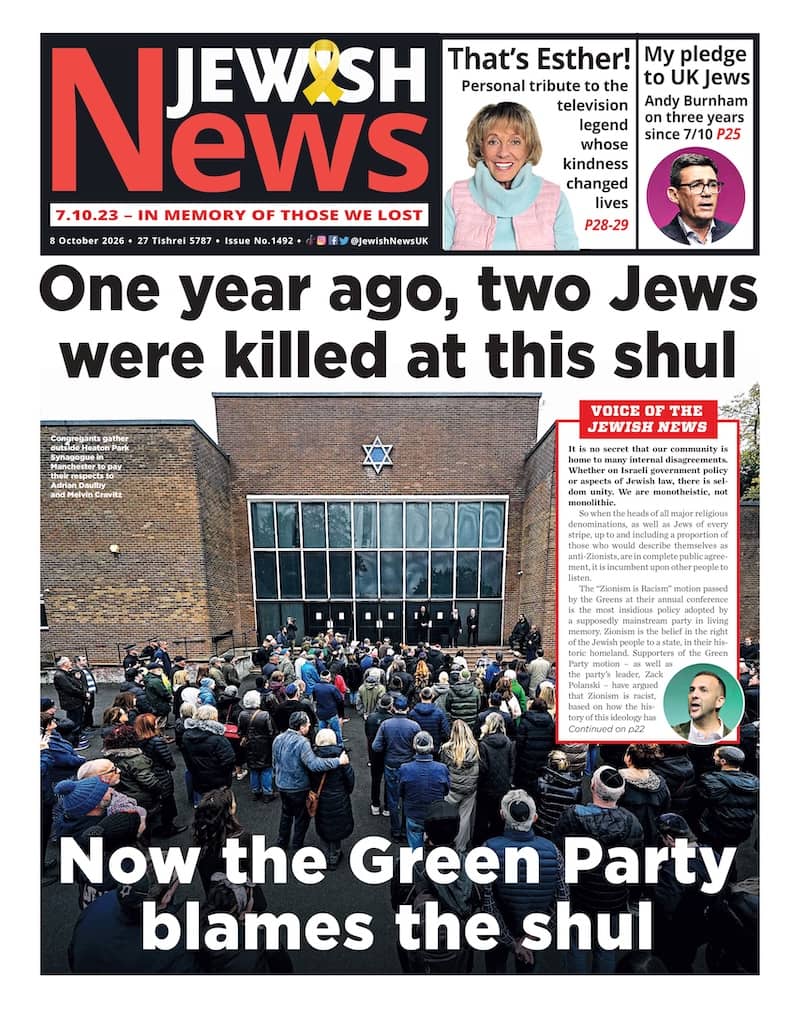
Jewish community leaders have called on ministers to adopt a sweeping national strategy to tackle antisemitism after the Yom Kippur terror attack at Heaton Park Synagogue in Manchester, arguing that the UK must act against the extremist ideology which motivated the kilings.
A new policy document – After the Heaton Park attack: Towards a Comprehensive Government Strategy on Antisemitism – has been jointly issued by the Board of Deputies of British Jews, the Jewish Leadership Council (JLC) and the Union of Jewish Students (UJS), following consultations with the Community Security Trust and others, including detailed proposals for policing, education and online regulation.
It sets out urgent priorities across policing, extremism, universities, and civil society, warning that while the government’s initial response has been appreciated, “emergency steps alone will not be sufficient to meet the long-term, society-wide challenge” posed by antisemitism in the UK.
The paper highlights the need for sustained visible policing around synagogues and schools, tougher enforcement on violent rhetoric at protests, greater powers for the Charity Commission to shut down extremist fronts, and tighter rules to confront harassment and incitement on university campuses, including chants such as “Global Intifada” and “Khaybar, yaa Yahood” which call for violence against Jews.
The document also calls Islamist antisemitism “the ideological threat” behind the Heaton Park attack, and urges action against groups linked to Muslim Brotherhood or supported by hostile foreign states such as Iran. It recommends expanding Prevent training to recognise antisemitic radicalisation, including from far-right and far-left movements.



On education, the groups want clearer consequences for harassment such as “Zionists are not welcome here”, police intervention when protests disrupt campus life, and contemporary antisemitism added to the national curriculum.
Board of Deputies President Phil Rosenberg said the killings of Melvin Cravitz and Adrian Daulby on Judaism’s holiest day were a devastating blow to British Jewish life, adding: “We have seen a series of welcome announcements from the Government. However, these measures on their own will not be sufficient to meet the long-term-society-wide challenge of confronting antisemitic hatred. We need to see a Comprehensive Government Strategy on Antisemitism, and this paper points the way to what that should include.”
JLC chair Keith Black said the attack had “shaken our community’s sense of safety and belonging”, while urging ministers to address the ideologies fuelling the threat. “Protecting Jewish life must not end at physical security measures,” he said. “We need sustained action to combat the root causes of antisemitism and extremism which make this security funding necessary.”
UJS president Louis Danker said universities must be a priority area after an 18-month surge in harassment targeting Jewish students. “Extreme student groups have never been so emboldened to glorify terrorism and incite hate,” he warned. “The government must act with urgency to break the culture of impunity, clarify universities’ obligations, and root out antisemitism from our campuses.”
The organisations are now seeking detailed engagement from departments across Whitehall, arguing the UK must respond to the attack with a strategy as far-reaching as the threat it exposed – one that confronts extremist ideology, not only the violence it inspires.

Keep community journalism free.
Jewish News is free for everyone. No paywall. No barriers. Just trusted journalism for anyone who wants to stay connected to Jewish life in Britain.
If you value that, please support us.
From as little as £5 a month, you can help keep our journalism free and accessible to all.
Every day, we report on the issues that matter to our community. We celebrate achievements, support charities, challenge antisemitism and ensure Jewish voices are heard more widely.
From as little as £5 a month, you can help us continue to:
- Report on the stories shaping Jewish life in the UK and beyond
- Bring our community together through shared stories, events and campaigns
- Celebrate the people, culture and moments that define our community
- Support organisations doing vital work across Jewish Britain
You can make a one-off donation or become a regular supporter. Every contribution helps keep our journalism free, independent and accessible to all.
If everyone who values Jewish News gave a small amount, it would make a real difference to our future.