
 Prefer Jewish News on Google
Manchester Jewish Museum unveils new artwork reflecting city’s changing communities
Adapting to Change is to be launched on Sunday as part of the Cheetham Festival of Culture 2025, celebrating cultural diversity
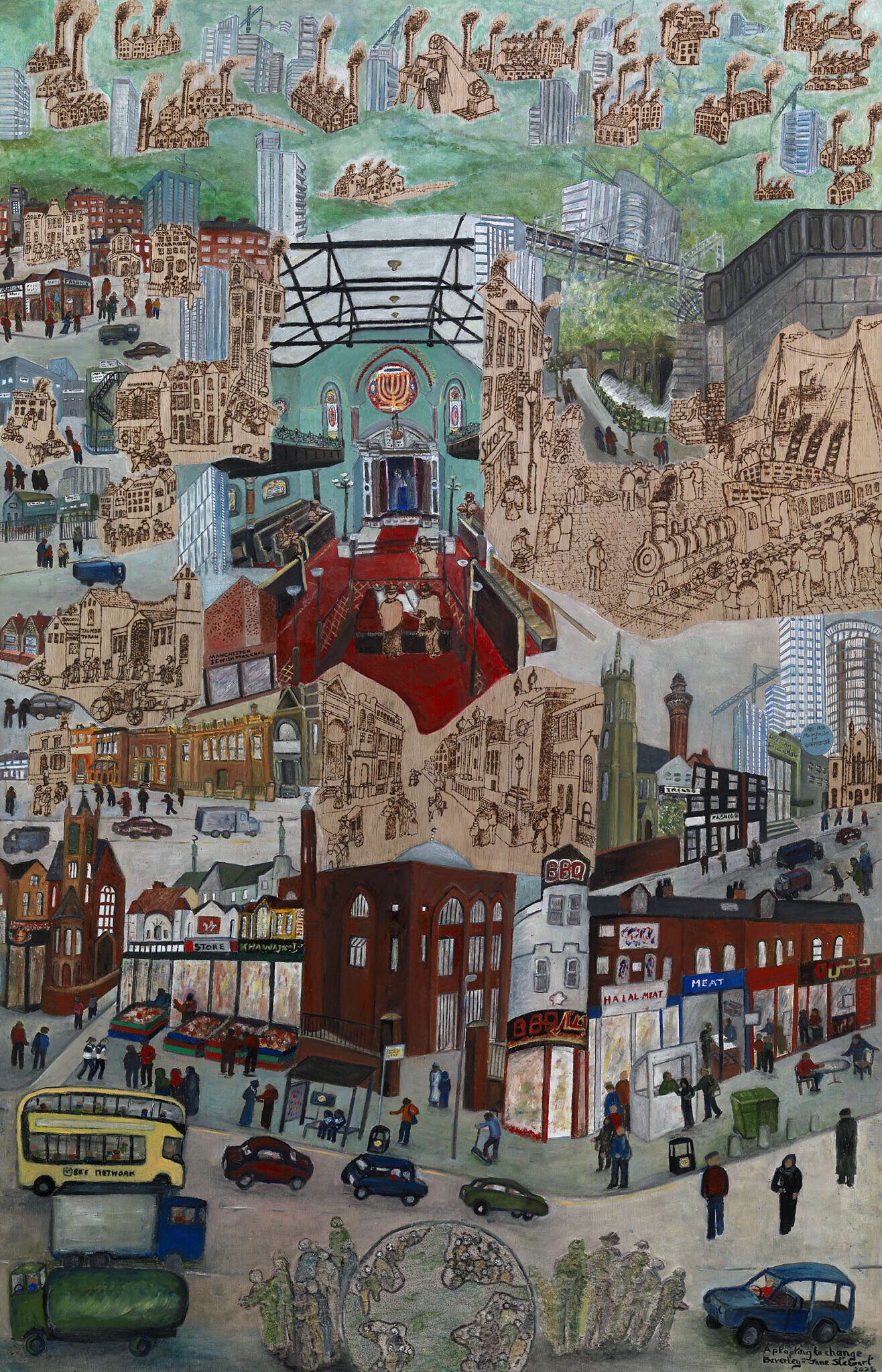
Manchester Jewish Museum has commissioned a new artwork by acclaimed Jewish artist Beverley-Jane Stewart for its permanent collection, to reflect the changing face of the immigrant communities in the city.
Adapting to Change is to be launched on Sunday (October 19) as part of the Cheetham Festival of Culture 2025, celebrating cultural diversity.
Ms Stewart has a long career of paintings about Jewish communities all over Britain, many of which feature a strong central image of a synagogue, surrounded by a border of tiny individual images showing the historical background of the community.
Her new work shows the art in sepia etchings of the Jewish community in Manchester, with colourful additions of other ethnic communities such as the Muslim, Sikh and Christian groups who now live in the Cheetham neighbourhood once entirely populated by Jews.
Ms Stewart says: “This large composition delves into the Jewish historical layers that once dominated this area. Juxtaposed with the past, I show modern Cheetham Hill with an exciting energy of cultural diversity shared within the public space. The message in this painting is not only to understand how communities evolve, but also to highlight the shared experiences many ethnic groups have in common”.

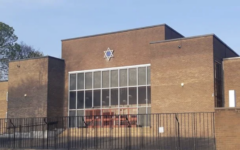
The timing of the event in the wake of the terror attack at Manchester’s Heaton Park Synagogue — which sits on the edge of Cheetham Hill — is coincidental, but the artist says: “It is important that harmony and cohesiveness is fostered especially in these turbulent times. The fear for safety by the recent tragic event suffered by the Manchester Jewish community, should be challenged. The practice of different religions or lifestyles should not be seen as a treat. The freedom to co-exist with our neighbours and enjoy diversity should be an enriching experience”.
The large painting on wood has several layers of technique to contrast the messages within the composition. Some sections are etched with a hot wire (pyrography), creating sepia shadows of past Jewish life. Manchester’s industrial fame, with its cotton mills, attracted many Jewish entrepreneurs in the early 1800s, establishing factories and synagogues in the area. Later, the railway brought ambitious but poverty-stricken pedlars from Europe to the Red Bank slums. The philanthropic consciousness of the wealthy Jewish establishment set up Jewish soup kitchens, hospitals, a “Home for Incurables”, a Board of Guardians, and schools, besides providing jobs in their factories.
Central to the picture is a Sephardi synagogue, which became the Manchester Jewish Museum, no longer a place of worship but a reminder of a past affluent Jewish life within this area. The iconic buildings of Jewish life are now replaced by fashion outlets many owned by the Asian community. Spreading more to the north, a wide variety of halal meat suppliers, restaurants, supermarkets and tailors decorate the pavements. Woven among a few churches are the mosques. The scattered array of homes, places of worship and shops bring a new colourful energy to this neighbourhood”.

Keep community journalism free.
Jewish News is free for everyone. No paywall. No barriers. Just trusted journalism for anyone who wants to stay connected to Jewish life in Britain.
If you value that, please support us.
From as little as £5 a month, you can help keep our journalism free and accessible to all.
Every day, we report on the issues that matter to our community. We celebrate achievements, support charities, challenge antisemitism and ensure Jewish voices are heard more widely.
From as little as £5 a month, you can help us continue to:
- Report on the stories shaping Jewish life in the UK and beyond
- Bring our community together through shared stories, events and campaigns
- Celebrate the people, culture and moments that define our community
- Support organisations doing vital work across Jewish Britain
You can make a one-off donation or become a regular supporter. Every contribution helps keep our journalism free, independent and accessible to all.
If everyone who values Jewish News gave a small amount, it would make a real difference to our future.





















