
 Prefer Jewish News on Google
Jewish Zionist politician joins Arab party Ra’am in push to defeat Netanyahu
'Hope won out' over fear, Mansour Abbas said as he welcomed former Yesh Atid lawmaker Yoav Segalovitz to his party
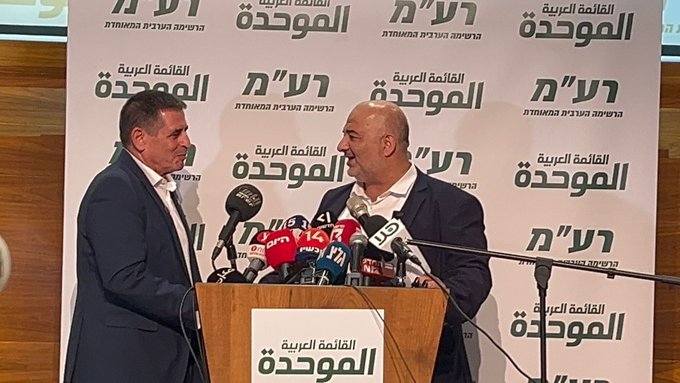
A Jewish Zionist politician has announced he’s joined an Arab party, in an unusual move that could help give the coalition of opposition parties enough votes to unseat Prime Minister Benjamin Netanyahu in the Israeli election.
Former Knesset member Yoav Segalovitz and Mansour Abbas, the leader of the Ra’am party, smiled, shook hands and hugged , as they told reporters in the majority Arab Israeli city of Nazareth that they would run together.
Segalovitz, formerly of the centrist Yesh Atid party, is the first lawmaker in decades to leave a Zionist party and join an Arab-led one.
“In every generation there is a moment when fear and hope stand together in the same room. This evening, in this room, hope won out,” Abbas said as he stood at a lectern next to Segalovitz.
“Welcome Yoav,” he said, adding, “we have work to do.”



Segalovitz, for his part, said he wanted to forge the alliance “precisely at this time, when there is such social polarisation between Jews and Arabs.” He said he hoped to “build a real political bridge,” acknowledging that it would face difficulties. “Even if the bridge is shaky or unstable, it will be built, and it will serve as a foundation for political cooperation going forward,” he said.
According to reports in the Israeli media, Segalovitz will be placed second on Ra’am’s slate and the alliance between the two politicians will be primarily technical, rather than a full political merger.
Analysts say Segalovitz’s inclusion could make Ra’am more palatable to parties in the opposition bloc that have so far ruled out forming a government with an Arab party. This includes former Israeli prime minister Yair Lapid of the Yesh Atid party, the architect of the previous government that relied on Abbas to forge a ruling coalition under Israel’s parliamentary system. It was that coalition was initially led by former prime minister Naftali Bennett and is referred to as the Bennett-Lapid government.
Recent polls suggest that Ra’am’s support may be essential for the opposition to win enough seats to replace Netanyahu’s government.
Pollster Yousef Makladeh told the Jewish Telegraphic Agency earlier this month that the Segalovitz alliance had been under discussion for several months. Abbas and Segalovitz met last week and said they had discussed “the importance of the move for all Israeli citizens and for the fabric of Jewish-Arab relations,” adding that the move allowed them to “present a worthy political alternative to the country’s citizens, Jews and Arabs.”
They described their alliance as “principled and necessary.”
Segalovitz, 67, is a former Israel Police major general who headed the force’s Investigations and Intelligence Division. He was a Knesset member for Yesh Atid from 2016 until his resignation this summer amid his talks with Ra’am.
He served as deputy minister of internal security in the Bennett-Lapid government from 2021 to 2022. In that role, he became the face of the government’s campaign against violent crime in Israel’s Arab community and succeeded in significantly reducing the number of homicides, which have surged under the current government.
His performance in the position, as well as his relationships with Arab-Israeli leaders, made him a particularly popular figure in parts of the Arab community. A Channel 13 poll published earlier this month found that the alliance could give Ra’am two additional seats on top of the five it currently holds — one from Arab voters and one from Jewish voters.
Ra’am, the party Segalovitz is joining, is an Arab party that emerged as the kingmaker after the 2021 election, when its support was crucial to the formation of the Bennett-Lapid government. Polls suggest it could once again find itself in a similar position after the next election.
In the latest Channel 12 News poll, the Jewish parties in the opposition bloc won 59 seats, two short of the 61 needed to form a government, while Ra’am won four.
Ra’am was founded in 1996, and its name stands for the United Arab List. The party was traditionally religious, but over the past year it has separated itself from the religious institutions that had dominated it. In recent years, Abbas has led an effort to distinguish Ra’am from other Arab parties, focusing on Jewish-Arab cooperation and domestic issues affecting Israel’s Arab community, such as crime, rather than the Israeli-Palestinian conflict.
Israeli right-wing politicians attacked the alliance even before it was formally announced. National Security Minister Itamar Ben-Gvir called it “a joint conspiracy by the left to pave the way for a future government with the Muslim Brotherhood.” Likud lawmaker Tally Gotliv called Segalovitz Abbas’ “pet Jew” and warned that the move could lead to “the imposition of Sharia law on Israel.”
After the announcement, Knesset Speaker Amir Ohana, a member of Netanyahu’s Likud party, wrote on X that “Eisenkot has no coalition without Abbas,” and accused Segalovitz of joining Ra’am in order to legitimize its participation in a future Eisenkot-led government. Ohana described Ra’am as an “Islamist list whose members are unable to say ‘Hamas is a terrorist organisation,’” and argued that such a government would be unable to fight Hamas, Hezbollah or Iran’s nuclear program.
Ben-Gvir posted an image depicting Abbas and Segalovitz wearing keffiyehs alongside Hamas flags, while Likud minister Eli Cohen said the move was intended to legitimise what he called Abbas’ “fifth column.”

Keep community journalism free.
Jewish News is free for everyone. No paywall. No barriers. Just trusted journalism for anyone who wants to stay connected to Jewish life in Britain.
If you value that, please support us.
From as little as £5 a month, you can help keep our journalism free and accessible to all.
Every day, we report on the issues that matter to our community. We celebrate achievements, support charities, challenge antisemitism and ensure Jewish voices are heard more widely.
From as little as £5 a month, you can help us continue to:
- Report on the stories shaping Jewish life in the UK and beyond
- Bring our community together through shared stories, events and campaigns
- Celebrate the people, culture and moments that define our community
- Support organisations doing vital work across Jewish Britain
You can make a one-off donation or become a regular supporter. Every contribution helps keep our journalism free, independent and accessible to all.
If everyone who values Jewish News gave a small amount, it would make a real difference to our future.





















