Prefer Jewish News on Google
Kamala Harris urges support for controversial Michigan senatorial candidate
Abdul El Sayed, who holds a strong anti-Israel stance, narrowly won a bitterly fought Democratic primary battle in the US state this week
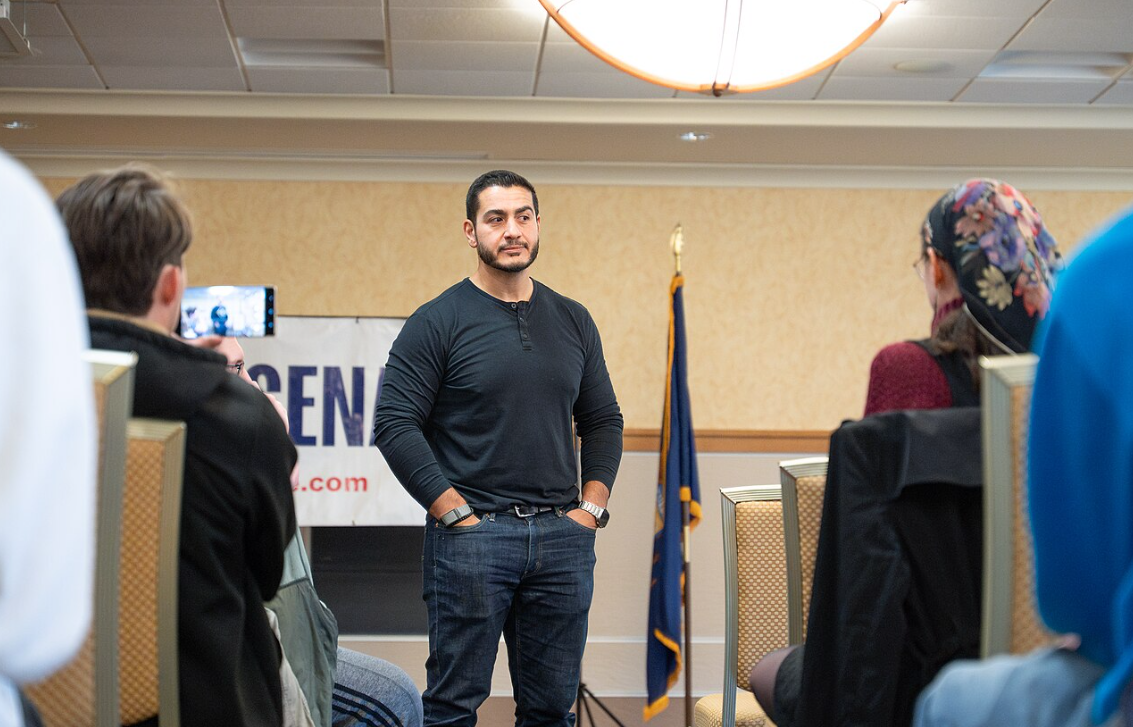
2024 nominee Kamala Harris and Senate Minority Leader Chuck Schumer are among a wide array of Democrats who have pledged their support for a controversial candidate who won Michigan’s Democratic senate primary this week.
In a message to voters, Harris urged people to support Abdul El Sayed, saying that the primary winner “needs us all to get behind him so he can fend off the attacks coming from Republicans across the country, and keep this critical Senate seat blue.”
El Sayed has made attacks on Israel, and particularly AIPAC, the major pro-Israel lobby group in the United States, a key part of his campaign. His campaigning with Hasan Piker, a far-left extreme anti-Israel online influencer, was criticised by many and is likely to prove a key line of attack from Republicans in the general election later this year.
In the first 90 seconds of his victory speech in Detroit Wednesday, Abdul El Sayed both lambasted the influence of AIPAC and appealed to his rival Haley Stevens, who had benefited from the pro-Israel lobby’s massive resources, to campaign with him.
The jarring and almost immediate transition in the freshly elected Michigan Senate nominee’s remarks illustrates the daunting bridge-building that Democrats face between the party’s pro- and anti-Israel wings ahead of a midterm election the party sees as crucial to wresting control of the Senate from the GOP.


Later, El-Sayed devoted a chunk of his speech to ensuring the safety of Michigan’s Jews, still rattled by his equivocal reaction to an attack on a suburban Detroit synagogue earlier this year.
At the outset of his speech, the newly minted nominee lauded Mallory McMorrow, another contender for the Democratic nomination who dropped out early, and who had introduced him Wednesday, stating, “You took on the power of AIPAC.” He continued, “You were willing to speak truth to a level of power that sometimes is unbeatable.” Like El-Sayed, McMorrow attacked Stevens for accepting the backing of funders affiliated with the American Israel Public Affairs Committee.
Three sentences later, El-Sayed appealed to Stevens, who was backed by upwards of $30 million in pro-Israel money, to join him in defeating Mike Rogers, a former congressman who is the Republican nominee to replace retiring Democratic Sen. Gary Peters.
“Whatever differences that we might have had in the primary,” he told his “colleague and friend” Stevens, “they pale in comparison to what unifies us – a recognition that so long as we want to keep our democracy, that democracy better be working for people, and that all of us have to come together to make sure that we never let Mike Rogers see the inside of the U.S. Senate.”
Stevens lost by less than 1 percentage point, a stunning rebuke to multiple pollsters who said she would lose by double digits. The more than $60 million spent on the race on her behalf helps make it the most expensive in Senate primary history.
Despite the close margin, Stevens quickly endorsed El-Sayed Wednesday, as did Schumer, the Jewish New York Senator who pushed hard for her to win.
“I spoke with Abdul a few moments ago to offer him my full support as we work to defeat Mike Rogers this November,” Stevens said on X.
The close call means El-Sayed now has to pivot to the voters Stevens won. Many of them are Black and working-class moderates who live in the Detroit area, as well as Jews who were unsettled by his attacks on Israel and his seeming insensitivity to Jewish security.
Republicans immediately signalled that El-Sayed’s animus toward Israel and its supporters – a dynamic that came to dominate the primary race – would be a focus of their general election campaign.
“Great news for the Republican Party,” President Donald Trump said Wednesday on the social media platform he owns, Truth Social. “El-Sayed, a Communist loser who hates Jews and Israel, is the projected winner in his race with the Socialist.” El-Sayed, a physician who is a former county health official, is not a communist and Stevens, a congresswoman who built her reputation as a champion of the state’s auto industry after its late 2000s crisis, is not a socialist.
El-Sayed in his victory speech acknowledged a primary race that was at times intensely bitter, with mutual accusations of anti-Arab racism, misogyny and antisemitism.
“As bitter and as divisive and as cynical as the campaign against us might have been, I want us to realize that there is so much more that unites us now, because the campaign that Mike Rogers and Donald Trump and their GOP MAGA allies are launching is already more bitter,” he said.
El-Sayed also appeared to recognize the aspects of his campaign that unsettled the approximately 130,000 Jews in the state, including his claim that “hurt people do hurt people,” after a man plowed a truck into a synagogue during pre-school hours. The assailant had relatives who were killed in an Israeli strike on Lebanon and El-Sayed’s remarks were interpreted by many as explaining away the attack.
“I want you to know that my commitment to your safety, my commitment to Jewish safety, is the same commitment that I have to the safety of my own daughters,” he said.
He also appeared to acknowledge the Jewish right to self-determination, something he has largely resisted. He thanked “Jewish American brothers and sisters” who backed his campaign, who he said “understand that self-determination for one people does not require the quenching of self-determination for another people.”
Notwithstanding that the comment came in the context of upholding the Palestinian right to self-determination, El-Sayed has until now declined to affirm Israel’s right to exist as a Jewish state.
The speech was nonetheless laced with references to his criticism of Israel, which he has accused of a genocide in its conduct of the Gaza war sparked by the Hamas-led attack on Oct. 7, 2023. . He repeated his pledge to reallocate the funds the United States spends on defense assistance to Israel to domestic priorities.
“I kept running up against one thing: the kind of politics that tell us that we cannot invest in those children because we should be sending their money to deny rights to other children abroad,” he said.

Keep community journalism free.
Jewish News is free for everyone. No paywall. No barriers. Just trusted journalism for anyone who wants to stay connected to Jewish life in Britain.
If you value that, please support us.
From as little as £5 a month, you can help keep our journalism free and accessible to all.
Every day, we report on the issues that matter to our community. We celebrate achievements, support charities, challenge antisemitism and ensure Jewish voices are heard more widely.
From as little as £5 a month, you can help us continue to:
- Report on the stories shaping Jewish life in the UK and beyond
- Bring our community together through shared stories, events and campaigns
- Celebrate the people, culture and moments that define our community
- Support organisations doing vital work across Jewish Britain
You can make a one-off donation or become a regular supporter. Every contribution helps keep our journalism free, independent and accessible to all.
If everyone who values Jewish News gave a small amount, it would make a real difference to our future.