Prefer Jewish News on Google
New York Times sued by shareholders over alleged anti-Israel bias
Jewish former employee claims she repeatedly raised concerns about antisemitism and Israel reporting during almost a decade at the newspaper
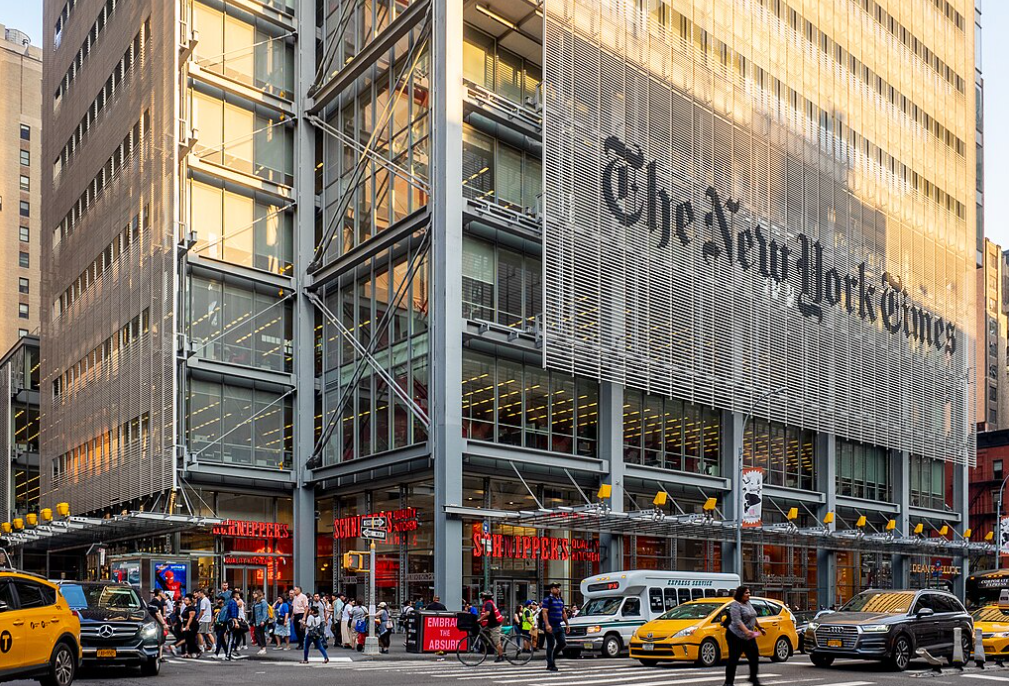
The New York Times is being sued by two shareholders seeking internal records about how the newspaper oversees its coverage of Israel and handles concerns about antisemitism.
The lawsuit was filed in New York on Wednesday by the State Board of Administration of Florida (SBA) and the National Centre for Public Policy Research (NCPPR), which both hold shares in the New York Times Company.
They want the newspaper’s parent company to hand over documents showing how its board monitors editorial standards, including accuracy and corrections.
The case follows months of correspondence between the shareholders and the Times and focuses heavily on its reporting of Israel and Gaza since the Hamas attacks of 7 October 2023.
It also contains claims from an anonymous Jewish former Times employee who worked on its video desk for almost a decade.



According to the lawsuit, the former employee raised concerns about antisemitism and what she believed was anti-Israel bias at least 15 times between 2019 and her departure in March 2026.
She is said to have raised the issue through several internal channels, including with managers, the newspaper’s standards team and human resources.
Speaking anonymously to The Free Press, which first reported details of the case, she said: “The public deserves a better picture of how the Times manufactures the news when Jews or Israel are involved.”
The lawsuit claims that in one meeting about the culture on the video desk, a human resources representative told her: “If you don’t like our values here, maybe you should go find a place whose values align with yours.”
It also alleges that after the 7 October attacks, staff on the video desk spent weeks looking for evidence that Hamas had not used tunnels beneath al-Shifa Hospital in Gaza.
The filing says the employee’s supervisor referred to “alleged tunnels” during a meeting on 20 November 2023, after the Israeli military had released footage it said showed tunnels beneath the hospital.
The shareholders point to a series of other reports and corrections which they argue raise questions about oversight at the newspaper.
Among them is The Times’ July 2025 coverage of Mohammed Zakaria al-Mutawaq, an emaciated Palestinian child whose photograph appeared in an article about starvation in Gaza.
The newspaper later added an editors’ note saying that, after publication, it had learnt from the boy’s doctor that he also had pre-existing health problems.
The lawsuit argues that information about his health should have been established before publication.
It also revisits the Times’ early reporting of the explosion at Gaza’s al-Ahli Hospital in October 2023. The newspaper later acknowledged that its initial coverage had “relied too heavily on claims by Hamas”.
The shareholders argue the issue matters to investors because the Times itself has warned that perceptions that its journalism is unreliable or biased could harm its business.
David Benger, an attorney representing the National Jewish Advocacy Centre, which is acting for NCPPR, told The Free Press: “Many New York Times readers have perceived a consistent anti-Jewish and anti-Israel bias for quite some time.
“Shareholders are entitled to see whether the board was watching at all.”
The lawsuit also cites a recent peer-reviewed study examining the newspaper’s coverage of the Gaza war.
As previously reported by Jewish News, Yale School of Management professor Edieal Pinker analysed 1,559 Times articles published between 7 October 2023 and 7 June 2024.
His research found that Israel was mentioned 27,205 times across the articles, compared with 8,499 mentions of Hamas. Pinker argued that the coverage placed far greater emphasis on Israel’s actions while giving less attention to Hamas’s continuing role in the war.
The Times rejected that criticism when approached by Jewish News earlier this month.
A spokesperson said: “The advocates behind multiple studies on media bias cherry-pick data that supports their beliefs while ignoring any evidence to the contrary.”
They added: “Our role is to seek the truth, even when it includes inconvenient or uncomfortable facts. We remain open to good-faith disagreement, but we will not let critics or advocacy campaigns move us away from independent reporting.”
The newspaper has also strongly rejected the new legal action.
A Times spokesperson told The Free Press: “This lawsuit has no merit and was brought for an improper purpose.”
They said it was “a transparent attempt to exert agenda-driven pressure against an independent media organisation, level false allegations of bias, and chill journalism protected by the First Amendment”.
“We will defend against the suit vigorously,” the spokesperson added.
The Times previously rejected requests from the shareholders to release the records. The two shareholders are now asking the court to order the company to hand them over.

Keep community journalism free.
Jewish News is free for everyone. No paywall. No barriers. Just trusted journalism for anyone who wants to stay connected to Jewish life in Britain.
If you value that, please support us.
From as little as £5 a month, you can help keep our journalism free and accessible to all.
Every day, we report on the issues that matter to our community. We celebrate achievements, support charities, challenge antisemitism and ensure Jewish voices are heard more widely.
From as little as £5 a month, you can help us continue to:
- Report on the stories shaping Jewish life in the UK and beyond
- Bring our community together through shared stories, events and campaigns
- Celebrate the people, culture and moments that define our community
- Support organisations doing vital work across Jewish Britain
You can make a one-off donation or become a regular supporter. Every contribution helps keep our journalism free, independent and accessible to all.
If everyone who values Jewish News gave a small amount, it would make a real difference to our future.