
 Prefer Jewish News on Google
OPINION: D-Day – a turning point in Jewish history
The Holocaust, the greatest human crime in world history, would likely have been even worse without D-Day
For most Jews, the most important days related to World War II are International Holocaust Remembrance Day and Yom HaShoah. International Holocaust Remembrance Day takes place on January 27, the date when Auschwitz was liberated by the Red Army in 1945, while Yom Hashoah (Holocaust and Ghetto Uprising Remembrance Day) is observed on the Hebrew date of the 27th of Nisan (which falls in April or May), the day the Warsaw Ghetto Uprising began.
But there is another date, seemingly less directly connected to the Holocaust, which also urgently needs remembrance.
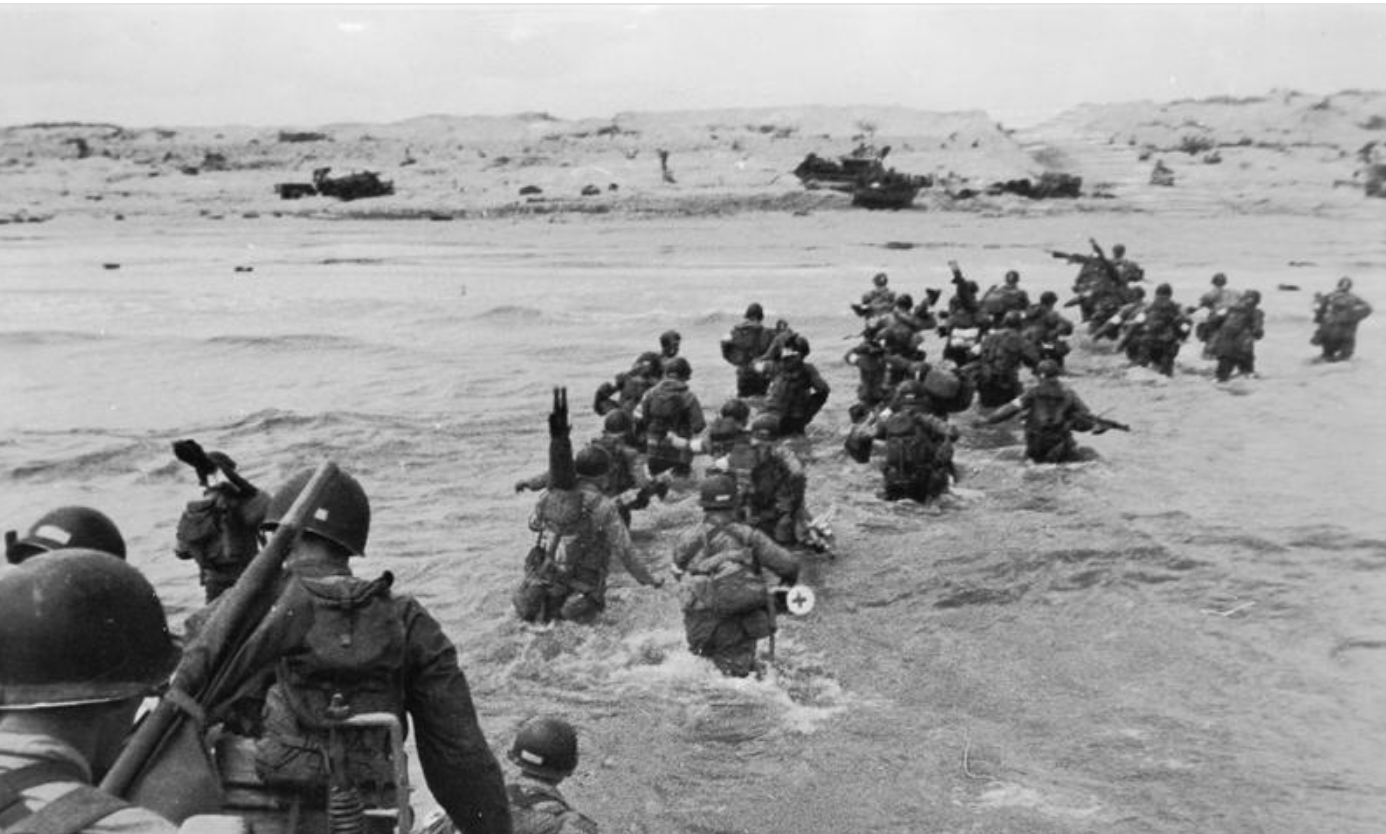
This Thursday June 6th, the 80th anniversary of D-Day will be commemorated in Europe. An estimated 160,000 Allied troops (including soldiers from USA, Britai%n, Canada, Free French, and other Commonwealth countries) landed in Normandy, making it the largest seaborne invasion in human history. It marked the beginning of the liberation of France and the rest of Western Europe, laying the foundations for the Allied victory on the Western Front. A true turning point in this great battle for the soul of Europe and beyond.
While this gallant display of mass courage was on display, the Nazis were accelerating their evil plans, systematically murdering Hungarian Jews by their thousands daily. However, without D-Day, and the successful Red Army assaults in the east already underway, the Holocaust – the greatest human crime in world history – would likely have been even worse.
D-Day began soon after midnight on June 6, 1944 (after being postponed for 24 hours because of bad weather), when paratroopers landed in German-occupied France. They were followed by Allied planes and warships, before troops landed on a 50-mile stretch of coastline divided into five beaches codenamed Gold, Juno, Omaha, Sword and Utah.



Although 4,414 Allied troops died that day, the landings were ultimately successful. A month later, the Allies liberated the vital city of Caen, and while there would be another 11 months to go before liberation, this was undoubtedly the beginning of the end for the Nazis.
Major commemorations are held every five years, and organizers say this year’s event could be one of the last to feature living veterans. In an interview, Gen. Michel Delion, the CEO of the French government agency in charge of the French commemoration efforts, said: “We are perfectly aware that for these centenarians, this is maybe the last chance to return to the beaches where they landed, where they fought and where their brothers-in-arms fell.” During the event, national ceremonies are held at the American, British, and Canadian cemeteries, while the French organize the main international commemoration, alongside other local events.
Just like the Holocaust, for years veterans have played a key role in telling the story of D-Day, doing a better job than any textbook could. Sadly, also like the Holocaust, only a few of the Allied troops are still alive to tell their tales.
According to statistics from the US Department of Veteran Affairs, out of the 16.4 million Americans who served in World War II, fewer than 100,000 are expected to be alive by the end of the year. Most of them are thought to be in their late nineties, meaning that soon there will be no surviving veterans left. It is estimated that over 4,000 of the Allied soldiers who participated in D-Day were Jewish, and 52 of them died.
Expressing sentiment that is very familiar to our annual March of the Living in Poland, the military historian Ben Brands recently noted, “People are realizing this generation is passing and they’re passing rapidly now, and it’s important to keep their stories alive, to keep the memories of those who died and are buried at Normandy, but also those who fought and survived because they can no longer be with us for that much longer to tell these stories.”
World War II may seem like ancient history to some, but with antisemitism rampant once again, its significance is greater than ever. Indeed, once again, the free world is being called to stand up with courage and unite around its blessed values of freedom and tolerance, democracy and human rights.
D-Day – and the courage and unity it embodies, in the face of the most horrific evil – deserves to take its place alongside International Holocaust Memorial Day and Yom HaShoah as one of the most important dates commemorating the defeat the Nazis and the triumph of freedom.
As Jewish educators, it is therefore incumbent upon us to work hard to transmit D-Day’s spirit of courage and hope to the next generations.
- Scott Saunders, Founder and Chair of the Holocaust charity UK March of the Living.

Keep community journalism free.
Jewish News is free for everyone. No paywall. No barriers. Just trusted journalism for anyone who wants to stay connected to Jewish life in Britain.
If you value that, please support us.
From as little as £5 a month, you can help keep our journalism free and accessible to all.
Every day, we report on the issues that matter to our community. We celebrate achievements, support charities, challenge antisemitism and ensure Jewish voices are heard more widely.
From as little as £5 a month, you can help us continue to:
- Report on the stories shaping Jewish life in the UK and beyond
- Bring our community together through shared stories, events and campaigns
- Celebrate the people, culture and moments that define our community
- Support organisations doing vital work across Jewish Britain
You can make a one-off donation or become a regular supporter. Every contribution helps keep our journalism free, independent and accessible to all.
If everyone who values Jewish News gave a small amount, it would make a real difference to our future.





















