Prefer Jewish News on Google
OPINION: Our pride at standing with hostage families as they moved heaven and earth for their loved ones
Adam Wagner and Adam Rose, who have represented the seven British-linked families, offer their thoughts on what impact the British government might have had on getting us to this day
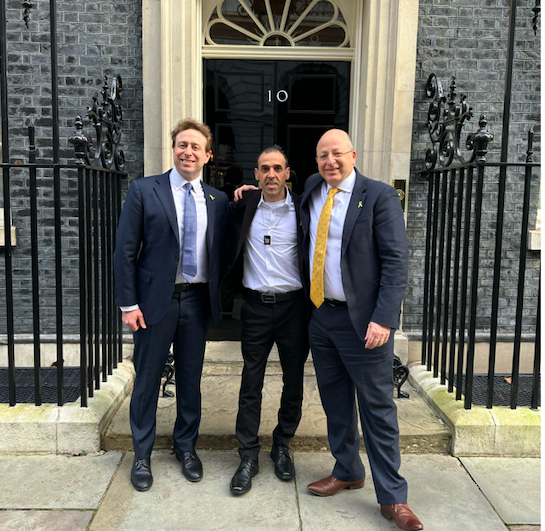
On Saturday, we led the Acheinu prayer for the hostages at our synagogue together. Like Jewish communities worldwide, we hoped that this was the last time we would have to sing a prayer on Shabbat for “our brothers and sisters… who are given over to trouble or captivity”.
The return of the hostages has been both a personal and professional mission for us in the past two years. We have worked with the seven British families of 10 hostages, as well as many of the families of the seventeen British citizens who were murdered on 7 October 2023.
We will have plenty more to say about the experiences we have had whilst standing alongside those extraordinary seven families for the past two years. For now, we want to focus on two points.
Firstly, a tribute to the hostages’ families. To their advocacy; to their fortitude and moral clarity; to their non-stop campaigning; to their sharing of their personal stories and those of the hostages. We have no doubt that their stirring advocacy to world leaders and many others, even in the midst of deep personal suffering, about the human being, the actual person held as hostage, has had an impact on today’s events.
It is a modern miracle that the Hostages and Missing Families Forum was set up just days after 7 October. That rather than separating into warring tribes (as others in the community have), the families of 251 hostages, in the immediacy of their grief and initial confusion, representing the full diversity of Israeli society, worked together for two years towards a common goal – the release of all.


We saw up close how difficult it has been at times to maintain this unity – the temptation to sacrifice togetherness for individual advancement was always there. But the families never succumbed to it.
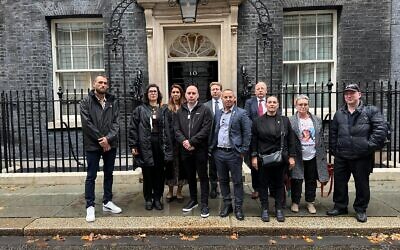
Hostages families in Downing Steet
From left: Moshe Or (brother of Avinatan Or), Sharone Lifschitz (daughter of Yocheved and Oded Lifschitz), Annabel Sheldon (Chief of Staff, Sharabi family), Stephen Brisley (brother-in-law of Eli Sharabi), Adam Wagner KC, Sharon Sharabi (brother of Eli Sharabi), Adam Rose, Ayelet Svatitzky (sister of Nadav Poppwell and daughter of Chana Peri), Mandy Damari (mother of Emily Damari), Rob Moss (uncle of Emily Damari).
They knew that they were stronger as a group, including the group of seven British families who advocated beautifully together, looked after each other and ultimately achieved so much because of that. The Jewish and wider community could learn a huge amount from their example. If President Trump is going to win the Nobel Peace Prize next year, then it should be shared with Hostages and Missing Families Forum. We cannot think of better candidates.
We wish the families only happiness and peace in the coming months and years. They have all become not just clients but also friends, and we will always be there for them if they need us. We hope that they do not.
Secondly, there has been a lot of discussion about what role the British Government did and did not play in the final deal. We are as well-placed as any to answer this question, having been in constant contact with Prime Ministers and Foreign Secretaries since October 2023 over this issue.
The truth is that there have been both positives and negatives. We first tried to petition the previous government to give the British-linked hostages British citizenship, so they would (we assumed at the time) be protected as dual citizens. The government refused, despite being threatened with legal action, and – disgracefully – the Home Office said that even if it did have the legal discretion to grant citizenship, it wouldn’t exercise it in the hostages’ favour.
But after that there was a breakthrough, and Lord Cameron agreed to a unique arrangement whereby a special new team in the Foreign Office, the Gaza Hostages Team, would provide specialist support to the British families. This was a game-changer. The families have received regular support from the UK ever since. The Labour Government agreed to continue the scheme, which has at a basic level meant that the families have received regular, weekly updates from a dedicated team and consular support when they needed it, something which surpassed what has been made available to other families worldwide, including in many senses in Israel itself.
Most importantly, this has guaranteed regular access by the families to two Prime Ministers, three Foreign Secretaries and two Middle East Ministers. As for the current Government, the families have met the Prime Minister three times at Downing Street, and between them have had closer to 10 meetings with the Foreign Secretaries, as well as countless other interactions. We doubt that any other members of the public have had such regular direct access at such a high level during this period.
Both Conservative and Labour governments have also arranged for the families to meet on multiple occasions with the Qatari negotiators – in London and Doha – as well as other important actors such as the US Government.
We have no doubt that the relationships that developed have made a difference. As a group, we have regularly been able to impact on government messaging and policy, and ensure that the British state’s focus remains on the hostages. Obviously, our success has ebbed and flowed, as inevitably the hostage families are not the only factor that the government has had to address. We have not held back – and the families have not either – from letting Prime Ministers and Foreign Secretaries know when they think things are going wrong.
As to the question of whether the British government impacted the eventual deal – this is also complicated. The majority (though not all) of the British hostage families opposed the recognition of a Palestinian State, especially whilst hostages were still held. This was hugely sensitive and controversial. However, it was our strong impression that the recognition decision was part of a wider transactional strategy of encouraging the Arab states to disown Hamas and condemn the 7 October attacks. We do not know if that made a difference, but it is plausible that it did.

We have also been assured by multiple Foreign Office officials and ministers, including the Prime Minister, that the British Government was working closely with the US behind the scenes to plan for the ‘day after’, which was a crucial component of the Trump-brokered deal. Our understanding is that this planning had been going on for many months, with Jonathan Powell at the centre. It was therefore no surprise to see Steve Witkoff thanking Britain and Powell directly.
When we started this work, we were told by the wonderful Richard Ratcliffe, husband of British-Iranian detainee Nazanin Zhagari-Ratcliffe, that the important thing was to “try lots of things” and that “you will probably never know what worked”. We have followed that mantra. We will leave the ultimate question of whether two successive British governments could and should have done more, or done things differently, to the historians. Our view, at this point, is that the answer is not simple, as much as political foes or allies would like it to be.
But the thing we are sure about is that the seven British families have moved heaven and earth to save their relatives and all of the other hostages, and it has been our honour and privilege to stand alongside them.
- Adam Wagner KC is a barrister at Doughty Street Chambers, and Adam Rose, solicitor, is a Partner at Mishcon de Reya. Both acted pro bono for all of the British hostage families.

Keep community journalism free.
Jewish News is free for everyone. No paywall. No barriers. Just trusted journalism for anyone who wants to stay connected to Jewish life in Britain.
If you value that, please support us.
From as little as £5 a month, you can help keep our journalism free and accessible to all.
Every day, we report on the issues that matter to our community. We celebrate achievements, support charities, challenge antisemitism and ensure Jewish voices are heard more widely.
From as little as £5 a month, you can help us continue to:
- Report on the stories shaping Jewish life in the UK and beyond
- Bring our community together through shared stories, events and campaigns
- Celebrate the people, culture and moments that define our community
- Support organisations doing vital work across Jewish Britain
You can make a one-off donation or become a regular supporter. Every contribution helps keep our journalism free, independent and accessible to all.
If everyone who values Jewish News gave a small amount, it would make a real difference to our future.