Prefer Jewish News on Google
OPINION: We urgently need to talk about Qatar
Qatar is - bizarrely - able to present itself as an honest broker because it is in the interests of the US, UK, France and a range of other Western countries to see it as a friend
In the wake of the September 11 terror attacks carried out by Al Qaeda on US soil, US President George Bush issued an ultimatum. Osama bin Laden, Al Qaeda’s leader, had been living in Afghanistan for decades. Bush demanded that the Taliban, which then controlled 85% of Afghan territory, extradite Bin Laden. When the Taliban refused, a joint US and UK invasion was launched, subsequently backed by dozens of countries around the world. The ensuing events provided a backdrop to the next twenty years, irrevocably altering 21st century history.
On 7 October 2023, Hamas launched a mass terror attack on Israeli soil, murdering 1,200 and taking 250 captives. Hamas’s top leaders – including Khaled Mashaal, Ismail Haniyeh, Khalil al-Hayya and Muhammad Ismail Darwish – were all based in Doha, the capital of the Emirate of Qatar, at the time. But in the immediate aftermath of the attacks, Israel made no public demand that Qatar extradite the leaders of Hamas.
Indeed, everything about Israel’s attitude towards Qatar suggests extreme wariness. Its successful elimination of Ismail Haniyeh came when the Hamas leader travelled to Tehran. Mossad, which has carried out a number of global extrajudicial assassinations over the years, has not appeared to make any such attempts on Qatari soil.
The reason Israel did not – or could not – make that ask of Qatar is likely the same reason why it has avoided operations in Doha. Israel’s traditional friends in the West have now also become Qatar’s friends in the West. If it had tried to force the issue, Jerusalem would not have been able to rely on the United States backing it up.
But what happened next was bizarre. Qatar, which had welcomed and shielded Hamas for so long, presented itself to the world – and particularly to the US – as an honest broker between Israel and Hamas. The idea is laughable – yet has somehow been taken seriously ever since.
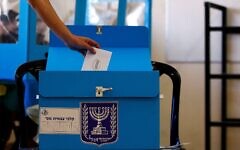
You might wonder how a country which has harboured the leaders of Hamas for many years could possibly have managed to reinvent itself as an honest broker between the terrorist organisation and Israel. The answer is simple – Qatar is able to present itself that way because it is in the interests of the US, UK, France and a range of other Western countries to see it as a friend. And everyone else – including Israel – appears to have to play along with this utter charade. Israel is unlikely to have been helped by the fact that for years it enabled a policy where tens of millions of dollars were sent monthly by Qatar to Hamas in Gaza; this realpolitik was intended to enable Hamas to run Gaza while simultaneously containing it – and we all know how that ended. Nor will Israel’s position have been aided by recent serious allegations suggesting that Qatar may have bribed senior advisors to Netanyahu.
Occasionally the light shines through. Late last year, headlines around the world suggested that Qatar, bowing to diplomatic pressure, had signalled to all senior Hamas operatives living in the Emirate that it was time for them to leave, with a number going to Turkey. In fact, this appears to have been highly overstated. Hamas senior leadership regularly visits Turkey from Qatar anyway, and some nine months later, it appears that Khaled Meshal and Khalil al-Hayya are still in Doha. So much for “US pressure”.
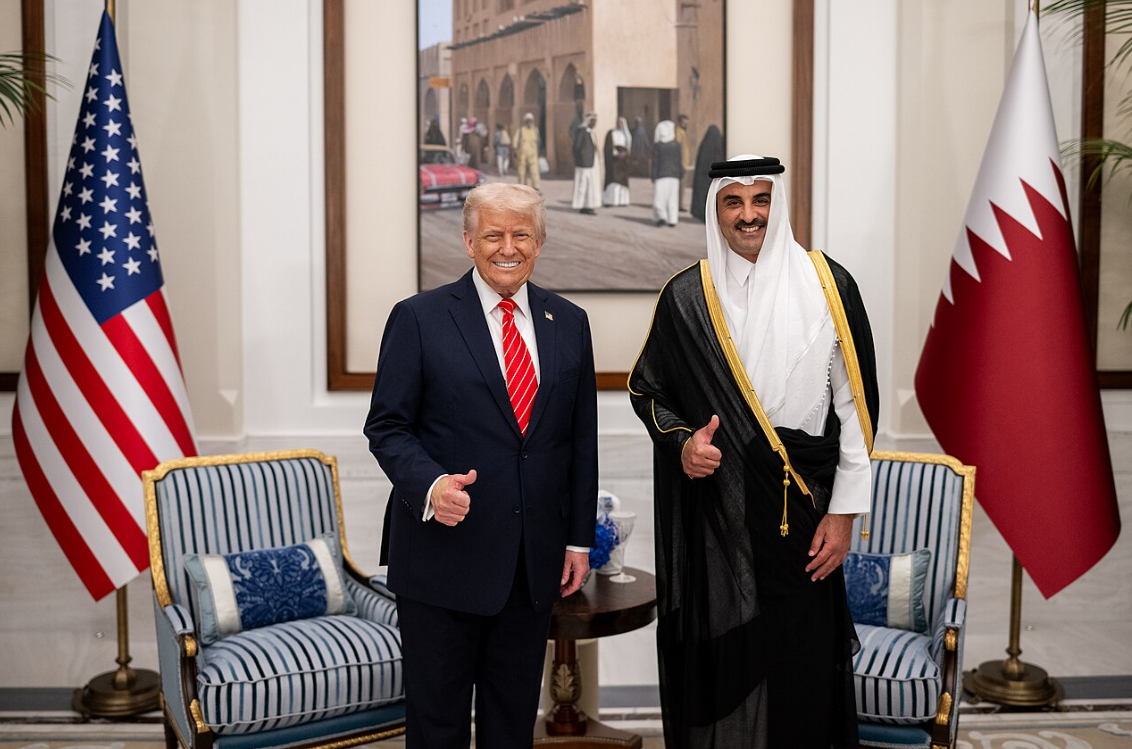
This farcical situation, in all its tawdriness, was on full display when Donald Trump visited Doha earlier this year. The Qataris, keen to flatter the Presidential ego, arranged for Hamas to release the last living US citizen hostage in Gaza, Edan Alexander. The fact that Qatar was able to do that – that it had that level of control over Hamas – should have made it clear worldwide that if it really wanted to, or if sufficient pressure was brought to bear on it, Qatar would in turn have been able to lean on Hamas to release all the remaining hostages. But no such efforts were made. Prior to Trump’s visit, it was announced that his organisation had agreed a deal for a luxury golf resort in Qatar. He would subsequently sign a deal to generate an economic exchange between the US and Qatar worth at least $1.2 trillion. It would also later emerge that the Qataris would be ‘gifting’ Trump a Jumbo Jet – worth $300 million – to serve as the next Air Force One.
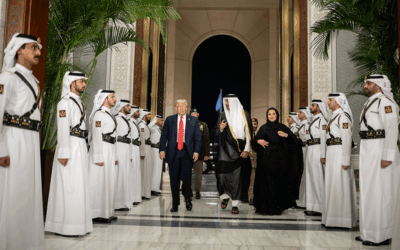
There are many people who howl about supposed Israeli influence and control over a variety of Western countries. Such people seem neither to know or care that within the last few decades the Qatari regime, via its QIA sovereign wealth fund, has invested eye-wateringly large sums of money into the economies of key Western nations. Recent reporting has shown that besides the recent Trump-associated spending, since 2012 Qatar has poured $33.4 billion into American businesses and real estate, and $6.25 billion into US universities. In France, the Emirate – which has a population of 300,000 – has invested tens of billions in the last decade, with a 2024 deal between the two countries seeing Qatar pledge to invest a further 10 billion Euros into key sectors of the French economy. And then we come to the UK, where in the last two decades Qatar has built up more than £100 billion – yes, that’s a ‘b’ – in assets, including in UK property, infrastructure and key businesses.
One doesn’t have to engage in bizarre conspiracy theories about direct control to understand that such a level of investment brings a great deal of indirect power – spoken or unspoken. No Western nation would reasonably want to go out of its way to make an enemy of a wildly wealthy Emirate that seems to be almost begging to shower it with money. A Times article on the subject in 2023 noted that “research commissioned by the gas-rich state claims its companies owned in the UK made revenues of £1.3 trillion from 2008 to 2022… in the City and Westminster it is seen as a cash cow.” And we haven’t even touched on the use of Qatar’s Al Udeid air force base by both the United States and the UK.
In December 2024, the Qatari charade played out in the UK, during a state visit of the Emirate’s royal couple. At a Buckingham Palace banquet, Qatar’s Emir was praised for his “tireless mediation efforts over the past year in pursuit of peace”.
And so it goes on. Like dominos, France, Britain and Canada (where Qatar has started small, incidentally announcing a £200 million investment last month) have all now expressed plans to recognise a Palestinian state, without the ending of Hamas as a necessary prerequisite. In the meantime, none of them have openly called upon Qatar to end what they must know it could have ended a long time ago – and none of them will.
They say that money talks, but real money doesn’t need to talk. It just sits there, lets governments notice its presence, and allows them to consider what would happen if it went away.

Keep community journalism free.
Jewish News is free for everyone. No paywall. No barriers. Just trusted journalism for anyone who wants to stay connected to Jewish life in Britain.
If you value that, please support us.
From as little as £5 a month, you can help keep our journalism free and accessible to all.
Every day, we report on the issues that matter to our community. We celebrate achievements, support charities, challenge antisemitism and ensure Jewish voices are heard more widely.
From as little as £5 a month, you can help us continue to:
- Report on the stories shaping Jewish life in the UK and beyond
- Bring our community together through shared stories, events and campaigns
- Celebrate the people, culture and moments that define our community
- Support organisations doing vital work across Jewish Britain
You can make a one-off donation or become a regular supporter. Every contribution helps keep our journalism free, independent and accessible to all.
If everyone who values Jewish News gave a small amount, it would make a real difference to our future.