Prefer Jewish News on Google
Our future depends on teaching today’s children to counter online conspiracies
The crisis of truth is no longer an abstract concern. It is affecting classrooms, family conversations and the way young people understand the world around them
The horrifying attack in Golders Green, and the recent arson attacks that preceded it, were yet more warning flares in a broader crisis: antisemitism is growing everywhere.
In the days that followed, the Prime Minister was right to describe rising antisemitism as a “crisis for all of us”. It is a crisis for the Jewish community, but it is also a crisis for Britain, and for every community that depends on truth, trust and the ability to live together.
Antisemitism, and wider hatred between communities, is being accelerated, amplified and normalised by online misinformation, disinformation and conspiracy theories.
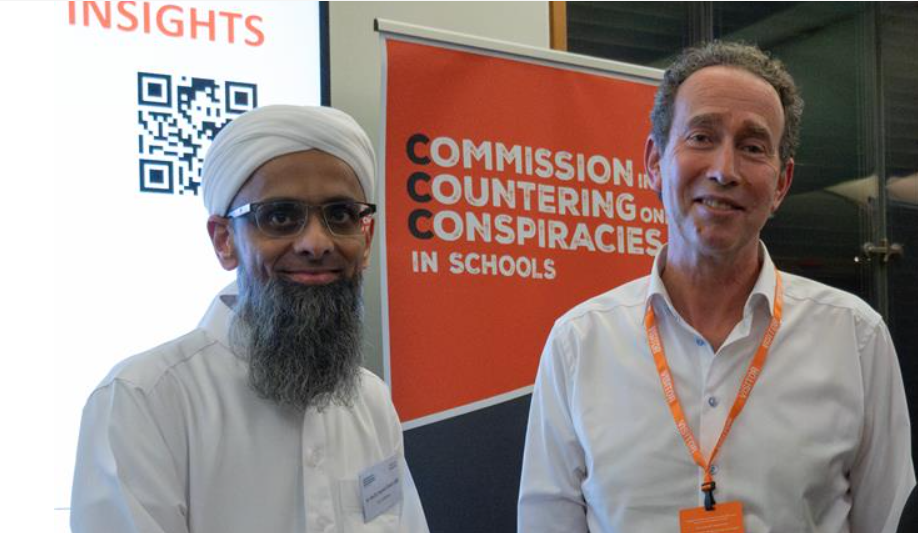
This was why we came together in 2024 to establish, and jointly lead, the Commission into Countering Online Conspiracies in Schools.
We did so because we were hearing the same message from classrooms and communities across the country: online conspiracy belief was no longer confined to the margins. It was marching openly through the school gates, with teachers on the frontline.
Teachers told us they felt overwhelmed. They were facing a growing stream of false, hateful and conspiratorial content, yet had little practical support on how to respond.
Parents, too, were worried and confused by what their children were seeing online — but schools were often unsure how to advise them.
Young people themselves admitted they were struggling to distinguish fact from fiction in a digital world designed to blur the line between the two.
For Pears Foundation, this work was shaped by a long history of supporting organisations across the youth sector, education, communities and social cohesion. That experience has given us a deep understanding of how the ties that bind us are being tested to breaking point — but also of what it takes to strengthen them.
For Star Academies, it was informed by supporting and running thirty‑six schools in some of Britain’s most ethnically diverse communities.
Together, those experiences make one thing clear: this is both a particular problem and a universal one. It affects all young people, all schools and every community.
The Commission is clear that the response cannot be fragmented or siloed. It must be collaborative, practical and rooted in the places where young people learn how to live alongside one another.
That is why schools matter so much. They are not just places where children learn to pass exams; they are where young people learn how to analyse information, how to question, how to socialise and how to grapple with complexity. They prepare children for life in modern Britain.
In an age shaped by algorithms, deepfakes and viral falsehoods, that preparation must include the skills, confidence and judgement to navigate the online world.
The Commission’s work aims to support all schools and all communities, including schools serving the Jewish community and the Star academies that serve Muslim communities.
And the need is growing.
Our evidence suggests we cannot afford complacency. The crisis of truth is no longer an abstract concern. It is affecting classrooms, family conversations and the way young people understand the world around them.
The Commission’s 2026 research, conducted by Public First, offers a stark warning. Parental reports of their child raising a conspiracy belief have risen by a third since 2025. Young people identified fake news as their second biggest concern online, behind only cyberbullying and online harassment. 81 per cent of school staff said a pupil had raised a conspiracy theory with them in school.
In focus groups, primary and secondary teachers described the range of material pupils now bring into classrooms: long-standing conspiracies about 9/11 or vaccines, alongside claims linked to current affairs and global conflicts. These are not harmless curiosities. They shape trust, belonging and the way young people see one another.
The confidence gap is now striking. 71 per cent of young people, 78 per cent of parents and 85 per cent of school staff either agreed or strongly agreed that it is harder to tell what is real and fake online. AI has made this challenge even more urgent. False content can now be created quickly, convincingly and at scale.
When children, parents and teachers all feel the ground seismically shifting beneath them, schools need more than warm words. They need tools.
Our Commission has worked to make the case in Whitehall and Westminster that online conspiracy belief, misinformation and disinformation are universal challenges requiring a universal response.
There are encouraging signs. The Commission’s research had a major influence on the Department for Education’s focus on media literacy through the Curriculum and Assessment Review, and its work to update Keeping Children Safe in Education guidance.
In line with the evidence, and our recommendations on teacher training, Pears Foundation has funded the creation of a brand new Centre for Digital Information Literacy in Schools, run by the National Institute of Teaching, and funded the UCL Institute of Education to develop and roll out research-informed teacher training.
But there is much more to do. The Commission is now moving into a third year of research with teachers, parents and young people. Our focus will remain fixed on practical action: better support for schools, stronger tools for teachers, and a shared commitment to helping children navigate the digital world safely and wisely.
We owe that to our children and to every community affected by hatred and division. Because the terror that happened in Golders Green did not begin on a street corner. Long before violence appears in public, ideas are circulated online, repeated in private and absorbed by young people still learning who to trust. We cannot wait until hatred spills into the open before we act.
Sir Trevor Pears is Executive Chair of the Pears Foundation. Sir Hamid Patel is Chief Executive of Star Academies. Together they are co-chairs of the Commission into Countering Online Conspiracy in Schools

Keep community journalism free.
Jewish News is free for everyone. No paywall. No barriers. Just trusted journalism for anyone who wants to stay connected to Jewish life in Britain.
If you value that, please support us.
From as little as £5 a month, you can help keep our journalism free and accessible to all.
Every day, we report on the issues that matter to our community. We celebrate achievements, support charities, challenge antisemitism and ensure Jewish voices are heard more widely.
From as little as £5 a month, you can help us continue to:
- Report on the stories shaping Jewish life in the UK and beyond
- Bring our community together through shared stories, events and campaigns
- Celebrate the people, culture and moments that define our community
- Support organisations doing vital work across Jewish Britain
You can make a one-off donation or become a regular supporter. Every contribution helps keep our journalism free, independent and accessible to all.
If everyone who values Jewish News gave a small amount, it would make a real difference to our future.