Prefer Jewish News on Google

Our homes are a last bastion of protection – now anti-Zionists want to take that too
Many "anti-racists' seem confused as to the visceral reaction by many Jews towards their door knocking campaigns
Let’s set the scene. You’re at home, going about the day, when suddenly the doorbell rings. You answer it, to find a keffiyeh-clad young man with a friendly expression, clutching a clipboard. “Good afternoon. I’m here to talk to you about an ‘Apartheid Free Zone’ campaign we’re conducting to boycott Israel in response to the apartheid in Palestine. We’d like to know whether you will join us, and pledge not to buy Israeli goods.”
You find yourself apologising – you’re a British Jew, after all, so apologising comes naturally – but tell them that you’re not interested. And as they walk away, you see them making a mark on their clipboard.
If asked, they would doubtless say that they’re simply recording your house number so that they don’t bother you again. The other way of looking at it, of course, is that your house has now been identified as a place which opposes something the campaigners believe to be an obvious expression of good.
By declining their polite invitation, therefore, you have therefore chosen to side with evil. For all you know, your house will now end up on a database, with others deemed hostile to the cause. This is slightly different to campaigning by political parties. All major political parties electioneer on the doorstep, but there are not, as far as I’m aware, simultaneously a large number of incidents around the country where people are targeted for physical and verbal abuse specifically because they will not agree to boycott the Conservative party, for instance.
For all you know, your house will now end up on a database, with others deemed hostile to the cause

Many so-called “anti-racist” campaigners seem to have no idea why many Jewish people are reacting to this so viscerally. The answer is simple. Vandalism of Israeli (and often kosher) items in supermarkets, or a campaign attempting to pressure shops not to buy Israeli products, is viewed as extremely unpleasant, but at a relative distance.
Although this door-knocking is not specifically targeted at Jews, there is, for so many of us, the perception that our homes are a safe place. That no matter what is being screeched at “anti-Israel” rallies or what hatred is directed towards you in the street, in this country your home is somewhere you can exist, unmolested. This is particularly valued, given the family stories so many of us have about our relatives having been driven out of their homes, whether in Europe or the Middle East.
Except now the anti-Zionists want to take away that safety too.
There is another element to consider here. It is a key article of faith on the anti-Zionist left that antisemitism and anti-Zionism are entirely different things, and that those who conflate the two are disingenuous, at best. The problem with this, of course, is that there has always been a strain of the far right which has been vocally “anti-Zionist” (the notorious antisemitic forgery isn’t called ‘Protocols of the Jewish elders’, for instance), and the language and conspiracy theories that they have long used has, in the last few decades, made the jump to the far left.
The “Zio” epithet, for example, was popularised by David Duke, perhaps best known as a former Imperial Wizard of the Ku Klux Klan. Conspiracy theories about Israel being some sort of world centre for paedophiles, or being behind 9/11, began their repulsive existence on American far right websites like Veterans Today or If Americans Knew.
Nowadays, you are just as likely to find them being mentioned by people with Human rights hashtags in their social media bios.
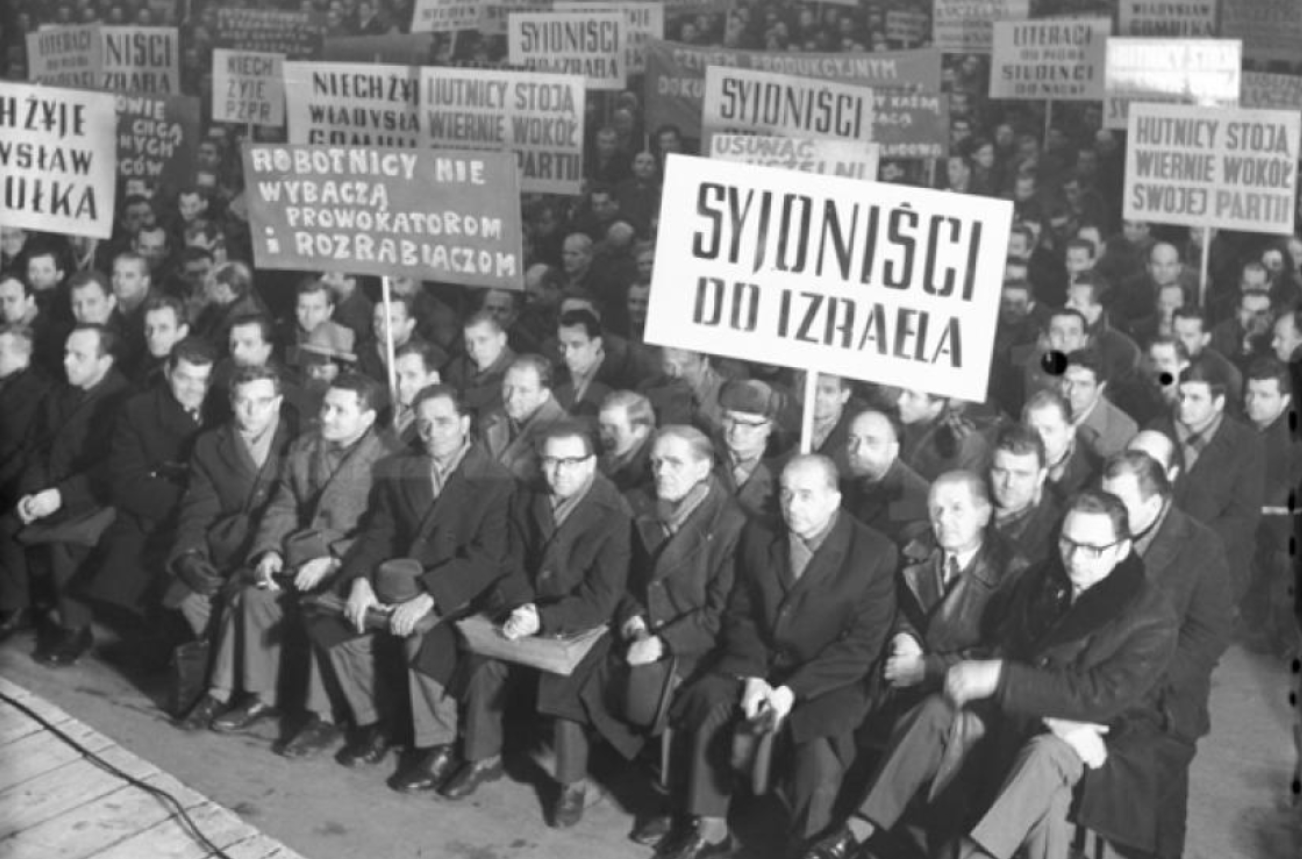
But of course, the last example of a campaign of nationwide state repression of Jews in Europe was not the Holocaust. It took place in Communist Poland, from 1967-1970, and it was specifically marketed as “anti-Zionist”, rather than antisemitic. This, of course, was a deep and insidious lie. Jews – or even those who merely had some Jewish ancestry – were accused of dual loyalty, and were purged from politics, universities, the law and the armed forces.
To add to the horror, a significant number of those targeted were Holocaust survivors. In 1967, the Jewish population of Poland was a little over 30,000 – less than 1% of its pre-World War Two level. By 1970, approximately 25,000 of that small remnant had fled. “Zionists to Israel!” was a popular exhortation at the time from those seeking to drive the Jews out – adding another level of grotesque irony to today’s exhortations among a cohort of the pro-Palestinian left that Jews in Israel should “go back to Poland”. It would only be after the collapse of Communist rule that the Polish government would acknowledge that the campaign was antisemitic and had hid behind the guise of “anti-Zionism”
This is not a part of history that those cheerfully knocking on doors in Brighton or Bristol (where the campaign began) are likely to have heard of. But maybe they’d like to take a little bit of time out from conducting house calls to read up about it. Because whether they realise it or not, their actions are being seen by many Jews not as continuing in the tradition of those who campaigned against apartheid in South Africa, but rather in the spirit of those who marched, perfectly convinced of their own righteousness, in Warsaw and Krakow and Lodz and Lublin in 1968.

Keep community journalism free.
Jewish News is free for everyone. No paywall. No barriers. Just trusted journalism for anyone who wants to stay connected to Jewish life in Britain.
If you value that, please support us.
From as little as £5 a month, you can help keep our journalism free and accessible to all.
Every day, we report on the issues that matter to our community. We celebrate achievements, support charities, challenge antisemitism and ensure Jewish voices are heard more widely.
From as little as £5 a month, you can help us continue to:
- Report on the stories shaping Jewish life in the UK and beyond
- Bring our community together through shared stories, events and campaigns
- Celebrate the people, culture and moments that define our community
- Support organisations doing vital work across Jewish Britain
You can make a one-off donation or become a regular supporter. Every contribution helps keep our journalism free, independent and accessible to all.
If everyone who values Jewish News gave a small amount, it would make a real difference to our future.