Prefer Jewish News on Google

Potholes or Palestine? A local election consumed by ideological obsession
It's no secret that the Green Party has put its anti-Israel stance front and centre in recent months. But what does that actually mean for voters next month?
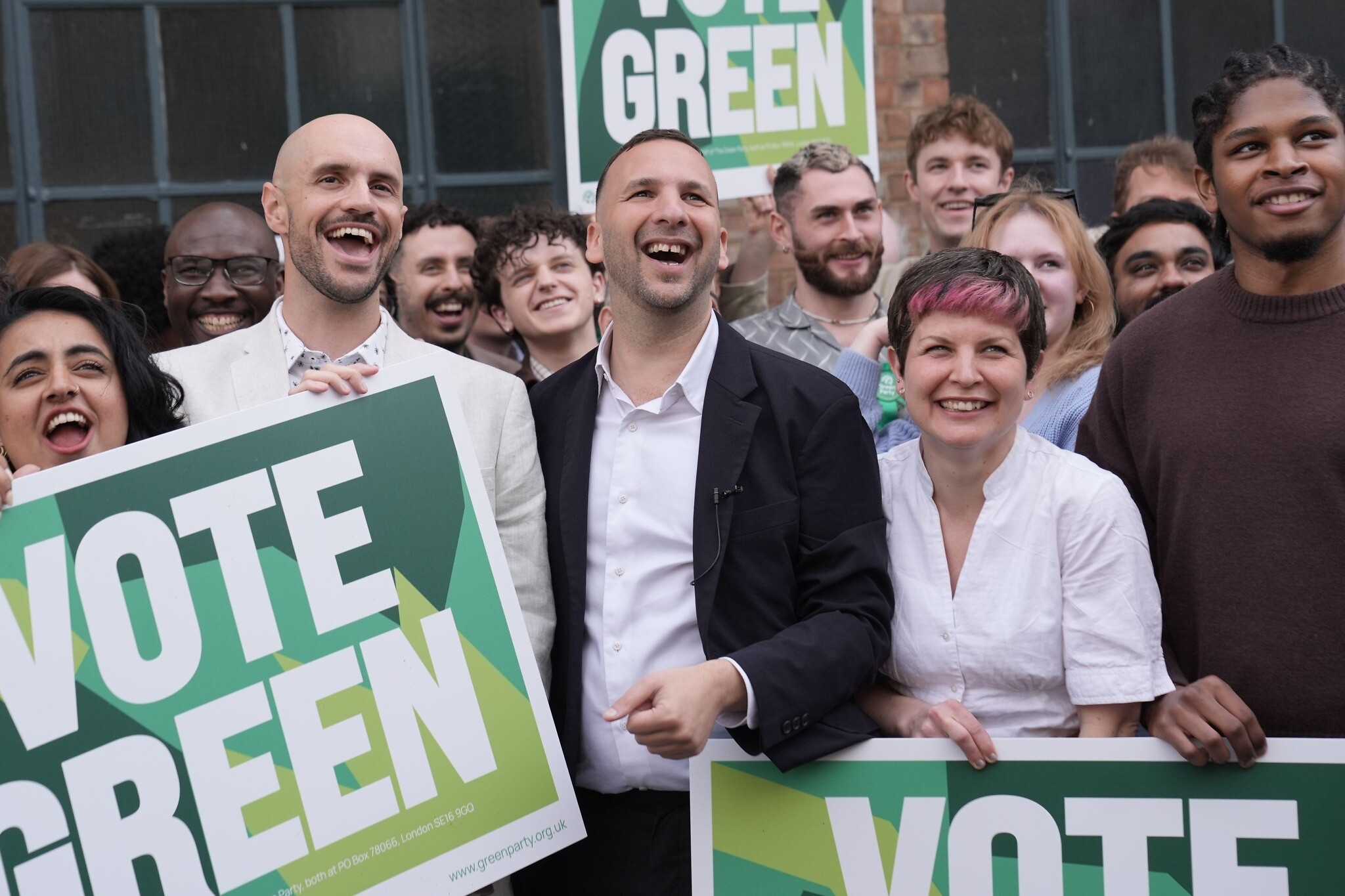
Next month large swathes of the UK, including the whole of London, will hold local elections. I’ll be casting my vote. Before I do, I’ll be thinking about local issues which affect me and which the council has the power to influence.
This will include potholes and bin collections, naturally, but also things like housing and planning – a considerable new housing development is being proposed near me and I am in favour of it, though I would very much like to ensure that if it goes ahead the necessary infrastructure will be in place to support it. It also includes libraries – a number of them have closed in the borough where I live. Local councils also have responsibility for certain education provisions which could potentially affect my family. I’ll be voting with that in mind as well.
It would be wrong to say that the Green Party does not concern itself with such issues – they do. They have local manifestos which cite a range of issues of concern to local residents. But they also have something else – an obsession with Israel.
The following is, verbatim, the language of a video released by Green Party candidates in Haringey this week:
“Voting Green in the Haringey local elections on 7 May is a vote against genocide. As a councillor I will take all appropriate steps to uphold the inalienable rights of the Palestinian people, 2. Support efforts to prevent, and ensure accountability for, Israel’s crimes of genocide, military occupation, ethnic cleansing and apartheid. 3. Ensure my council is not complicit in and does not help to normalise Israel’s violations of international law, including through the council divesting pensions and any other funds it administers from complicit companies and through its procurement policies.”

That was it. Nothing else.
The Green Party and its defenders will put forward the following case. They will say that the Gaza War (which they refer to as the “Gaza genocide”) is the defining moral issue of our times (which ignores a whole host of other horrifying conflicts going on in the world, but bear with me here). If you hold that opinion, as many Green supporters do, then it is profoundly irresponsible – indeed, immoral – not to consider one’s stance on Israel as being a contributing factor when going to the polling station.
But let’s dig into this a little deeper. I was interested in the language around “inalienable rights of the Palestinian people” in the video. It is a phrase that is regularly used in many places, including in United Nations resolutions. But the place I have seen it most prominently within a Green Party context is in the recent “Zionism is Racism” motion put forward at the Green Party’s Spring conference. The relevant paragraph (the fourth resolution it calls on the Greens to adopt) says:
“The Green Party affirms the Palestinian people’s inalienable right to self-determination, including the right of the Palestinian people to resistance and liberation from Israeli occupation, domination and subjugation, and acknowledges that the struggle to achieve that liberation by all available means under international law is legitimate.”
In a further helpful clarification, one of the appendices at the end of the motion specifically refers to the right to “armed struggle”.
There is only one major Palestinian group currently engaged in “armed struggle” with Israel, and it happens to be proscribed in the UK. At this point I should also note that the proposer of the Green Party motion in question has made it clear that she thinks Hamas should not be proscribed.
Maybe Haringey Greens do not mean that language in this context – and maybe they do. The language is vague enough to tick all boxes.
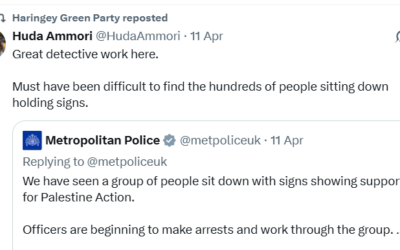
Let us turn to number two. Again, what exactly could “efforts to prevent and ensure accountability for” mean, other than the economic boycott measures specifically mentioned in number 3? It becomes a little clearer when you realise that one of the two sitting Green Haringey councillors signed an open letter decrying the proscription of Palestine Action last year (the letter falsely refers to “peaceful protest tactics”, which may raise some eyebrows among anyone actually aware of some activities the group has undertaken). A number of other Haringey Green candidates have expressed open support for Palestine Action.
And that, of course, brings us to number three, which is the area in which local councils actually do have some say – local investments, including “the council divesting pensions and any other funds it administers from complicit companies” connected to Israel. The Haringey Greens Manifesto goes slightly further, referring to how “research by the Palestine Solidarity Campaign shows that Haringey’s pension scheme has investments in BAE systems, Palantir, Barclays, and other companies complicit in Israel’s violations of international law.”
That “other companies” element is, again, slightly vague – and again, if you do a bit of digging, you can see why. The PSC identifies more than 30 companies in which Haringey council has “complicit investments”. These include Alphabet (which owns Google and YouTube), Amazon, Axa, Boeing, Ford, HSBC, Hyundai, McDonalds and Sony.
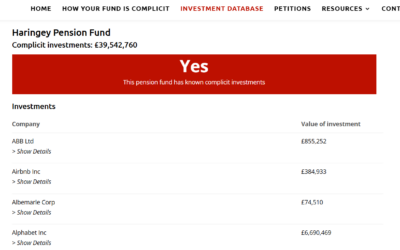
In some cases, the companies listed by PSC merely operate in Israel. In others, firms are deemed “complicit” not because of anything they have done personally, but because they have investments in companies on the actual ‘bad’ list. A third category includes global corporations who have at some point sold any equipment to Israel (including non-military equipment).
This is not normal behaviour.
I imagine there are many people in the UK who are deeply concerned at the devastation they have seen in Gaza. Some may look at the Green party’s general rhetoric and find themselves nodding in agreement. My advice is to spend just a little bit of time looking further into what you are being told (advice I would extend towards anyone looking at any political party, for that matter).
You may find yourself nodding a little less and shaking your head a little more.

Keep community journalism free.
Jewish News is free for everyone. No paywall. No barriers. Just trusted journalism for anyone who wants to stay connected to Jewish life in Britain.
If you value that, please support us.
From as little as £5 a month, you can help keep our journalism free and accessible to all.
Every day, we report on the issues that matter to our community. We celebrate achievements, support charities, challenge antisemitism and ensure Jewish voices are heard more widely.
From as little as £5 a month, you can help us continue to:
- Report on the stories shaping Jewish life in the UK and beyond
- Bring our community together through shared stories, events and campaigns
- Celebrate the people, culture and moments that define our community
- Support organisations doing vital work across Jewish Britain
You can make a one-off donation or become a regular supporter. Every contribution helps keep our journalism free, independent and accessible to all.
If everyone who values Jewish News gave a small amount, it would make a real difference to our future.