Prefer Jewish News on Google
Rabbi confronts Board chief to his face during Shabbat sermon
Rabbi Gabriel Kanter-Webber said: 'Here I am today, looking the Board of Deputies’ chief executive in the eye and telling him just how poorly his institution has behaved'

A Brighton rabbi used his Shabbat service, attended by members of the Board of Deputies, to publicly lambast the organisation’s handling of deputies who signed a letter condemning Israeli military action in Gaza.
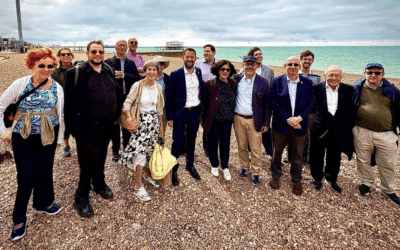
Rabbi Gabriel Kanter-Webber of Brighton and Hove Progressive Synagogue addressed the issue during his sermon in a service coinciding with the Board’s plenary in the city last weekend. Among those present were several deputies and the Board’s chief executive, Michael Wegier.
The rabbi condemned the Board’s decision to sanction 36 deputies who signed a letter to the Financial Times in April, which accused the Israeli government of breaking the ceasefire and reigniting the war in Gaza. He said the signatories had acted “in the name of heaven”.
The letter stated: “Israel’s soul is being ripped out and we, members of the Board of Deputies of British Jews, fear for the future of the Israel we love.” It added that silence was being interpreted as support for policies “contrary to our Jewish values”.
Last month, 31 of the deputies had warning letters sent to their Synagogue. The other five, some of whom had given media appearances after the letter was published putting forward their position, were suspended from the Board for two years, with three of them given the opportunity “reduce the suspension to six months by way of an apology to affected parties” – an offer they rejected.




Kanter-Webber told his congregation that “there is a fundamental message here that the Board of Deputies overlooked when saying to itself: ‘Will no-one rid us of these turbulent Liberal and Reform members?’
“The 36 deputies who signed the Financial Times letter, and the five who allegedly aggravated their sin of signing it by doing extra-bad things like sharing it with friends on Facebook, were not mounting a coup. They had no interest in trying to overthrow the leadership of the Board. No. What they were doing was an act of thought leadership for the benefit of the wider community. Not everyone was going to follow them; not everyone will follow any leader. However, what they were doing was, without a shadow of a doubt, for the sake of heaven.”
Kanter-Webber also called out the Board’s chief executive directly, saying: “Here I am today, looking the Board of Deputies’ chief executive in the eye and telling him just how poorly his institution has behaved.”
Jewish News understands that despite Kanter-Webber also saying that he had known Wegier for many years and that “I’m sure he’ll have been expecting me to deliver a word of rebuke”, the Board had been unaware that the rabbi would choose to conduct himself in such a fashion during his sermon.
In its announcement of the sanctions against the deputies, the Board stressed that “the breaches primarily arose from the public presentation and promotion of the letter, which created the misleading impression that this was an official document of the Board as a whole.” The organisation also confirmed that the letter was “neither authorised by the Board nor did the signatories share it with the organisation before sending to the Financial Times.”
While the letter received some support within the community, the Board also received a great deal of criticism from British Jews who believed that the 36 Deputies were putting forward the organisation’s official position.
Kanter-Webber also claimed: “The disciplinary panel’s unpublished findings include the extraordinary assertion that it undermines the ‘harmonious … working environment’ of the Board for its members to have and share their own opinions, and doing so is ‘disrespectful to other[s] who may not hold the same views’.
“Apparently, the very suggestion that ‘there are divisions [between the 350] members of the Board’ is something that brings the institution ‘into disrepute’ (because who could possibly have guessed, without it being illicitly leaked to the press, that not all Jews agree when it comes to Israel?)”
Jewish News understands that Wegier was given an opportunity to address congregants a little later during the service and told those present that Kanter-Webber’s statements about the Board’s conduct were inaccurate.
Jewish News also understands there has been considerable friction between the Progressive Movement and the Board as a result of the sanctions on the deputies; every one of the 36 representing a synagogue came from the Progressive Movement.
Last month the Progressive Moment response to the Board’s action stressed that it had noted that “the decision was taken due to a breach of the Board’s Code of Conduct, and not because of any specific views expressed by the Deputies.
“A key principle of Progressive Judaism is diversity of voice. We believe that the Jewish community, and the world, benefits from such robust and open dialogue, in which we seek to disagree respectfully. We therefore hope that the Board’s decision will not be used by anyone to seek to silence these important conversations.”
The movement declined to comment on Kanter-Webber’s sermon, in which he also sought to compare the current disagreements between Deputies to the major change in attitude towards Zionism in the Board some 80 years ago.
“These days it feels faintly laughable to recall that as recently as the late 1930s, the presidency of the Board of Deputies was held by a barrister called Neville Laski who was ‘fiercely anti-Zionist’”, he said.
“How did the Board transition from electing an anti-Zionist leader in 1933 to becoming a Zionist institution a decade later without minority voices pushing for change? Nobody today would suggest that the early Zionist Deputies should have been suspended for undermining the ‘harmonious … working environment’ of the Board. Nobody today would suggest that, by believing something contrary to the president’s own doctrines, they were being “disrespectful to other[s]”.
Kanter-Webber did not include any reference to what else might have happened after the late 1930s which may have influenced the Board’s attitude towards Zionism.
The Progressive rabbi concluded his talk by saying “The future of the Liberal and Reform shuls’ relationship with the Board of Deputies may be very much up in the air, but our commitment to open-minded listening continues unabashed.” It is unclear whether he meant the specific shuls which the suspended Deputies came from, or the wider Progressive movement.
Rabbi Gabriel Kanter-Webber has been approached for comment.

Keep community journalism free.
Jewish News is free for everyone. No paywall. No barriers. Just trusted journalism for anyone who wants to stay connected to Jewish life in Britain.
If you value that, please support us.
From as little as £5 a month, you can help keep our journalism free and accessible to all.
Every day, we report on the issues that matter to our community. We celebrate achievements, support charities, challenge antisemitism and ensure Jewish voices are heard more widely.
From as little as £5 a month, you can help us continue to:
- Report on the stories shaping Jewish life in the UK and beyond
- Bring our community together through shared stories, events and campaigns
- Celebrate the people, culture and moments that define our community
- Support organisations doing vital work across Jewish Britain
You can make a one-off donation or become a regular supporter. Every contribution helps keep our journalism free, independent and accessible to all.
If everyone who values Jewish News gave a small amount, it would make a real difference to our future.