Prefer Jewish News on Google
Real-life Holocaust survivors star in Scarlett Johansson’s directorial debut
Rita Zohar, who was born in a concentration camp, said her role in the new film allowed her to verbalise her experience
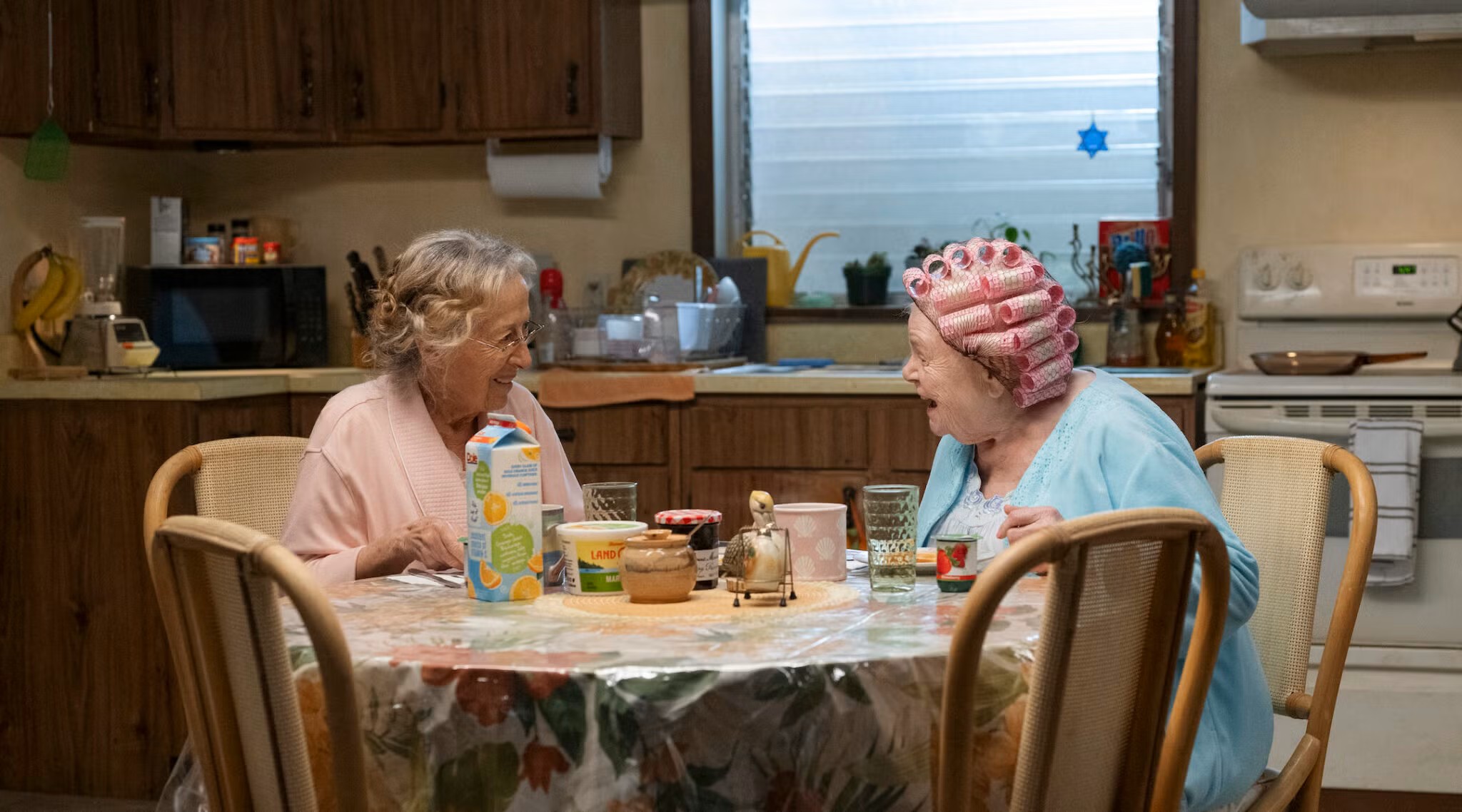
When Rita Zohar stepped into the role of Bessie Stern, a Holocaust survivor whose death sets in motion Scarlett Johansson’s new film Eleanor the Great, she wasn’t simply acting.
Zohar, 81, is a childhood survivor of the Holocaust. She was also drawing on her lived experience of loss and resilience to bring life to her character.
“This role in this movie has given me a voice,” Zohar told the Jewish Telegraphic Agency. “Even though this is not my story, this is not what happened to me or my family, but still, by being able to verbalise it, I connected to Bessie, and I became Bessie in the film.”
Eleanor the Great, Johansson’s directorial debut, stars 95-year-old Jewish actress June Squibb as she seeks connection in New York City following the death of her best friend Bessie. Feeling isolated, Squibb’s character, Eleanor Morgenstein, winds up joining a support group for Holocaust survivors at the local Jewish community center.
There, when pressed by the group’s members to share her story, Morgenstein tells Bessie’s story as her own, which Zohar orates in her own words.
“At one point, they asked her, and they kind of pressure her to tell her story, and without any intention to lie, she starts telling the story as if it was hers,” said Zohar. “And then what happens in the movie is that she starts the first sentence, and then I appear and I tell the story.”
That choice, according to the script’s author Tory Kamen, was intentional. In an interview with Hey Alma, Kamen said the character Bessie was named after her grandmother’s best friend in Florida, who is a Holocaust survivor.
“Another thing that was important to me was that we never really saw Eleanor telling Bessie’s story. I wanted that to be from Bessie’s mouth. That story should only be told by Bessie,” Kamen said. “And Rita Zohar, who plays Bessie, is a Holocaust survivor herself, and does an unbelievable job.”
Morgenstein’s story echoes others who have also falsely portrayed themselves as survivors. In 2016, a Pennsylvania man publicly apologised after giving speeches claiming to have survived Auschwitz, and in 2019, a German historian was outed for fabricating a family history of suffering in the Holocaust.
Later on in the film, Morgenstein’s story is picked up by a young journalism student played by Erin Kellyman, whose father’s efforts to learn more about her story threatens to reveal her dishonesty.
For Johansson, who broke down in tears on the PBS show Finding Your Roots in 2017 after learning her family had perished in the Warsaw Ghetto, the movie had a special resonance.
“A lot of my family history was lost and it wasn’t until many years later that I was actually able to connect with my family heritage,” Johansson said in a red carpet interview at the Toronto Film Festival. “I think because of that, this story really resonated with me. These survivors’ stories are lost, there are organisations like Shoah that are committed to documenting them for future generations and their work is so important. I hope that this film really encourages people to ask questions of their relatives and to keep their stories alive.”
Johansson worked with the USC Shoah Foundation as well as Congregation Rodeph Sholom, a Reform synagogue in Manhattan, to ensure real Holocaust survivors were featured in the film.
That decision also led to the casting of Zohar, who was born in a concentration camp in Ukraine in 1944 where she was hidden during her infancy in a gap between two walls beneath a window.
“When the Russians came and liberated the camp, at that time, I was four-and-a-half months old, and that probably saved my life, because I wouldn’t have been able to survive longer than that,” said Zohar.
While the majority of her family was murdered, Zohar survived along with her mother and grandmother. After the war, Zohar’s remaining family emigrated to Romania where they lived until she and her mother moved to Israel in the 1950s.
“Arriving to Israel, it’s as if you discovered the sun for the first time,” said Zohar. “It was our sun, it was our country, and the whole country was at that time, so together, we were so high.”
At 14, Zohar began touring around the world with her mother acting in Israel’s Yiddish theatre before eventually starring in major movies, including Amadeus, in Hollywood in the 1980s. She later returned to Israel, where she starred in several critically acclaimed films including Laura Adler’s Last Love Affair and Mrs. Moskowitz and the Cats.
For Zohar, while some critics of Eleanor the Great have balked at the movie’s false Holocaust narrative, she believes the film lends from a long tradition of Jews empathizing with their ancestors’ persecution, and that for Squibb’s character, “it’s as if she was there”.
“They talk about Eleanor telling a lie, and I look at it a little bit differently, because when we celebrate Passover or any of the Jewish holidays, and we talk about the history and that we were slaves, we always say it as if we were there,” said Zohar.
As the remaining Holocaust survivor population sharply declines, Zohar said that continuing to contribute to Holocaust storytelling was “a gift.”
“It’s extremely important, because you have to look at the age,” Zohar said. “I mean, there will come a time that there will be no survivors, and who will tell our story?”

Keep community journalism free.
Jewish News is free for everyone. No paywall. No barriers. Just trusted journalism for anyone who wants to stay connected to Jewish life in Britain.
If you value that, please support us.
From as little as £5 a month, you can help keep our journalism free and accessible to all.
Every day, we report on the issues that matter to our community. We celebrate achievements, support charities, challenge antisemitism and ensure Jewish voices are heard more widely.
From as little as £5 a month, you can help us continue to:
- Report on the stories shaping Jewish life in the UK and beyond
- Bring our community together through shared stories, events and campaigns
- Celebrate the people, culture and moments that define our community
- Support organisations doing vital work across Jewish Britain
You can make a one-off donation or become a regular supporter. Every contribution helps keep our journalism free, independent and accessible to all.
If everyone who values Jewish News gave a small amount, it would make a real difference to our future.