Prefer Jewish News on Google
Foreign Secretary arrives in Saudi Arabia after talks with Israeli, US, and Gulf State counterparts
Cooper said:'The UK stands with our allies against Iran's reckless attacks on its neighbours'
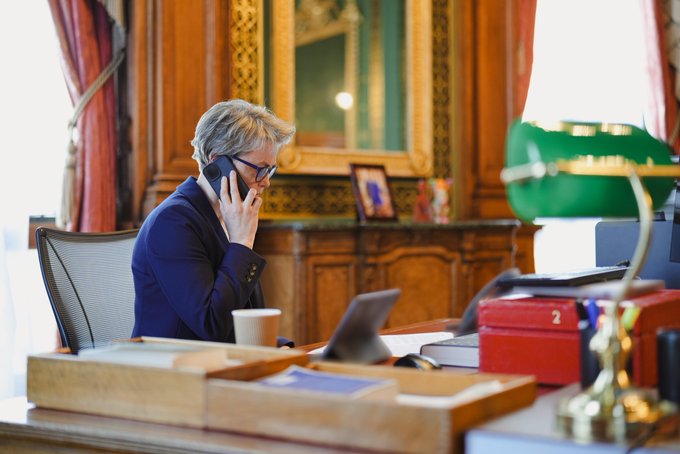
Foreign Secretary Yvette Cooper has travelled to Saudi Arabia in a show of solidarity with Britain’s allies in the Gulf.
She has also engaged in urgent talks with counterparts in the United Arab Emirates, Qutar and Bahrain about joint efforts to protect UK citizens and safeguard regional responsibility.
Discussions followed her earlier extensive telephone conversation with Israel’s foreign minister Gideon Sa’ar on Wednesday, and also with US officials.
Cooper said:”The UK stands with our allies against Iran’s reckless attacks on its neighbours.
“We’re working around the clock to return British citizens and protect UK interets in the region.”



Her arrival in Riyadh – the first to the region by a UK minister since the outbreak of war – came hours after Saudi Arabia said it shot down one drone targeting the capital’s diplomatic quarter and another heading for an oil field in the east of the country.
Cooper met Saudi Arabia’s foreign minister and interior minister during her visit to Riyadh.
After an hour-long meeting at the foreign ministry with Prince Faisal bin Farhan to discuss the conflict with Iran, she travelled to the interior ministry to speak to Prince Abdulaziz bin Saud.
Abdulaziz opened the meeting by saying it was a “tough time” for the region but it was important to “deal with reality as it is”.
She visited Saudi Arabia’s General Authority for Civil Aviation (GACA) to thank staff for their work keeping the country’s airspace open.
Saudi Arabian airspace has remained open throughout the Iran crisis, despite occasional brief airport closures, providing corridors for aircraft repatriating people from other Gulf nations.
Ms Cooper has already visited staff at the British embassy in Riyadh to thank them for their work helping British nationals in the Gulf.
They included members of the Foreign Office’s rapid deployment team, scrambled to the region the day after the war began to assist in the consular effort.
Some 63,000 British nationals have already returned from the region, which Ms Cooper said was a “huge tribute” to the consular team’s work.
On Wednesday morning she spoke with Israeli foreign minister Gideon Sa’ar.
The call is believed to be the first senior-level contact between the UK government and Israel since the outbreak of war with Iran twelve days ago.
Following the telephone conversation Sa’ar immediately posted on X: “Held an extensive call with UK Foreign Secretary Yvette Cooper and briefed her on our war against the Iranian terror regime.
“I described the regime’s savage attacks against us and its neighbouring states, while not possessing a nuclear umbrella. Imagine what it could do if it had nuclear weapons.
“I detailed the Iranian proxy Hezbollah’s attacks against Israel’s citizens and communities, and even against Cyprus.
“I said that Lebanon will remain under de facto Iranian occupation if Hezbollah isn’t dismantled.”
Jewish News understands the conversation also involved discussion about the situation in Gaza.
Cooper is understood to have expressed the UK’s solidarity with Israel, amid ongoing strikes from Iran and its proxies.
She also noted that the UK is conducting defensive operations and wants to see a resolution to restore regional stability.
PM Keir Starmer has so far stopped short of offering immediate support for US-Israeli strikes on Iran, favouring instead defensive operations to protect British interests in the region.
However, the UK has allowed US bombers to use RAF bases to refuel and launch attacks.
Jewish News understands that Israel was not surprised by this position, but relations between Benjamin Netanyahu’s government and the UK remain “tense.”
Sources indicate a series of backchannel discussions have been taking place between officials on both sides, both before and since the conflict began.
It is understood that after Wednesaday’s call both sides suggested the talks between Cooper and Sa’ar had been constructive.

Cooper and Sa’ar previously engaged in a heated exchange last month during a UN session convened by the UK as part of its presidency of the Security Council.
On that occasion, Cooper raised concerns about settler violence and the situation in the West Bank, calling for stronger Palestinian leadership.
In response, Sa’ar paid tribute to Britain’s longstanding support for the State of Israel, referencing pivotal moments such as the Balfour Declaration, Winston Churchill’s visit, and the Commonwealth’s role in supporting the establishment of a Jewish state.

Keep community journalism free.
Jewish News is free for everyone. No paywall. No barriers. Just trusted journalism for anyone who wants to stay connected to Jewish life in Britain.
If you value that, please support us.
From as little as £5 a month, you can help keep our journalism free and accessible to all.
Every day, we report on the issues that matter to our community. We celebrate achievements, support charities, challenge antisemitism and ensure Jewish voices are heard more widely.
From as little as £5 a month, you can help us continue to:
- Report on the stories shaping Jewish life in the UK and beyond
- Bring our community together through shared stories, events and campaigns
- Celebrate the people, culture and moments that define our community
- Support organisations doing vital work across Jewish Britain
You can make a one-off donation or become a regular supporter. Every contribution helps keep our journalism free, independent and accessible to all.
If everyone who values Jewish News gave a small amount, it would make a real difference to our future.