Prefer Jewish News on Google
Settlements sanctions ‘clumsy tool but not same as an attack on Jews’, says Progressive Judaism
Co-leaders Rabbi Josh Levy and Rabbi Charley Baginsky claim ''No single response can speak for British Jews' as left-wing group Yachad welcomes 'important and necessary' government move
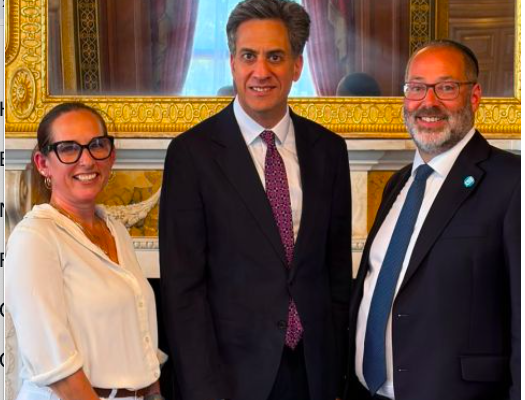
UK Government sanctions on illegal Israeli settlements “are not the same as an attack on Jews”, The Movement for Progressive Judaism has said.
It has insisted that holding the Israeli government “accountable for its actions does not cause antisemitism” in a statement a day after outrage from some quarters at Britain’s ban on trade with settlements in the West Bank.
Foreign Secretary Ed Miliband declared himself a “proud British Jew” who is “unwavering” in his support for the State of Israel as he told Parliament on Tuesday of the ban and sanctions on individuals and firms providing services to settlers.
Sir Ephraim Mirvis, Chief Rabbi of the United Hebrew Congregations of Great Britain and the Commonwealth, branded it “truly a dark day for British Jews”, describing the measures as “little more than political flag-bearing for mendacious anti-Israel rhetoric”.
He suggested people who “use hatred as a weapon against Jews” could be emboldened by the UK Government’s decision, adding the sanctions would “do nothing to advance the cause of peace”.



The Movement for Progressive Judaism, which says it represents around 30% of synagogue-affiliated Jews across the UK and Ireland, said: “No single response can speak for British Jews.”
Co-leaders of the movement Rabbi Josh Levy and Rabbi Charley Baginsky said in a joint statement: “Our community holds a genuine diversity of views on sanctions, settlements and the actions of both the British and Israeli governments.
“Jewish leadership has a responsibility to make that diversity visible, not to place those who disagree beyond the communal boundary.”
While they described sanctions as “a clumsy tool” and “almost certainly not a perfect mechanism”, they challenged those who reject them to “offer more than condemnation”.
They added: “We must say how settlement expansion will be opposed, what consequences should follow settler violence and dispossession, and how we will support Israelis and Palestinians working for democracy, dignity and peace.”
They asserted that “antisemites cause antisemitism”, rather than criticism of Israeli government actions, and warned that “Palestinian rights and international accountability cannot be made contingent upon the good behaviour of antisemites”.
They added: “Measures directed at Israeli settlements are not the same as an attack on Jews. We should take care not to collapse the distinction between them.”
British Jewish organisation Yachad voiced support for the UK Government’s announcement, describing it as an “important and necessary development”.
It recognised the “many different views in our community on this issue” but said it is clear the announcement “is not anti-Israel, and it is certainly not antisemitic”.
They added: “It is also not a boycott of Israel and it is not directed at all Israelis. It draws a clear line between sovereign Israel and the occupation.”
The Board of Deputies of British Jews – a representative body of more than 300 deputies directly elected by the synagogues and communal organisations they represent – said it had “deep regret” about the UK Government’s announcement and warned that “the deteriorating relationship between the UK and Israel has the potential to negatively impact the two countries’ security and their economies, and further inflame community tensions here too”.

Keep community journalism free.
Jewish News is free for everyone. No paywall. No barriers. Just trusted journalism for anyone who wants to stay connected to Jewish life in Britain.
If you value that, please support us.
From as little as £5 a month, you can help keep our journalism free and accessible to all.
Every day, we report on the issues that matter to our community. We celebrate achievements, support charities, challenge antisemitism and ensure Jewish voices are heard more widely.
From as little as £5 a month, you can help us continue to:
- Report on the stories shaping Jewish life in the UK and beyond
- Bring our community together through shared stories, events and campaigns
- Celebrate the people, culture and moments that define our community
- Support organisations doing vital work across Jewish Britain
You can make a one-off donation or become a regular supporter. Every contribution helps keep our journalism free, independent and accessible to all.
If everyone who values Jewish News gave a small amount, it would make a real difference to our future.