Prefer Jewish News on Google
‘Surreal’ moment an Auschwitz education centre opened its doors to Ukraine refugees
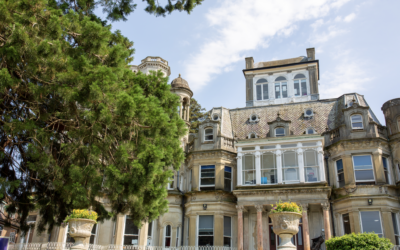
The building, normally used for teaching young people about the Holocaust, is a short walk from the site of the former death camp
A youth education centre near Auschwitz dedicated to preserving memories of Second World War and the Holocaust has opened its doors to help refugees fleeing war in the present.
A first bus carrying some 50 refugees, mostly women and children, arrived over the weekend at the International Youth Meeting Centre in Oswiecim, Poland.
The building, roughly a 20-minute walk from the Auschwitz-Birkenau death camp’s infamous entrance, usually hosts educational events about the Holocaust.
But its director Leszek Szuster said it would be doing everything possible to make sure that those fleeing the war in Ukraine had a safe place to stay.
The number of refugees displaced since Russia’s invasion of Ukraine began last month has exceeded three million, according to the latest United Nations figures.


At least 1.7 million of them have crossed the border into Poland, where citizens have stepped in to house refugees and non-governmental organisations and local communities have mobilised volunteers to provide everything from food and water to mobile SIM cards.
Among the new arrivals was Tamila Tvardovska, who came from Nikopol in southern Ukraine with her mother and three young children.
“I think there will be peaceful skies above our heads (here),” she said when asked about what the future holds for her.
“We were told that Kyiv was bombarded. We were at home. It was a terrifying feeling.
“We were told, we saw it on the news. The children were shocked.”
Pavel, a 27-year-old economist, took a drag from his vape pen in the courtyard of the centre as he recalled scenes of chaos when he fled Kyiv with his girlfriend and his mother soon after the start of the invasion.
To suddenly become a refugee and to be sheltering in a place of such historical significance as Auschwitz was surreal, he said.
More than 1.1 million men, women and children, mostly Jews, lost their lives at Auschwitz, built by the Nazi Germans in occupied Poland as the largest of their concentration camps and extermination centres.
Just a few weeks ago, Pavel said, he was playing guitar and eating sushi in his flat with his girlfriend.
“I don’t know what to do, I don’t know where to live. I left my life there. I don’t know,” he said.

Keep community journalism free.
Jewish News is free for everyone. No paywall. No barriers. Just trusted journalism for anyone who wants to stay connected to Jewish life in Britain.
If you value that, please support us.
From as little as £5 a month, you can help keep our journalism free and accessible to all.
Every day, we report on the issues that matter to our community. We celebrate achievements, support charities, challenge antisemitism and ensure Jewish voices are heard more widely.
From as little as £5 a month, you can help us continue to:
- Report on the stories shaping Jewish life in the UK and beyond
- Bring our community together through shared stories, events and campaigns
- Celebrate the people, culture and moments that define our community
- Support organisations doing vital work across Jewish Britain
You can make a one-off donation or become a regular supporter. Every contribution helps keep our journalism free, independent and accessible to all.
If everyone who values Jewish News gave a small amount, it would make a real difference to our future.