Survivors gather at Auschwitz for International Holocaust Remembrance Day
Political leaders say the Shoah must serve as a warning amid signs of rising extremism around the world
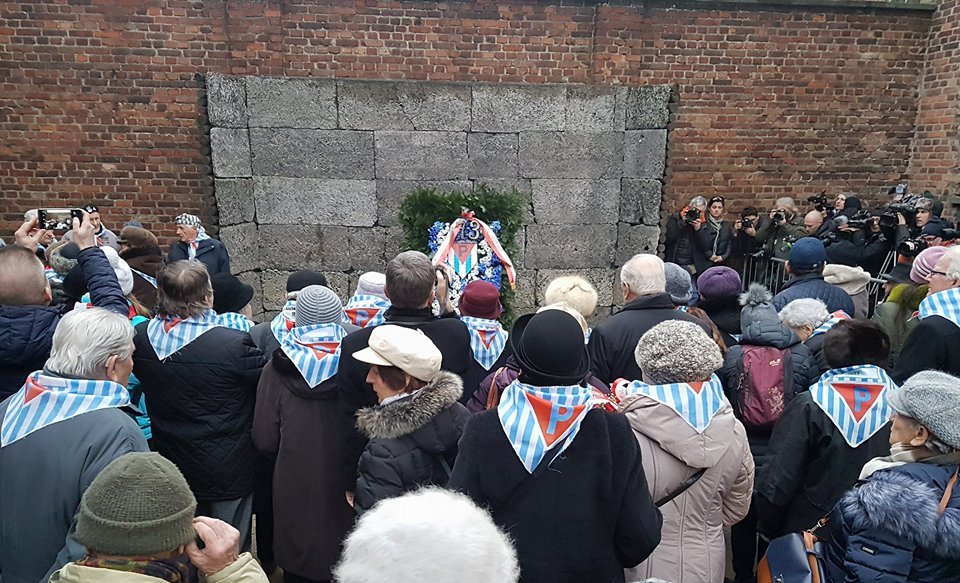
Elderly survivors are gathering at the former Auschwitz death camp as political leaders warned that the Nazi genocide must continue to serve as a warning while the world marked International Holocaust Remembrance Day.
In Warsaw, Poland, US Secretary of State Rex Tillerson paid his respects in a solemn ceremony at a memorial to the Jews who died revolting against German forces in the doomed Warsaw Ghetto Uprising of 1943.
Mr Tillerson trailed two uniformed Polish military officers and readjusted a wreath underneath the monument, a hulking structure located in what was once the Warsaw Ghetto.
The head of Warsaw’s Jewish community read a prayer and Mr Tillerson made brief remarks about the importance of not forgetting the horrors of the Holocaust.
Survivors gather at Auschwitz to tell their story:

Over 60 survivors will attend the commemoration event of the 73rd anniversary of the liberation of Auschwitz. Before the official part many of them tell their stories to journalists from all around the world. pic.twitter.com/F8RQVUMnQ8
— Auschwitz Memorial (@AuschwitzMuseum) January 27, 2018
“On this occasion it reminds us that we can never, we can never, be indifferent to the face of evil,” Mr Tillerson said.
“The western alliance which emerged from World War II has committed itself to the assuring the security of all, that this would never happen again,” he said. “As we mark this day in solemn remembrance, let us repeat the words of our own commitment: Never again. Never again.”
His words came amid signs in Europe and beyond that ultra-nationalism and extreme right-wing groups are on the rise.
In Germany and Austria, the nations that perpetrated the killing of 6 million Jews and millions of others during World War II, far-right parties with their roots in the Nazi era are gaining strength.
The anti-migrant, anti-Muslim AfD party won seats in the German parliament for the first time last year, while in Austria the nationalist, anti-migrant Freedom Party is in the government. Both parties have had issues with members making anti-Semitic remarks.
Even Poland – which was occupied and terrorised by Hitler’s regime – was convulsed this week by revelations of a fringe neo-Nazi group that honours Hitler.
Other ultra-nationalist parties that espouse anti-Jewish and anti-Muslim views seem increasingly emboldened as well.
In Europe, that support is partially a backlash to the large influx of mostly Muslim migrants to Europe that peaked in 2015.
Some of those migrants, especially from Arab countries, have brought their own brand of anti-Semitism with them.
In Germany, many Jews have reported feeling threatened by anti-Semitism – both from native far-right groups and from Arabs – and Jewish institutions across the country have increased security.
Meanwhile, Muslim immigrants have been the target of German far-right attacks or threats.
German Chancellor Angela Merkel marked the day by addressing the rising anti-Semitism in her weekly Saturday podcast.
She said that schools, which already teach about the country’s Nazi past, will need to work harder at that especially so immigrant students from Arab countries will not “exercise anti-Semitism.”
She called it “incomprehensible and a disgrace that no Jewish institution can exist without police security -whether it is a school, a kindergarten or a synagogue.”
Commemorations are set to take place on Saturday after dusk, after the end of the Jewish Sabbath, to mark the 73rd anniversary of the liberation of Auschwitz, located in southern Poland.
The United Nations recognised January 27 as International Holocaust Remembrance Day in 2005.

Keep community journalism free.
Jewish News is free for everyone. No paywall. No barriers. Just trusted journalism for anyone who wants to stay connected to Jewish life in Britain.
If you value that, please support us.
From as little as £5 a month, you can help keep our journalism free and accessible to all.
Every day, we report on the issues that matter to our community. We celebrate achievements, support charities, challenge antisemitism and ensure Jewish voices are heard more widely.
From as little as £5 a month, you can help us continue to:
- Report on the stories shaping Jewish life in the UK and beyond
- Bring our community together through shared stories, events and campaigns
- Celebrate the people, culture and moments that define our community
- Support organisations doing vital work across Jewish Britain
You can make a one-off donation or become a regular supporter. Every contribution helps keep our journalism free, independent and accessible to all.
If everyone who values Jewish News gave a small amount, it would make a real difference to our future.