
 Prefer Jewish News on Google
Suspected architect of antisemitic attacks across UK met Ayatollah Khamenei days before his death
US prosecutors allege that Mohammad Baqer Saad Dawood al-Saadi travelled to Iran shortly before war broke out earlier this year
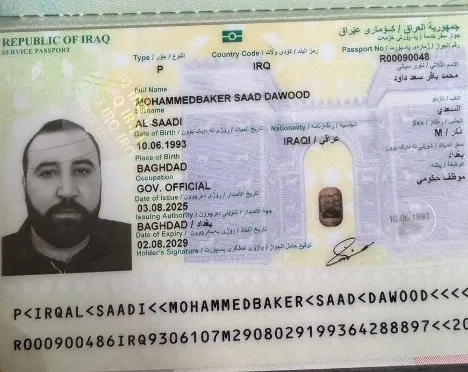
The suspected architect of the recent campaign of antisemitic attacks across Britain met Iran’s supreme leader just days before his death at the start of the conflict with Israel and the United States, according to newly released documents.
US prosecutors allege that Mohammad Baqer Saad Dawood al-Saadi, a senior Iraqi militia commander accused of directing attacks against Jewish targets in Britain and Europe, travelled to Iran for a meeting with Ayatollah Ali Khamenei shortly before war broke out earlier this year.
The claim is contained in a 35-page federal indictment, obtained by The Sunday Times, which provides the most detailed account yet of what American authorities describe as an Iranian-backed campaign targeting Jewish communities in the West.
According to the indictment, Saadi, 32, played a central role in coordinating at least 18 attacks and plots across Britain and Europe, including a series of arson attacks on Jewish institutions in London and an alleged plan to kill worshippers at synagogues in the United States.
US officials allege that Saadi used encrypted communications and Apple’s FaceTime platform to direct attacks in real time from Iraq, at times watching incidents unfold live and helping to produce propaganda videos afterwards.

“Saadi was close with Khamenei,” prosecutors wrote. “Approximately three days before the Iranian military conflict began and Khamenei was killed, Saadi met Khamenei in Iran.”
Western intelligence officials familiar with the case said the allegation appeared credible.
The indictment also links Saadi to online promotion of the stabbing of two Jewish men in Golders Green in April. British counterterrorism investigators have disputed Hayi’s claim of responsibility for that attack and believe it was likely an opportunistic attempt to exploit the incident for propaganda purposes
Saadi was arrested in Turkey on May 14 before being extradited to New York, where he now faces eight terrorism-related charges.
American prosecutors say he was a senior commander in Kata’ib Hezbollah, the powerful Iraqi militia backed by Iran’s Islamic Revolutionary Guard Corps. They allege that a previously obscure group, Harakat Ashab al-Yamin al-Islamiya (Hayi), which claimed responsibility for attacks in Britain, was in reality operating as a front organisation linked to the militia.
The indictment alleges that Saadi recruited criminal networks in multiple countries to carry out attacks in exchange for cryptocurrency payments, creating what prosecutors describe as a decentralised terror infrastructure capable of striking Western targets while maintaining plausible deniability for Tehran.
Among the incidents cited are a number of arson attacks against Jewish organisations in London, including the firebombing of a fleet of ambulances in Golders Green in March.
Prosecutors allege that during several attacks Saadi joined live video calls with those carrying them out, filmed incidents as they unfolded and later helped disseminate footage online.
“The defendant participated in FaceTime calls with attackers as they were carrying out certain of the European terrorist attacks in real time,” the indictment states. It further alleges that he discussed the need for “psychological warfare” and the timing of attacks with fellow members of Kata’ib Hezbollah.
Investigators say material recovered from Saadi’s iPhone included a charter for Hayi dated March this year declaring that the United States, Israel and anyone cooperating with them “will not be secure”.
The court papers also contain photographs that prosecutors claim show Saadi monitoring attacks remotely and posing alongside weapons.
According to the indictment, Saadi waived his right to legal counsel following his arrest and told FBI agents that he had enjoyed direct access to senior Iranian figures. He allegedly described himself as being “like a son” to Qasem Soleimani, the commander of Iran’s Quds Force who was killed in a US drone strike in Baghdad in 2020.
The indictment also links Saadi to online promotion of the stabbing of two Jewish men in Golders Green in April. British counterterrorism investigators have disputed Hayi’s claim of responsibility for that attack and believe it was likely an opportunistic attempt to exploit the incident for propaganda purposes.
A 45-year-old man has been charged with attempted murder.
The court papers further allege that on the day of the stabbing Saadi told an associate: “If God grants us success tonight, there will be a shooting at a restaurant.”
No such attack is known to have taken place.

Keep community journalism free.
Jewish News is free for everyone. No paywall. No barriers. Just trusted journalism for anyone who wants to stay connected to Jewish life in Britain.
If you value that, please support us.
From as little as £5 a month, you can help keep our journalism free and accessible to all.
Every day, we report on the issues that matter to our community. We celebrate achievements, support charities, challenge antisemitism and ensure Jewish voices are heard more widely.
From as little as £5 a month, you can help us continue to:
- Report on the stories shaping Jewish life in the UK and beyond
- Bring our community together through shared stories, events and campaigns
- Celebrate the people, culture and moments that define our community
- Support organisations doing vital work across Jewish Britain
You can make a one-off donation or become a regular supporter. Every contribution helps keep our journalism free, independent and accessible to all.
If everyone who values Jewish News gave a small amount, it would make a real difference to our future.





















