Prefer Jewish News on Google
The courage of Maureen Lipman
By insisting upon conversation, she has exposed the weakness of a politics that is far more comfortable with boycott than with argument
There is a Hebrew word that has acquired a reputation for being almost untranslatable: hadar. Some render it as dignity, but that does not quite capture it; others suggest nobility of spirit, moral stature, or even a certain kind of grace. None of these translations is entirely satisfactory.
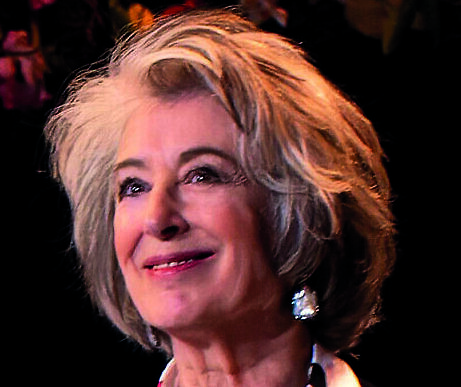
From now on, however, I suspect that explaining hadar will be rather easier, because one can simply point to Dame Maureen Lipman.
Over the past few months, Lipman has faced attempts to silence and boycott her; campaigners in Aberdeen circulated an image depicting her with devil’s horns and a pitchfork — demonisation in the most literal sense of the word. She has had to resort to private security in order to continue working. More recently, two actors withdrew from the play Right Before I Go after her participation was announced, citing her publicly expressed views on Israel and Palestine.
Confronted with all this, Lipman has not merely stood her ground. She has challenged her critics to do something that our boycott-minded culture seems to find difficult: to talk to her. Speaking of Gerard McCarthy, the actor who withdrew rather than share a stage with her, Dame Maureen said: “I am asking for him to have the courage to face me.”
That is hadar: the ability to remain upright when other people are trying to shame you.
It is an especially courageous response at a time when public debate is treated as an arena for propaganda. Yehuda Kurtzer has recently described a version of this phenomenon occurring, remarkably enough, at the Shalom Hartman Institute: activists organising through WhatsApp around public events so that question-and-answer sessions become occasions for the repetition of familiar accusations, such as “the genocide taking place in Gaza”.
The method can work remarkably well, of course, until somebody asks questions such as: what is the evidence? In Lipman’s case, one might ask an even simpler question: how, precisely, does boycotting a Jewish actress on a London stage bring peace in the Middle East one inch closer?
By insisting upon conversation, Lipman has exposed the weakness of a politics that is far more comfortable with boycott than with argument.
And this, to me, belongs to the very best of the Jewish tradition, and particularly to the best tradition of Progressive Judaism. We Progressive Jews have always lived through argument: with Orthodoxy and secularism, with tradition and modernity, with historical criticism and changing moral understandings. We reject the idea that the intellectual world is a landscape divided neatly between the pure and the contaminated. We thrive on debate.
But those demanding that Dame Maureen Lipman be cancelled speak that language of purity and contamination. They consider morally permissible only a very narrow range of opinions. To them, those who cross the boundary of the accepted narrative are considered morally contaminating.
Inspirational Reform rabbis such as Lionel Blue and Hugo Gryn embodied the opposite attitude. They understood, and taught by example, that the person sitting opposite us does not cease to be a person simply because we believe that person to be wrong. Disagreement does not require dehumanisation.
Maureen Lipman has refused this division between the pure and the impure. And she has done it with remarkable class.
So perhaps I can finally stop worrying about how to translate that word. If you want to know what hadar means, look at Maureen Lipman.
And may 5787 bring us many more Jews like Dame Maureen.
Rabbi Andrea Zanardo is rabbi at Brighton & Hove Reform Synagogue

Keep community journalism free.
Jewish News is free for everyone. No paywall. No barriers. Just trusted journalism for anyone who wants to stay connected to Jewish life in Britain.
If you value that, please support us.
From as little as £5 a month, you can help keep our journalism free and accessible to all.
Every day, we report on the issues that matter to our community. We celebrate achievements, support charities, challenge antisemitism and ensure Jewish voices are heard more widely.
From as little as £5 a month, you can help us continue to:
- Report on the stories shaping Jewish life in the UK and beyond
- Bring our community together through shared stories, events and campaigns
- Celebrate the people, culture and moments that define our community
- Support organisations doing vital work across Jewish Britain
You can make a one-off donation or become a regular supporter. Every contribution helps keep our journalism free, independent and accessible to all.
If everyone who values Jewish News gave a small amount, it would make a real difference to our future.